
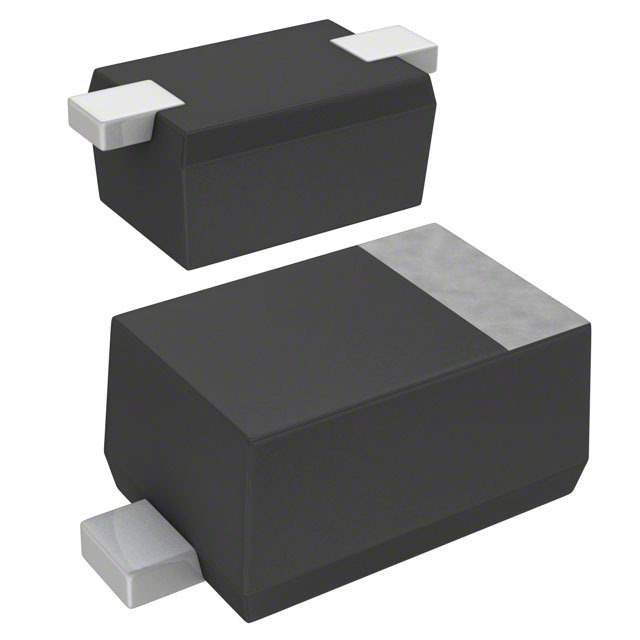
13V stand-off, 17.5V minimum breakdown, 5pF at 1MHz, SSMini2-F5-B, -40°C to 85°C
Quick Engineering Summary
| Field | Value |
|---|---|
| Manufacturer | Panasonic |
| Category | TVS - Diodes |
| Package | SSMini2-F5-B |
| Core function | TVS DIODE 13VWM SSMINI2-F5-B |
| Key electrical range | Capacitance @ Frequency: 5pF @ 1MHz; Minimum Breakdown Voltage: 17.5V; STAND-OFF Voltage (Vwm): 13V; Supply and Demand Status: Balance |
| Reported stock | 11705 pcs reported — confirm on RFQ |
Not for high-voltage rails; useful on 13V-class nodes
Wrong job first: this is not the part to park on a rail that normally lives above 13V, because the listed 13V stand-off is a ceiling for continuous exposure, not a normal operating point.
It fits better as low-capacitance transient protection on a single bidirectional line that needs to stay quiet in normal service and clamp only when the line is pushed past its intended range. The 5pF @ 1MHz figure keeps it in play on signal nodes where a heavier TVS would distort the line, and the SSMini2-F5-B package points to dense board-level protection rather than cable-entry energy handling. In other words, DZ2S180C0L looks like a compact board protector, not a universal surge answer.
13V and 17.5V set the rail window
13V is the first hard limit. It tells you the protected node must remain at or below 13V in normal operation, but it does not tell you how hard the device clamps during a real surge because no clamping voltage is listed.
The 17.5V minimum breakdown sets the other edge of the window. Conduction begins only after the line rises beyond that threshold, so any circuit that cannot tolerate excursions between 13V and 17.5V still needs tighter protection upstream or downstream. Add the -40°C to 85°C operating range and the fit narrows further: this listing supports ordinary ambient board environments, not hotter placements where ambient headroom is already thin.
The real fit is dense SMT protection, not brute-force surge work
The constraint is missing surge-energy context. You get a bidirectional, 1-channel TVS in SMD (SMT) form, packaged as SSMini2-F5-B, and that is enough to place DZ2S180C0L near a connector, sensor line, or general-purpose I/O where board area is tight and polarity can swing either way.
What the numbers do not support is any claim about heavy transient endurance. There is no peak pulse power, no peak pulse current, and no thermal resistance in the listing, so you cannot tell whether the package is merely compact or compact and thermally stressed in your event profile. That is where field returns start: the part survives bench zaps, then fails after repeated hits because the energy budget was never actually known.
Buy it as a current-line part, not a lifecycle certainty
And that uncertainty carries into purchasing. Stock shows 11705, packaging is Reel - TR with 3k pcs, and supply-demand is Balance, so DZ2S180C0L is buyable now; lifecycle is still unresolved because one field says Unknown while another says Active. EU RoHS is compliant.
The missing datasheet items are the ones that decide risk
Several gaps matter.
DZ2S180C0L still needs clamping voltage, peak pulse current or power, and thermal data before you can judge whether the protection level actually matches the threat on the line. The capacitance number is useful, but it is only one slice of behavior.
There is no pinout or package drawing here, so footprint confirmation still depends on the full datasheet, and there is no leakage figure to show what the device does to a high-impedance node in normal service. For a TVS, those omissions are not housekeeping details; they separate a clean design-in from a part that quietly shifts margins after assembly.
One more gap is event behavior over time. No derating curve is listed, and no surge waveform context appears beside the voltage numbers, so the ambient limit and the transient limit never meet on the page. That point needs to be closed before DZ2S180C0L moves from a plausible protector to a signed-off one.
View the Win-Source product page for DZ2S180C0L.
Key Takeaways for Engineers & Buyers
- Keep DZ2S180C0L on rails that must stay below 13V in normal operation.
- Check signal loading against 5pF @ 1MHz before placing DZ2S180C0L on fast nodes.
- Buy in reel multiples around 3k pcs if this moves into volume.