
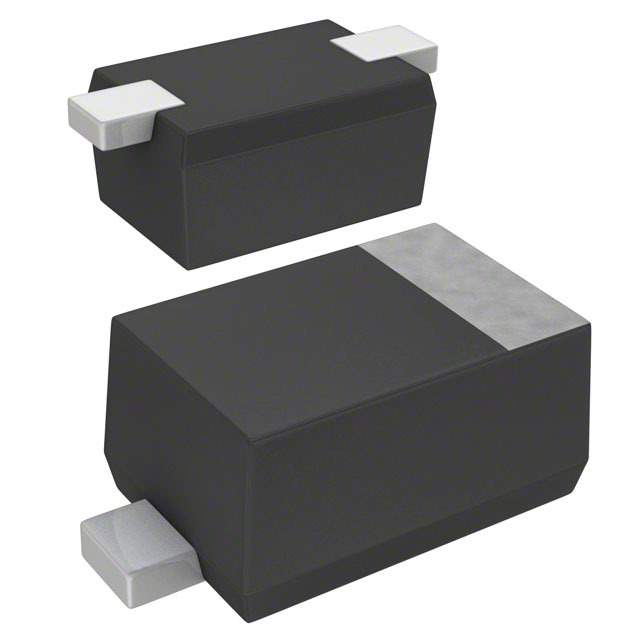
18 V, 150 mW, 60 Ohms max Zzt, SSMini2-F5-B: usable only if your line already carries it
Quick Engineering Summary
| Field | Value |
|---|---|
| Manufacturer | Panasonic |
| Category | Diodes - Zener - Single |
| Package | SSMini2-F5-B |
| Core function | DIODE ZENER 18V 150MW SSMINI2 |
| Key electrical range | Supply and Demand Status: Limited |
| Reported stock | 1 pcs reported — confirm on RFQ |
Can you start a new build on this part?
Can I still build this into a new board? Not wisely. Conflicting lifecycle signals show Active in one field and 停止提供 in another, so the conservative call is sustaining designs only. EU RoHS is listed, but supply is still limited.
The 18 V mark is useful, but the 150 mW ceiling decides it
And that is the number that really sets the job. The 18 V zener value tells you where DZ2S180M0L fits in a clamp or reference role, but the 150 mW maximum is the hard ceiling, and it limits how much current or thermal stress the device can tolerate long before nominal voltage becomes the interesting part of the discussion.
Then there is 60 Ohms maximum Zzt. That dynamic-impedance ceiling says the clamp will shift with current, so it is a poor choice when the rail has to stay tight through load or surge variation. The ±2.5% tolerance helps with nominal selection, but it does not cancel the impedance limit. Forward conduction is bounded too: 1 V at 10 mA is a listed condition, useful for polarity-fault thinking rather than a target operating point.
Small package, narrow job
The constraint is straightforward: SSMini2-F5-B and a 150 mW ceiling keep this in signal-level protection and light reference duty, not in spots where a zener is expected to absorb repeated energy or clean up a noisy power rail.
Leakage is one reason it still earns a place. At 50 nA at 13 V, reverse loss stays low on high-impedance sensing nodes. Surface-mount packaging in SC-79, SOD-523 class footprints also suits dense boards where area matters, but package size alone does not answer thermal headroom because no thermal resistance or derating curve is listed.
Wrong for surge-heavy clamps, fine for quiet bias protection
Wrong for surge-heavy clamps first. The listing gives no IFSM, no pulse-power curve, and no thermal resistance, so the numbers that would settle repetitive pulse or transient survival are missing.
It fits better as a compact 18 V zener on an existing board that already uses this footprint and only needs modest dissipation. Electrically, that is manageable. Supply is the harder problem: it is marked Limited, stock is 1, and packaging is Reel - TR with 3000 per package. If DZ2S180M0L is already on your AVL, lock down remaining line demand now and avoid opening a new layout around it.
What the listing still doesn't tell you
The weak point is context, not the voltage rating.
For DZ2S180M0L, the first gap is thermal: no thermal resistance and no derating curve are listed, so ambient headroom cannot be judged from the 150 mW ceiling alone. The second gap is surge behavior: no IFSM or pulse-power information appears, leaving transient survival unanswered. The third gap is mechanical certainty. Package names are present, but a drawing and pinout are not, and that matters when SSMini2-F5-B, SC-79, and SOD-523 can end up filtered through assembly-library conventions instead of one unambiguous land pattern.
There is also a performance gap for precision work. The listing gives 60 Ohms maximum Zzt and ±2.5% tolerance, but no curve showing how the zener moves across current, and that missing behavior is what separates a nominal 18 V clamp from one that actually stays inside a threshold budget when current shifts.
View the Win-Source product page for DZ2S180M0L.
Key Takeaways for Engineers & Buyers
- Treat 150 mW as the dissipation ceiling; don't size DZ2S180M0L from the 18 V nominal alone.
- Check clamp accuracy against the ±2.5% zener tolerance before releasing any tight-threshold rail monitor.
- Secure reel planning early: package is TR, 3000 per package, while listed stock is 1.