
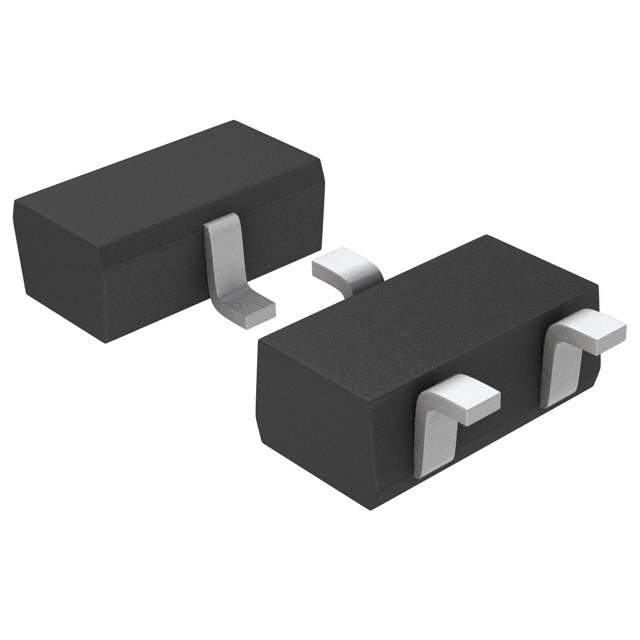
6.8V zener, 150mW ceiling, 1V at 10mA forward drop, SSSMini3-F2-B package
Quick Engineering Summary
| Field | Value |
|---|---|
| Manufacturer | Panasonic |
| Category | Diodes - Zener - Arrays |
| Package | SSSMini3-F2-B |
| Core function | DIODE ZENER ARRAY 6. |
| Key electrical range | Current - Reverse Leakage @ Vr: 100nA @ 4V; Maximum Power Dissipation: 150mW; Supply and Demand Status: Balance; Voltage - Forward (Vf) (Max) @ If: 1V @ 10mA |
| Reported stock | 22600 pcs reported — confirm on RFQ |
150mW is the number that limits this part first
150mW is the hard ceiling. It decides whether this zener array belongs in the protection network before the 6.8V nominal value even enters the discussion, because once fault energy starts landing in the device, package limits take over fast.
In basic form, the part is a zener array in SSSMini3-F2-B with a 1 pair common anode configuration and a 6.8V nominal zener value. That points it toward low-voltage clamping or reference work, not higher rails. The nominal value alone does not settle accuracy, though, because no tolerance is listed, and that missing detail matters if the threshold has to be tight rather than simply in range.
The forward-drop figure also needs a careful read. The listing gives 1V at 10mA, and that should be treated as a ceiling at that stated current, not as a casual operating point. In practice, it says the forward path has a real voltage cost and a real dissipation cost whenever the array is driven that way. Add the 30 Ohm maximum impedance and the picture sharpens: clamp stiffness is only partly described here, so the fit is better for light-duty rail or signal protection than for anything that expects the zener voltage to stay tightly held while current moves around.
Use it for sustaining designs, not a fresh platform
Not for new design-in.
The lifecycle conflict is direct: the part is marked Active, yet the signals also include 停止提供. That contradiction outweighs the favorable status field for any fresh platform. Even with 22600 pieces showing and reel packaging available, continuity is the real issue.
For an existing production line, those two supply details still help. Stock on hand and TR format support continued SMT assembly without forcing a packaging change. For a new board, they do not cancel the lifecycle warning.
RoHS is straightforward; it is listed as EU RoHS compliant. Keep the part on sustaining builds where the footprint and behavior are already qualified, and leave it out of a new release until the lifecycle story stops disagreeing with itself.
22600 pieces help, but the topology still decides the fit
22600 pieces help because they are the clearest near-term supply signal, and they line up with reel packaging for automated placement.
That still does not make the fit broad. The common-anode, 1 pair topology belongs in circuits that actually want a shared node, such as compact paired low-voltage clamps around one point. It does not suit layouts that need independent single zeners, and it does not suit higher-energy suppression where a 150mW ceiling is too small to wave away.
Leakage is one of the more useful clues here. The listing gives 100nA reverse leakage at 4V, which is a good sign for sensitive nodes below the 6.8V nominal zener point. It does not describe behavior across the full clamp region, so the stock count should not be mistaken for a broad application fit. When the common-anode connection is intentional, the part can save space. When it is not, it just complicates routing.
The missing curves are what still block a clean call
Wrong for thermal or surge-sensitive decisions first, because the listing stops short of the numbers that would settle them.
The gaps are concrete: no derating curve for the 150mW limit, no thermal resistance, no surge or IFSM figure, and no pinout or package drawing even though orientation matters in a common-anode array. Zener tolerance is also missing, so the 6.8V nominal value cannot be treated as a tight threshold. Those omissions set the constraint on ambient headroom, pulse survivability, and footprint release.
View the Win-Source product page for DZ37068D0L.
Key Takeaways for Engineers & Buyers
- Hold DZ37068D0L for existing builds; resolve the Active versus 停止提供 lifecycle conflict before adding it to a new BOM.
- Keep dissipation inside the 150mW ceiling; no derating curve is listed to extend that limit.
- Check the common-anode orientation against your clamp topology before layout in SSSMini3-F2-B.