
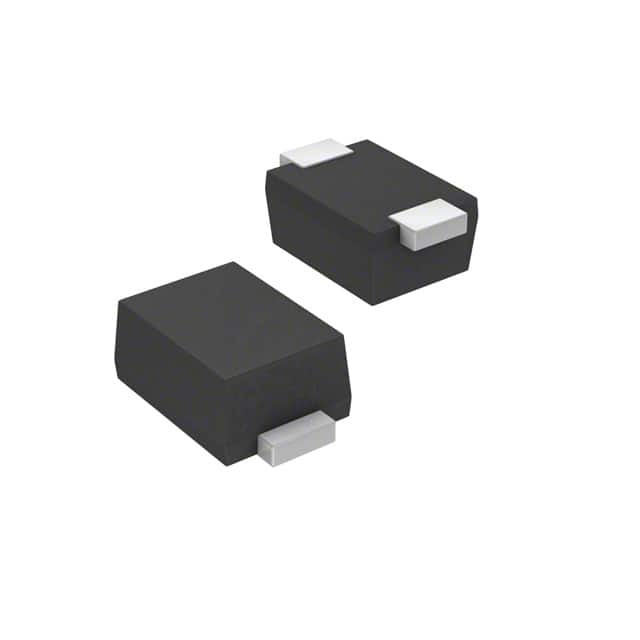
12 V zener, 200 mW ceiling, SOD-923 package, -65°C to 150°C junction range
Quick Engineering Summary
| Field | Value |
|---|---|
| Manufacturer | Diodes Incorporated |
| Category | Diodes - Zener - Single |
| Package | Tape & Reel |
| Core function | DIODE ZENER 12V 200MW SOD923 |
| Key electrical range | Current - Reverse Leakage @ Vr: 100 nA @ 9 V; Power - Max: 200 mW; Temperature Range - Operating: -65°C ~ 150°C (TJ); Tolerance: ±5% |
| Reported stock | 10000 pcs reported — confirm on RFQ |
Not for power clamps; fine for small 12 V shunts
Wrong part for any rail clamp that burns real power. Fine for low-power 12 V zener duty in tight layouts, where SOD-923 is the point and the 200 mW rating stays a hard ceiling.
200 mW closes the thermal argument first
200 mW is the number that decides whether this device belongs in the circuit at all. In SOD-923, that rating is a dissipation ceiling, not a usable operating point, and it does not answer the missing thermal questions by itself.
The rest of the electrical picture narrows the use case. The 12 V zener rating sets the nominal clamp or reference level, and the ±5% tolerance defines how much rail window the design must absorb before layout starts. The 900 mV maximum forward drop at 10 mA matters only if the part can be driven forward in fault or polarity-reversal conditions. The 30 Ohms maximum impedance is also a limit with consequences: if the circuit expects a stiff zener knee, clamp voltage can shift enough with current that DZ9F12S92-7 behaves less like a quiet reference and more like a loose protector.
Use it where leakage matters more than surge muscle
Good fit.
Compact bias networks, light rail clamps, and small signal boards are the natural home for this part when board area is scarce and reverse leakage has to stay low. The listed 100 nA at 9 V is the quiet number here, supporting designs that cannot tolerate much standby bleed before the zener reaches its nominal region.
The limits are just as clear. If the job needs surge handling, a low dynamic clamp, or confidence under repeated fault energy, the listing does not give IFSM, derating, or thermal resistance, and the 200 mW ceiling in SOD-923 leaves little room to ignore those omissions. The -65°C to 150°C operating range is a junction range, useful for environmental screening, but it does not settle ambient headroom or pad design.
10,000 pcs is the buying constraint
10,000 pcs is the decisive figure here. It matches the standard package and tape-and-reel presentation, so this is not a spot-buy listing for a few loose parts.
If the build consumes reels cleanly, buy to reel count and skip partial-reel handling. Lifecycle is Active with no stated conflict, MSL 1 (Unlimited) removes one storage concern, and EU RoHS is already in place.
One sourcing caution remains. The open-market fake threat is listed at 60pct. That does not change the electrical fit of DZ9F12S92-7, but it does affect how you source it when the approved channel is under pressure.
The missing datasheet items are the real stop signs
The constraint is incomplete behavior around the headline numbers. That is what the listing creates, and it is what decides whether a small zener stays uneventful in production or turns into a debug sink.
There is no thermal resistance, so the 200 mW ceiling cannot be translated into ambient headroom or pad sensitivity. There is no derating curve, leaving a direct gap between the -65°C to 150°C junction range and any real board temperature. There is no surge or non-repetitive current figure such as IFSM, so fault survival remains open.
The mechanical gaps matter too. There is no pinout or package drawing here, and with SOD-923 parts that omission is easy to underestimate until footprint or orientation errors show up late in the build.
The electrical picture is still incomplete as well. The listing gives 30 Ohms maximum impedance and 100 nA at 9 V, but no fuller zener curve, so you still cannot see how sharply DZ9F12S92-7 reaches regulation across current, and that missing behavior is the real reason to keep it in light clamp and reference work rather than ask it to do more.
View the Win-Source product page for DZ9F12S92-7.
Key Takeaways for Engineers & Buyers
- Keep DZ9F12S92-7 in low-power clamp and reference roles; 200 mW is the hard dissipation ceiling.
- Check board density before release; SOD-923 is the real fit constraint, not the 12 V nominal alone.
- Buy on reel strategy if the line can use 10,000 pcs; that matches both standard package and listed stock.