
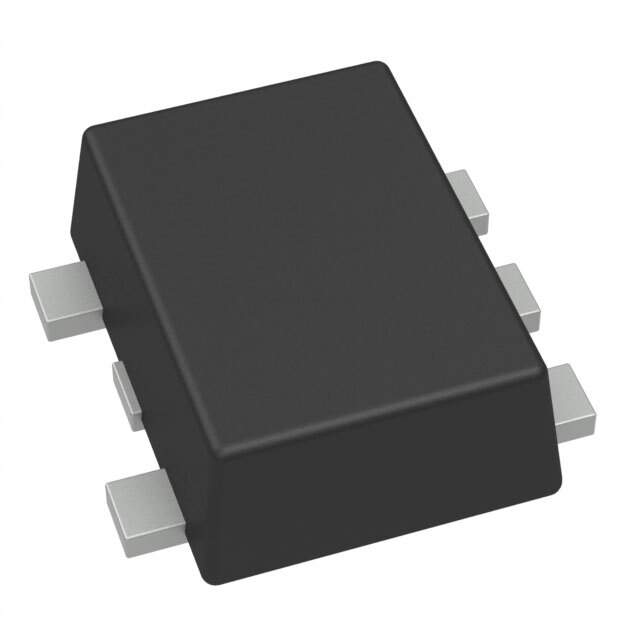
3V stand-off, 13V clamp, 20W ceiling, SOT-553, -55°C to 150°C TJ, 4 unidirectional channels
Quick Engineering Summary
| Field | Value |
|---|---|
| Manufacturer | Diodes Incorporated |
| Category | TVS - Diodes |
| Package | SOT-553 |
| Core function | TVS DIODE 3VWM 13VC SOT553 |
| Key electrical range | Max Clamping Voltage: 13V; Minimum Breakdown Voltage: 5.3V; Power Dissipation - Pd: 20W; STAND-OFF Voltage (Vwm): 3V |
| Reported stock | 32500 pcs reported — confirm on RFQ |
3V decides whether this TVS belongs on the rail at all
3V is the gatekeeper here. The listed stand-off voltage is the ceiling for normal continuous bias, so it tells you where DZQA5V6AXV5-7 can sit without entering protection behavior in routine operation. Rails that live above 3V are out before package or inventory even matter.
The rest of the voltage stack lines up with that read. Breakdown starts at 5.3V, and clamping is listed at 13V. Those are protection limits, not operating targets, and if the protected node cannot tolerate a surge being held as high as 13V, DZQA5V6AXV5-7 is the wrong device even when the nominal rail looks compatible.
20W helps only if the missing surge current data checks out
20W is useful only up to a point. It is a ceiling, not a promise about every pulse shape, and the listing does not give peak pulse current for 10/1000µs.
That missing current number is what gives the 13V clamp figure real context, because clamp voltage only means something when you know the surge condition that produces it. With SOT-553 and 4 unidirectional channels, this points to compact multi-line protection rather than a single heavy line where board area is easy to spend.
Not for high-voltage rails; better on dense low-voltage line groups
Not for anything that normally rides above 3V. That keeps DZQA5V6AXV5-7 in the narrow lane its numbers support.
It fits better on a compact board that needs four unidirectional protection paths in SOT-553, with operating junction temperature listed from -55°C to 150°C. The Automotive application tag and AEC-Q101 qualification make placement on vehicle electronics easier, but they do not answer the electrical fit by themselves. That still starts with the 3V stand-off and ends with whether a 13V clamp is acceptable at the protected node.
Buy it, but clear one contradiction
Buyable now.
Stock is listed at 32500, but the Active lifecycle status still conflicts with the 2023 estimated EOL field. EU RoHS is compliant.
What is still missing before this part closes cleanly?
What would you ask for first? The missing surge detail, because that is what turns headline limits into a usable protection model.
DZQA5V6AXV5-7 is missing peak pulse current at 10/1000µs in the main specifications, and without it the 20W ceiling and 13V clamp are harder to compare against a real surge requirement. That is the first gap.
Two more missing items matter in practice. Junction capacitance is not listed, so signal loading on fast or sensitive lines cannot be judged from this page. Pinout and package drawing are also absent here, which leaves board escape and channel assignment unresolved even though the package name is given as SOT-553.
Thermal resistance and the forward electrical curves would help too, but they are not carried here. So the page gets you to a short list, not to closure: the fit still depends on the missing surge, capacitance, and mechanical details.
View the Win-Source product page for DZQA5V6AXV5-7.
Key Takeaways for Engineers & Buyers
- Keep DZQA5V6AXV5-7 on rails that stay below 3V in normal operation.
- Budget for a 13V clamping ceiling when checking downstream tolerance during surge events.
- Clear the Active status against the 2023 EOL field before locking DZQA5V6AXV5-7 into a long program.