
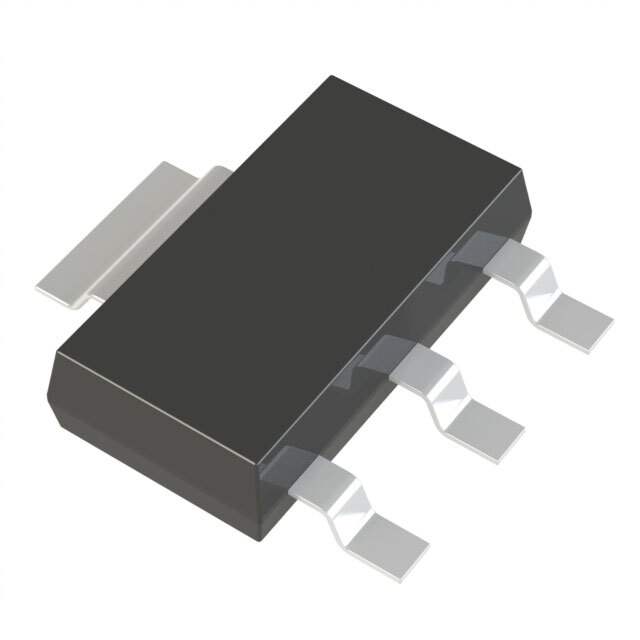
40V VCEO, 600mA collector ceiling, 1W dissipation, SOT-223, -55°C to 150°C junction
Quick Engineering Summary
| Field | Value |
|---|---|
| Manufacturer | Diodes Incorporated |
| Category | Transistors (BJT) - Single |
| Package | SOT-223 |
| Core function | TRANS NPN 40V 0. |
| Key electrical range | Collector Cut-off Current(Max): 10nA (ICBO); Frequency - Transition: 300MHz; Maximum Current Collector: 600mA; Maximum Power Dissipation: 1W |
| Reported stock | 12500 pcs reported — confirm on RFQ |
Lifecycle is the weak point, not the silicon
The weak point comes first. Lifecycle stays Unknown, even though specifications list DZT2222A-13 as Active, stock shows 12500, and EU RoHS compliance is stated.
That leaves new design-in as a follow-up decision, not a clean signoff.
The real ceiling is heat, not headline current
The constraint is dissipation. A 600mA maximum collector current and 40V VCEO look generous, but the 1W maximum power dissipation is the limit that decides whether the device survives the load condition or drives junction temperature too far.
The 40V VCEO rating settles the collector-emitter breakdown ceiling, so rails and transients above that are out. It does not answer how much current can be switched at that voltage on your board. The 600mA collector rating is a ceiling too, not a normal operating point, and when voltage and current rise together, the 1W limit becomes the first number that matters.
The listed 1V VCE(sat) at 50mA, 500mA is still useful as a switching loss marker at that test point. Without a curve, though, dissipation away from that condition is still an open question.
SOT-223 makes sense when board copper does the work
1W is enough to make package choice matter. In SOT-223 and as an SMD part, this is a board-mounted small-signal power BJT rather than a through-hole option for hand assembly.
The fit is fairly clear: NPN polarity, 300MHz transition frequency, and hFE of 100 at 150mA, 10V point to general switching and gain stages where board copper can carry the thermal load. It is less convincing when saturation loss is tightly budgeted, because only one VCE(sat) point is listed, or when thermal margin is thin, because RθJC and the package drawing are not given.
Wrong for fast-switching certainty; fine for reel-fed builds
Wrong for switching-speed-sensitive work first. This page gives no pinout, no package drawing, no thermal resistance, and no switching data such as storage time or capacitances, so the missing details are concrete and material.
The production case is simpler. Packaging is Reel - TR and stock is 12500, which fits SMT assembly flow better than loose-piece service demand. For a running line, align buys to the reel flow already in use and clear the lifecycle conflict before freezing the AVL.
View the Win-Source product page for DZT2222A-13.
Key Takeaways for Engineers & Buyers
- Treat 600mA collector current as a ceiling; check your load line against the 1W dissipation limit.
- Use the 1V VCE(sat) at 50mA, 500mA as a loss budget marker for low-side switching, not as a guaranteed operating point.
- Resolve the Unknown lifecycle versus Active status before releasing DZT2222A-13 on a new BOM.