
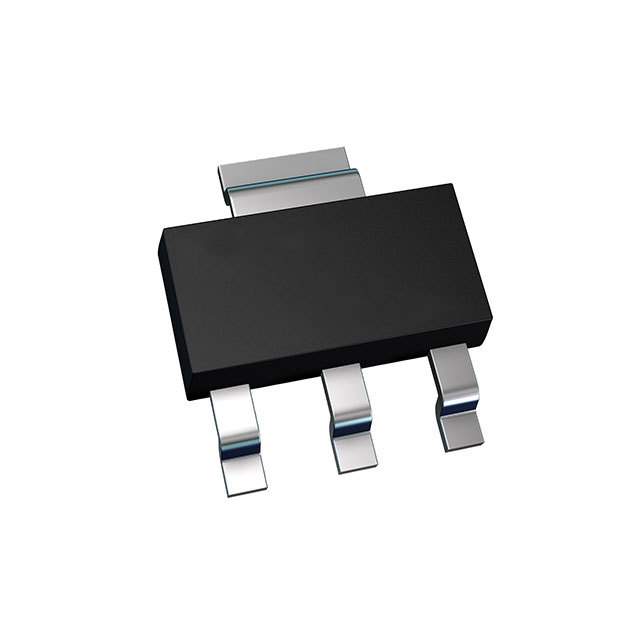
60V VCEO, 1A collector, 1W dissipation, SOT-223-3 package, -55°C to 150°C junction
Quick Engineering Summary
| Field | Value |
|---|---|
| Manufacturer | Diodes Incorporated |
| Category | Transistors (BJT) - Single |
| Package | SOT-223 |
| Core function | TRANS NPN 60V 1A SOT-223-3 |
| Key electrical range | Collector Cut-off Current(Max): 100nA; Frequency - Transition: 150MHz; Maximum Current Collector: 1A; Maximum Power Dissipation: 1W |
| Reported stock | 8700 pcs reported — confirm on RFQ |
EOL is the problem; the electrical envelope is not
The weak point comes first: DZT491-13 is EOL, and that alone removes it from new design work. The better news is that the listed envelope still works for sustaining use: 60V VCEO, 1A maximum collector current, 1W maximum power dissipation, and an SOT-223-3 package suited to normal board assembly.
There is also a status conflict inside the listing. Lifecycle is EOL, while another field says Active. Treat that as an internal mismatch, not a reason to reopen the part for new design-in. EU RoHS is compliant, so compliance is not the blocker here. Lifecycle is.
Not for casual switching margins, fine for bounded board loads
This is the wrong transistor for any new stage that needs voltage margin, thermal headroom, and a stable sourcing horizon. It fits existing production better, where the schematic, footprint, and qualification history already expect DZT491-13 in SOT-223-3 and the immediate job is keeping the line running.
The 60V VCEO figure sets a hard ceiling for rail and fault cases. It does not say the part is comfortable on a 60V rail under real switching stress, and designs that live near that edge run straight into the missing safe-operating detail. The 1A collector current is also a maximum, not a working point, so it rules out heavier load paths without telling you what current remains practical at temperature on your board copper.
Thermals are where the listing gets thin. It gives 1W maximum power dissipation and a maximum VCE(sat) of 500mV at 100mA, 1A, which is enough to show that conduction loss belongs in the budget when the part is driven hard as a saturated switch, but not enough to turn that budget into a confident board decision without the missing thermal data. The minimum hFE of 100 at 500mA, 5V helps judge whether the base-drive plan is in the right neighborhood, yet it is not a blanket promise across the full load range.
That leaves a narrow but useful fit: board-mounted NPN switching or linear duties already released around this package and voltage class. For fresh designs, the lifecycle stop is reason enough to move on.
Can you still buy enough to cover a running line?
Yes. 8700 pieces are listed, and reel packaging fits production handling. That supports a sustaining buy for DZT491-13 if the line is active, but it does not justify new design use.
60V is listed; the missing curves still decide the risk
60V is the headline figure, but it is not the one that closes the risk. What would actually settle the review on DZT491-13 is thermal resistance, the derating curve, pinout, package drawing, and safe-operating detail around current and voltage stress. Without those, the 1W ceiling stays abstract and the SOT-223-3 footprint cannot be checked from this page.
Other gaps matter too. There is no junction capacitance, and switching detail stops at 150MHz transition frequency. Fast-edge behavior and charge storage remain open questions, and that is where a transistor that looks acceptable in a static table can still cause trouble in the real circuit.
View the Win-Source product page for DZT491-13.
Key Takeaways for Engineers & Buyers
- Block DZT491-13 on new BOMs; lifecycle is EOL.
- Check rail and fault cases against the 60V VCEO ceiling, not the nominal bus.
- Reserve the 8700 pieces for existing production builds that already use SOT-223-3.