
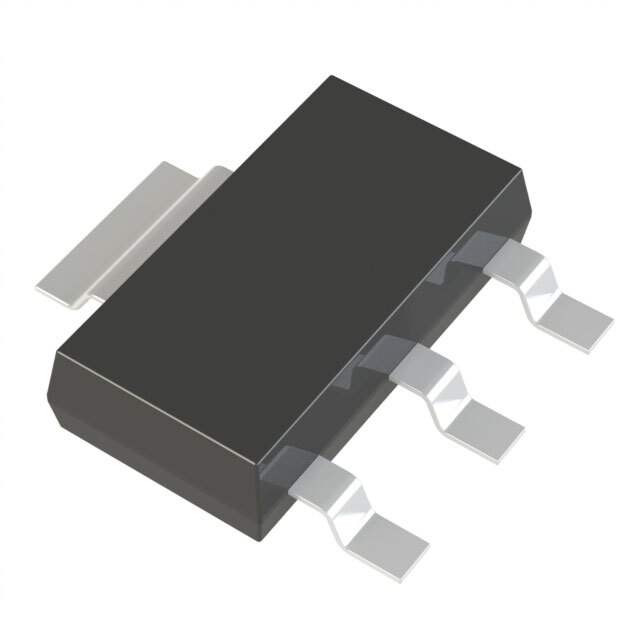
150V VCEO, 600mA collector ceiling, 1W dissipation, SOT-223-3 package, -55°C to 150°C TJ
Quick Engineering Summary
| Field | Value |
|---|---|
| Manufacturer | Diodes Incorporated |
| Category | Transistors (BJT) - Single |
| Package | SOT-223 |
| Core function | TRANS PNP 150V 0. |
| Key electrical range | Collector Cut-off Current(Max): 50nA (ICBO); Frequency - Transition: 300MHz; Maximum Current Collector: 600mA; Maximum Power Dissipation: 1W |
| Reported stock | 7500 pcs reported — confirm on RFQ |
Still, this is a real new-design part
And that is really the point: not gain, not transition frequency, but the mix of Active lifecycle, 150V VCEO, and a SOT-223 body that gives DZT5401-13 a defined place in high-voltage small-signal power stages.
The 150V collector-emitter breakdown rating is a ceiling, not a rail to lean on. It settles whether this PNP belongs on higher-voltage bias rails, startup paths, or discrete level-shift nodes that would rule out low-voltage BJTs, but it does not answer switching loss, safe operating area, or transient survival because those curves are not here. EU RoHS is compliant, and there is no lifecycle conflict to explain away.
Can you keep building with it?
Can I buy this in a way that fits production? Yes, with one obvious constraint: DZT5401-13 is packed Reel - TR, quantity per package 2,500, and listed stock is 7500.
That works cleanly for a running line and poorly for loose service use. The supply and demand status is Balance, popularity is High, and it is marked common-used, so the commercial signal reads healthy rather than thin.
The electrical ceilings decide whether that buy makes sense. Maximum collector current is 600mA, and maximum power dissipation is 1W. Both are ceilings, and neither says you can hold 600mA continuously in any ambient you like, because the thermal path and derating would decide that and they are absent here. Max VCE(sat) is 500mV @ 5mA, 50mA, useful as a bounded drop at that stated test point, not as a description of behavior across the rest of the current range.
Plan reel-based intake, and reserve enough of the 7500 on hand to cover the next build window. For a high-voltage PNP with this kind of fit, stock can tighten quickly.
50nA leakage is the quiet clue
50nA (ICBO) is a ceiling. Small, but useful. It makes DZT5401-13 more credible in bias networks and high-impedance sensing edges where collector cutoff leakage can move an error budget, while still leaving temperature dependence unstated.
The fit is narrow, and that's fine
The weak point comes first: this listing does not give the curves that let you push DZT5401-13 toward its edges. The strong point is that the intended slot is still clear.
It fits discrete high-voltage PNP duties where 150V matters more than brute current: startup circuits, level shifting, pull-up or high-side control stages, and linear or switching support functions that want a board-mounted SOT-223 transistor instead of a through-hole device. The minimum hFE of 60 @ 10mA, 5V is enough to show you should not assume heroic gain at arbitrary operating points, while the 300MHz transition frequency says this is not a plodding transistor family. It does not support claims about RF linearity, storage time, or fast switching cleanup, because the listing stops short of the waveforms and charge behavior that would settle those questions.
What the listing still doesn't settle
Some gaps matter.
The missing items are the ones that decide edge use. There is no safe operating area plot, no thermal resistance, no derating curve, and no pinout or package drawing in this listing.
For DZT5401-13, those gaps separate a comfortable 150V PNP choice from one you use only after the full datasheet answers the thermal and stress questions.
View the Win-Source product page for DZT5401-13.
Key Takeaways for Engineers & Buyers
- Keep DZT5401-13 in high-side or level-shift stages that need the full 150V VCEO ceiling.
- Budget heat from the 1W dissipation limit before using the full 600mA collector rating.
- Buy in reel multiples of 2,500; current stock is 7500.