
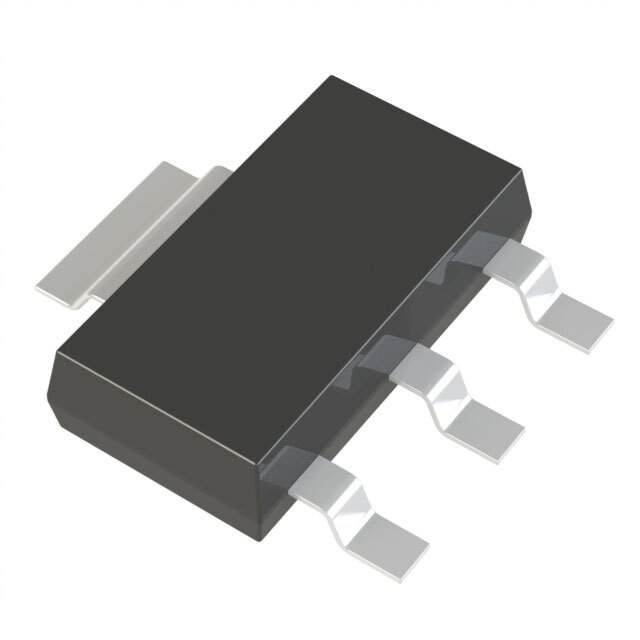
160V VCEO, 600mA collector ceiling, 1W dissipation limit, SOT-223-3, -55°C to 150°C TJ
Quick Engineering Summary
| Field | Value |
|---|---|
| Manufacturer | Diodes Incorporated |
| Category | Transistors (BJT) - Single |
| Package | SOT-223 |
| Core function | TRANS NPN 160V 0. |
| Key electrical range | Collector Cut-off Current(Max): 50nA (ICBO); Frequency - Transition: 300MHz; Maximum Current Collector: 600mA; Maximum Power Dissipation: 1W |
| Reported stock | 17500 pcs reported — confirm on RFQ |
Not for power switching; useful on high-voltage signal rails
Wrong for comfortable high-dissipation switching. The 600mA collector rating and 1W maximum power dissipation are ceilings, not a promise of continuous operation in your thermal conditions.
Better fit: high-voltage NPN duty in SOT-223, where the 160V VCEO matters more than raw current. Active status and EU RoHS support new design-in.
160V is the number that decides whether it belongs
160V is the deciding number. That VCEO maximum collector-emitter breakdown voltage settles rail withstand for offline-adjacent sensing, startup bias chains, and other high-voltage small-signal jobs, but it does not settle operation under load because the listing shows no SOA curve, no thermal resistance, and no package drawing.
The next limit that changes the design is 1W maximum power dissipation. Treat it as a hard ceiling. The same listing also gives 600mA maximum collector current, and those numbers are not interchangeable. Size DZT5551-13 by current alone and package temperature becomes the failure point long before the current line on the BOM looks unreasonable.
The 200mV maximum VCE(sat) at 5mA, 50mA is useful only at that stated test condition. It says the part can pull down cleanly in modest-current saturated switching; it says nothing about saturation near the 600mA ceiling. The 50nA ICBO maximum is the quiet spec in the set, and it matters when leakage on a high-value bias network would shift a threshold or leave a node hanging when it should be off.
Gain is bounded too. The minimum hFE of 80 at 10mA, 5V is enough to frame base-drive expectations around light collector current, but not to stretch across every operating point. DZT5551-13 may suit a fast, high-voltage control node thanks to the 300MHz transition frequency, yet without switching waveforms or capacitance data you still do not know how it behaves on the edges that usually make or break EMI and storage time.
17500 pieces helps, but supply is still the buying constraint
17500 pieces gets attention because the same record marks supply and demand as Limited.
That changes the buying move for DZT5551-13. For a fresh program, qualify it only if SOT-223-3 and reel packaging already fit your assembly flow, then place demand early instead of assuming the line will stay easy to refill. For an existing production build, this is not a lifecycle problem; it is a replenishment timing problem.
The missing curves are what still block a hard sign-off
What would a buyer ask first: what is still missing before release? More than one headline spec. DZT5551-13 still needs a thermal resistance figure, an SOA view, and a package drawing with pinout before you can judge how close that 1W ceiling sits to your real ambient and copper.
The switching picture is thin as well. There is no junction capacitance, no reverse or storage-time behavior, and no forward transfer detail beyond hFE at 10mA, 5V. ECAD is listed only as contact-to-download, so layout work is not closed from this page alone.
View the Win-Source product page for DZT5551-13.
Key Takeaways for Engineers & Buyers
- Keep DZT5551-13 on high-voltage small-signal rails, not low-voltage power switching.
- Budget around the 1W ceiling before using the full 600mA collector rating.
- Place reel demand early; stock shows 17500 while supply status is Limited.