
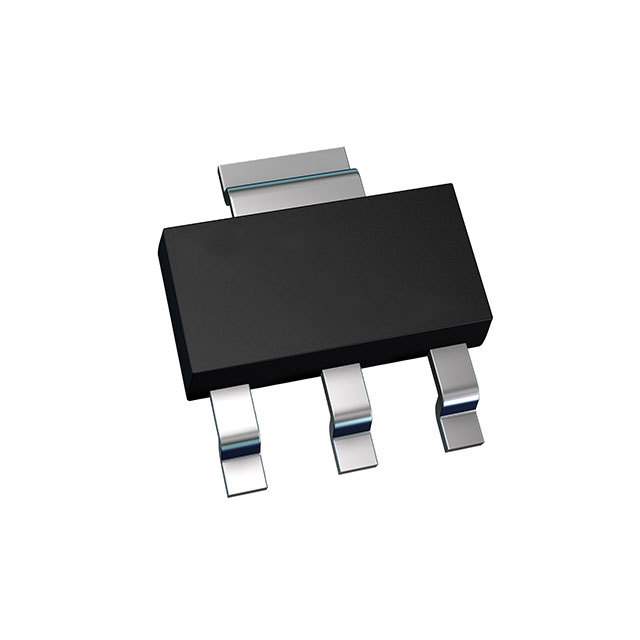
60V VCEO ceiling, 1A collector limit, 1W dissipation cap, SOT-223 package, -55°C to 150°C operating range
Quick Engineering Summary
| Field | Value |
|---|---|
| Manufacturer | Diodes Incorporated |
| Category | Transistors (BJT) - Single |
| Package | SOT-223 |
| Core function | TRANS PNP 60V 1A SOT-223-3 |
| Key electrical range | Collector Cut-off Current(Max): 100nA; Frequency - Transition: 150MHz; Maximum Current Collector: 1A; Maximum Power Dissipation: 1W |
| Reported stock | 1 pcs reported — confirm on RFQ |
Lifecycle is the weak point, not the transistor
The weak point is lifecycle visibility, not the silicon. DZT591C-13 is marked Unknown, and the only on-hand quantity shown is 1. Electrically, though, the fit is more straightforward: a PNP in SOT-223 with a 60V VCEO ceiling, 1A maximum collector current, and 1W maximum power dissipation sits in the right class for board-level high-side switching or linear bias work that needs more voltage headroom than small-signal SOT-23 parts usually suggest.
That still does not make it a blind new-design pick. Unknown lifecycle means unverified, not obsolete, so it belongs in a design only when the package and polarity are already what the circuit needs and the buy plan is controlled. EU RoHS is clear enough here and not the issue.
The real constraint is heat, not headline current
Heat sets the boundary first. The 1A maximum collector current is only a ceiling, and the 1W maximum power dissipation is the harder one because it decides whether a valid schematic choice becomes a hot board once the part is soldered down and asked to carry real load in real ambient conditions.
The listed VCE(sat) is 600mV @ 100mA, 1A. Treat that as a conduction-loss clue, not a blanket promise of low drop under every drive condition. If the design expects this PNP to switch hard, that figure says saturation loss is not trivial, so the thermal budget has to be checked against the 1W ceiling instead of hand-waved away because the collector current line says 1A.
The 60V VCEO rating is another hard ceiling. It answers one question cleanly: DZT591C-13 does not belong on rails above 60V. It does not answer surge behavior, clamp needs, or inductive turn-off stress, because no secondary breakdown, avalanche, or transient detail is listed here. The operating range of -55°C to 150°C (TJ) helps frame the part, but it remains a junction limit, not permission to run the board hot without thermal-path data such as thermal resistance or a derating curve.
So the fit is narrow and practical
So the fit is narrow and practical. DZT591C-13 suits compact board-mounted PNP stages where SOT-223 helps spread heat and where 60V and 1A work as ceilings. It does not fit designs that need guaranteed low saturation loss, high pulse-stress data, or a through-hole service part.
Buy carefully, then ask for the missing curves
Stock is thin.
With quantity at 1 and packaging listed as Cut Reel, the immediate constraint is continuity, not compliance. If this part is for existing production, place the buy against known demand now rather than assuming the same line item will still be there later.
The missing items are concrete: thermal resistance, derating curve, pinout or package drawing, and safe operating area. Saturation behavior beyond the single 600mV @ 100mA, 1A line matters too, because that is what separates a transistor that merely fits the rail from one that stays cool enough in the real circuit.
View the Win-Source product page for DZT591C-13.
Key Takeaways for Engineers & Buyers
- Keep VCEO below the 60V ceiling; this listing does not close transient margin by itself.
- Budget heat against the 1W dissipation limit and 600mV VCE(sat) at 100mA, 1A.
- Do not count on spot buys; listed stock is 1 and packaging is Cut Reel.