
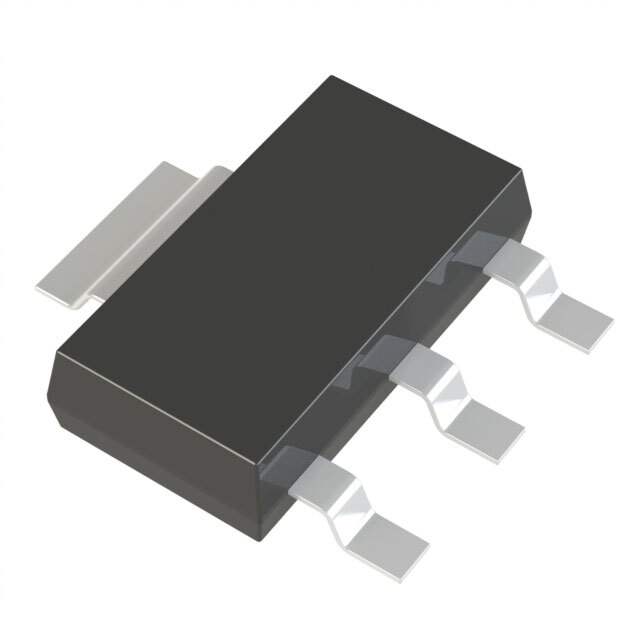
60V VCEO, 6A collector, 1W dissipation, SOT-223-3, for lines that already depend on it.
Quick Engineering Summary
| Field | Value |
|---|---|
| Manufacturer | Diodes Incorporated |
| Category | Transistors (BJT) - Single |
| Package | SOT-223 |
| Core function | TRANS NPN 60V 6A SOT-223-3 |
| Key electrical range | Collector Cut-off Current(Max): 50nA (ICBO); Frequency - Transition: 130MHz; Maximum Current Collector: 6A; Maximum Power Dissipation: 1W |
| Reported stock | 4980 pcs reported — confirm on RFQ |
60V is enough only if the lifecycle problem is already solved
60V is the collector-emitter breakdown ceiling, and it answers only one question: whether the transistor can survive the rail and transient envelope already on the board. It does not answer the first sourcing question. Lifecycle does, and the answer is EOL.
After that, the other limits still matter. The 6A collector current is a ceiling, not a continuous-use promise at any ambient, and the 1W power dissipation limit is often the tighter constraint in SOT-223-3 on real boards. Add the listed 375mV max VCE(sat) at 300mA, 6A and the trade becomes clear: it may switch hard enough for low-drop paths, but the dissipation budget still decides whether the package runs cool or runs out of margin.
New design-in: no
No.
EU RoHS is compliant, but that does not offset an EOL lifecycle. Keep DZT851-13 to sustaining designs only.
And the stock number changes the buying move
So the buying move changes too. There are 4980 pieces listed, packaged on reel - TR. That is enough to matter if an existing assembly still needs coverage, but it is not a reason to pull the part into fresh work. Buy for the running line, then stop the exposure from growing.
One status field says Active while the lifecycle block and Lifecycle Status both say EOL. Treat that as a documentation conflict resolved in the conservative direction, because the explicit lifecycle signals agree with each other and they are the ones that set sourcing risk.
Wrong for fresh platforms, still usable in compact low-side work
Wrong for fresh platforms first. Any new design that needs a stable second-source path, a long service tail, or clean lifecycle paperwork should move on immediately. It also isn't the transistor to approve from this page alone when switching speed, saturation behavior, or thermal margin are tight, because the missing details are the ones that close those questions.
Its remaining fit is narrower. Existing SMT boards already laid out for SOT-223-3 can still use a single NPN transistor here where 60V is the voltage ceiling and 6A is the collector-current ceiling, with gain listed as 100 @ 2A, 1V. That gain point helps at that stated condition only; it does not describe base drive across the rest of the load line.
The 130MHz transition frequency says this is not a slow power BJT. Still, without switching waveforms, it does not close a fast-edge design. The practical gaps are concrete: pinout and package drawing are needed before layout or service documentation can be trusted, and thermal resistance or a derating curve is needed before the 1W limit can be translated into ambient headroom. A safe-operating-area view is also absent, which matters whenever a 60V, 6A transistor may see simultaneous voltage and current stress in the field.
View the Win-Source product page for DZT851-13.
Key Takeaways for Engineers & Buyers
- Freeze DZT851-13 to existing builds only; lifecycle is EOL.
- Check rail stress against the 60V VCEO ceiling before approving any last-time buy.
- Review thermal headroom around the 1W dissipation limit in SOT-223-3.