
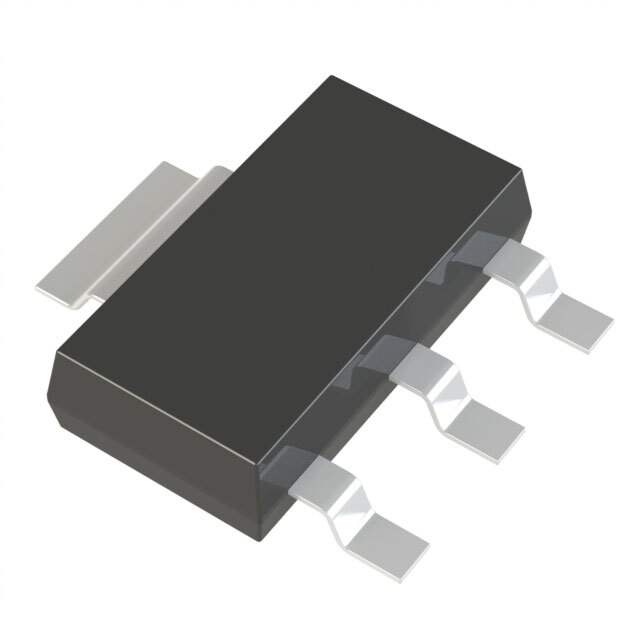
100V VCEO, 6A collector ceiling, 1W dissipation limit, SOT-223, -55°C to 150°C junction range
Quick Engineering Summary
| Field | Value |
|---|---|
| Manufacturer | Diodes Incorporated |
| Category | Transistors (BJT) - Single |
| Package | SOT-223 |
| Core function | TRANS NPN 100V 6A SOT-223-3 |
| Key electrical range | Collector Cut-off Current(Max): 10nA (ICBO); Frequency - Transition: 130MHz; Maximum Current Collector: 6A; Maximum Power Dissipation: 1W |
| Reported stock | 30908 pcs reported — confirm on RFQ |
EOL is the problem; the electrical envelope is not
The weak point comes first: this device is EOL, and that alone removes it from new design-in. The better news is electrical, not lifecycle. A 100V VCEO ceiling, 6A maximum collector current, and SOT-223 package still describe a useful high-voltage, board-mounted NPN for sustaining designs that already know the footprint and bias scheme.
One listing conflict needs a firm call. A generic Status field says Active, while the dedicated lifecycle fields say EOL. Don’t split the difference. Treat DZT853-13 as EOL, keep it to existing production, and take EU RoHS compliance as a convenience, not a reason to extend its life.
Those headline numbers are ceilings with sharp consequences
And that is exactly why the attractive numbers need to be read as limits, not comfort. The 6A maximum collector current is a ceiling, not permission to run DZT853-13 at 6A in any board condition, and the 1W maximum power dissipation is the tighter limit that will decide whether the package survives the load.
The 100V VCEO figure settles one question quickly: it fits rails and transients that need that collector-emitter breakdown ceiling, and it rules out any design that needs more voltage headroom. The 340mV maximum VCE(sat) at 500mA, 5A is useful because it ties conduction loss to a stated test point instead of vague low-saturation language, but it still does not give the full thermal picture across current and temperature. The 100 minimum hFE at 2A, 2V helps with base-drive budgeting at that condition only. In practice, the current, voltage, and saturation numbers can all look acceptable while the 1W ceiling ends the discussion first.
Can you still buy enough to hold a running line?
Can you still get enough to keep production moving? Yes, for now: 30908 pieces are listed, and that is the fact that keeps DZT853-13 in the conversation after an EOL call.
For a sustaining build, the basics are straightforward. It is an NPN in SOT-223, supplied on reel, so it matches automated SMT assembly and compact power or driver stages where a through-hole transistor would be a process mismatch. The 130MHz transition frequency says it is not a slow switch. It does not, by itself, finish a switching-speed decision, because the listing does not include switching waveforms or charge-related behavior that would show how the part behaves in the actual drive network.
That leaves the commercial decision simpler than the electrical one. Stock exists now; lifecycle does not. If DZT853-13 is already qualified in an existing product, pull in what the line needs while reel stock is still visible in quantity, and put the migration plan beside that buy. If it is not already on your AVL, stop there. Remaining availability supports continuity, not a new commitment.
The missing datasheet items are the real review blockers
Wrong for final thermal or switching signoff as listed. Fine for an initial keep-or-kill call.
What is missing is concrete: no thermal resistance, no derating curve, no pinout or package drawing, and no switching data such as capacitance detail. Those gaps decide ambient headroom, land pattern confidence, and fast-switching behavior.
View the Win-Source product page for DZT853-13.
Key Takeaways for Engineers & Buyers
- Block DZT853-13 on new BOMs; lifecycle is EOL.
- Check junction heating against the 1W dissipation ceiling before using the 6A collector rating.
- Reserve reel stock now if the line still needs SOT-223 NPN devices at 100V.