
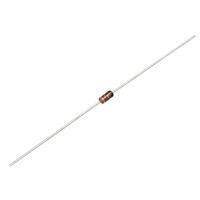
30V, 12.4mA, 300mW, through-hole, -30°C to 150°C: the ceilings that decide whether E-103 fits
Quick Engineering Summary
| Field | Value |
|---|---|
| Manufacturer | Semitec USA Corp |
| Category | Current Regulation - Diodes, Transistors |
| Package | Not listed for this part |
| Core function | DIODE CUR REG 30V 12. |
| Key electrical range | DIODE CUR REG 30V 12.4MA 300MW |
| Reported stock | 180000 pcs reported — confirm on RFQ |
The 30V and 300mW ceilings set the whole argument
The constraint is straightforward: the charger node and its dissipation have to stay inside 30V and 300mW. Those are ceilings, not normal operating targets. The listed 12.4mA regulator current sets the scale of the current path, but it does not answer the thermal question on its own; once the 3.5V limit and 300mW maximum are in play, the fit comes down to whether the device remains a small current regulator or becomes a heat source.
That keeps E-103 in modest current-setting work, especially in battery charger circuitry where through-hole assembly is acceptable. Active lifecycle and EU RoHS are easy checks. The real call is whether the charger node, including fault cases, stays within those limits.
12.4mA is the fit number, not a promise of margin
So the 12.4mA figure matters more than the category label. E-103 fits low-current charger paths where about 12.4mA is the job, and it does not fit a design that needs headroom above that number because the listing gives 12.4mA as the regulator current maximum.
The -30°C to 150°C operating temperature range is broad. It keeps the part in play for cold starts and hot enclosures. Still, temperature range alone does not settle reliability, and without a derating curve or thermal resistance you cannot tell how much ambient headroom is left when the device is asked to hold current near its listed limit.
The weak point is documentation depth
The weak point comes first: E-103 is only lightly described here. Still, what is listed is coherent enough for a first fit pass. You have a through-hole current regulation diode, a stated battery charger application, and ceilings of 30V, 12.4mA, 3.5V, and 300mW. Plausible for simple charger circuitry; thin for anything that needs tight review.
The missing details are concrete and important. There is no package drawing beyond through-hole and bulk packaging, no pinout, no thermal resistance, and no derating curve. For a current-regulating diode, those gaps drive board spacing, assembly assumptions, and how much ambient temperature E-103 can really tolerate before the 300mW ceiling becomes the limiting factor instead of the current number.
Wrong for dense SMT builds, right for steady through-hole demand
Wrong first: E-103 is a poor match for dense SMT assemblies or any design that needs a defined surface-mount package, because the listing gives through-hole mounting only and leaves package and supplier device package blank. It is also the wrong choice when the review depends on surge behavior, detailed thermal modeling, or mechanical envelope control. Those answers are not here.
On the other side, E-103 fits sustaining and new through-hole charger designs that need a simple current-regulating element and can stay inside the listed 30V, 12.4mA, and 300mW ceilings. That is a narrow job, but a real one, and the listed battery charger application lines up with it.
The stock figure of 180000 is the one supply fact worth acting on now. It supports a running line, but it says nothing about your exact build cadence or packaging preference. If E-103 is headed into production, reserve quantity against the schedule and confirm that bulk packaging works with the insertion flow.
That is the practical case. E-103 is not a broadly documented platform part; it is a specific fit for a narrow electrical job, and when that job matches a battery charger path with through-hole assembly, the active lifecycle makes the decision easier.
View the Win-Source product page for E-103.
Key Takeaways for Engineers & Buyers
- Keep E-103 on charger circuits that stay below the 30V Vak ceiling.
- Budget dissipation from the 3.5V limit, 12.4mA regulation current, and 300mW maximum before locking layout.
- Use E-103 only where through-hole assembly is acceptable and secure the current stock if the build is near-term.