
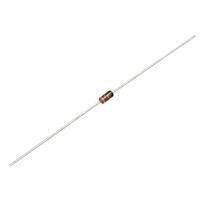
30V Vak max, 14.4mA regulation current max, 300mW max, axial through-hole, -30°C to 150°C
Quick Engineering Summary
| Field | Value |
|---|---|
| Manufacturer | Semitec USA Corp |
| Category | Current Regulation - Diodes, Transistors |
| Package | Not listed for this part |
| Core function | DIODE CUR REG 30V 14. |
| Key electrical range | DIODE CUR REG 30V 14.4MA 300MW |
| Reported stock | 91000 pcs reported — confirm on RFQ |
Can you design E-123 into a new build?
Can this go into a new build without drama? Yes, if the brief is tight. E-123 is Active, the lifecycle signals agree, and the listing is enough to place it in a through-hole current regulation slot where 30V Vak maximum, 14.4mA regulation current maximum, and 300mW maximum already fit the circuit.
That still leaves the hard parts open. The category and description identify a current regulation diode, and the application field points at battery chargers, but this page does not include the curve data that shows how tightly E-123 holds current across voltage and temperature. EU RoHS is compliant.
The real constraint is the dissipation ceiling
The real constraint is the dissipation ceiling. The listing gives 3.8V as a voltage limit maximum, 14.4mA as regulation current maximum, and 300mW as power maximum. Those numbers are ceilings, not operating promises, so they mark where margin runs out rather than where the part will normally sit in your circuit.
The 30V Vak maximum settles one decision fast: if the regulated branch can see more than 30V from anode to cathode, E-123 is out. If the rail stays under that ceiling, the remaining question is thermal, because the missing derating curve and missing thermal resistance are what determine whether the axial body can live at temperature in a charger enclosure instead of only surviving on paper.
Assembly flow matters too. This is an axial, through-hole device in bulk packaging, which makes E-123 a natural fit for low-count power or serviceable boards and a less natural fit for dense automated SMT lines, where hand insertion and board-to-board thermal variation can become the first problem before the electrical limits do.
91000 pieces changes the buy call
91000 pieces makes E-123 a practical running-line choice. Buy to your build plan while that stock is there.
Bulk axial packaging is the catch. It fits manual or mixed assembly better than lines built around taped automation.
What the listing still doesn't answer
The weak point is missing detail. E-123 still needs the current regulation curve over voltage and temperature, because the 14.4mA figure alone does not show how the charger behaves across the full -30°C to 150°C operating range.
Two gaps matter right away: thermal resistance or a derating curve for the 300mW ceiling, and a mechanical drawing or pinout confirmation for the axial body. Without those, board spacing, lead forming, and ambient headroom stay open. Surge current behavior is absent as well.
View the Win-Source product page for E-123.
Key Takeaways for Engineers & Buyers
- Keep E-123 below the 30V Vak ceiling; that limit does not tell you startup or surge behavior.
- Budget dissipation from the 3.8V limit and 14.4mA current ceiling; the thermal path is not described here.
- Use the 91000 stock as a buy signal for current builds if axial through-hole and bulk packaging fit your line.