
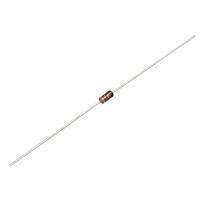
100V ceiling, 1.7mA regulation limit, 300mW max, axial through-hole package, -30°C to 150°C range
Quick Engineering Summary
| Field | Value |
|---|---|
| Manufacturer | Semitec USA Corp |
| Category | Current Regulation - Diodes, Transistors |
| Package | Not listed for this part |
| Core function | DIODE CUR REG 100V 1. |
| Key electrical range | DIODE CUR REG 100V 1.7MA 300MW |
| Reported stock | 110000 pcs reported — confirm on RFQ |
Not for power rails; useful in tiny current paths
This is not a power-rail part. E-152 tops out at 1.7mA regulator current, so it belongs in biasing, sensing, or charger-side housekeeping where the circuit needs a very small controlled current, not in rails feeding logic, LEDs, or any pulsed load.
It does bring voltage headroom to that kind of job. The 100V Vak maximum leaves room on higher-voltage nodes, but survival still comes down to the other ceiling: 300mW maximum dissipation. With Active lifecycle and EU RoHS status, E-152 is a reasonable new design-in choice when those limits fit the circuit and assembly flow.
Those ceilings decide fit faster than the category name
And that is the point: the 1.7mA and 300mW ceilings tell you more than the broad current-regulator label. A current-regulating diode can sound flexible until continuous voltage drop turns dissipation into the first failure mode, while the 100V maximum only sets the upper terminal-voltage limit.
The -30°C to 150°C range helps, but it does not answer the thermal question by itself. E-152 can sit in hotter equipment than many commodity parts, yet that range alone does not show how much of the 300mW ceiling remains at elevated ambient, and that missing detail is exactly what can turn a harmless bias element into a warm field return.
Buy it for the line you have
Only if it fits.
E-152 is through-hole, axial, and bulk packed. If your build still accepts hand insertion or axial automation, the listed stock of 110000 supports a running line or a fresh release. If not, stop there.
The missing thermal and dynamic data still matter
The constraint is incomplete closure. The listing is enough to place E-152 in a low-current path, but not enough to finish a thermal or transient review.
Start with dissipation. You have a 300mW maximum and an operating range of -30°C to 150°C, but no derating curve showing how allowable power falls with ambient or lead temperature. That leaves the main stress limit only partly defined, especially in equipment that runs hot for long periods.
Thermal resistance is also absent. Without it, package-level temperature rise stays unknown even though dissipation is one of the two central design constraints, and that makes it hard to judge margin when the part is asked to absorb a sustained voltage drop near its limits.
The electrical picture is incomplete too. The listing gives 1.7mA maximum and a 2V maximum limit, but no curve showing how regulation is reached or held across voltage and temperature. Mechanical detail is similarly thin: axial through-hole tells you the assembly style, not lead spacing, body size, or hole pattern. For E-152, those gaps separate a quick schematic pick from a released part.
View the Win-Source product page for E-152.
Key Takeaways for Engineers & Buyers
- Keep E-152 on low-current bias or charger paths; 1.7mA is the listed regulation ceiling, not a target for every load.
- Check assembly flow before release: E-152 is axial through-hole and bulk packed, so it does not drop into an SMT-only line.
- Pull the full datasheet for E-152 before thermal signoff; the listing gives 300mW max but no thermal resistance or derating curve.