
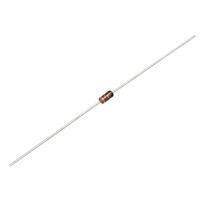
25V ceiling, 20mA regulation, 300mW limit, axial through-hole package, -30°C to 150°C operating range
Quick Engineering Summary
| Field | Value |
|---|---|
| Manufacturer | Semitec USA Corp |
| Category | Current Regulation - Diodes, Transistors |
| Package | Not listed for this part |
| Core function | DIODE CUR REG 25V 20MA 300MW |
| Key electrical range | DIODE CUR REG 25V 20MA 300MW |
| Reported stock | 96000 pcs reported — confirm on RFQ |
Thin electrical detail, but still a usable line item
The weak point comes first: E-183 is listed with enough numbers to screen fit, not enough to close behavior. Still, Active lifecycle, EU RoHS, and 96000 in stock make it a credible new design-in candidate when a through-hole current regulator fits and a datasheet follow-up is acceptable.
The 20mA rating is the real boundary here
That is the real dividing line. The 20mA regulator current is a ceiling on what E-183 is meant to regulate, not a promise that every load condition around that number behaves the same, so it settles whether the part belongs in higher-current bias or drive paths while leaving regulation accuracy unresolved.
The 25V Vak maximum is the next hard stop. It sets rail compatibility and fault headroom; exceed it and the part is outside its listed limit, while staying below it still does not say how tightly current holds across voltage. Then there is the 4.6V voltage limit and the 300mW maximum power, which need to be read together because they define the dissipation budget implied by the listing, and that budget is likely to bite first in a small axial body if the surrounding circuit lets the device sit near its limits for long stretches.
The -30°C to 150°C operating range is broad enough for ordinary industrial ambient swings, but without a derating curve or thermal resistance, it does not answer how much margin remains once the part is warm on a real board.
Best fit is simple current limiting in through-hole builds
Use it narrowly.
E-183 fits low-current analog biasing, charger-related current limiting, and other simple through-hole circuits where an axial part is acceptable and the design intent is closer to current regulation than switching. The package and mounting style push it toward serviceable leaded assemblies rather than dense surface-mount layouts, and the 20mA ceiling rules it out quickly for LED strings, actuator drive, or other loads where current demand can climb past that number. If your design needs compact placement, automated SMT flow, or tight control over current across voltage and temperature, this listing does not provide enough evidence yet.
Can you buy it for a running line without drama?
Is there enough stock to keep a line moving?
96000 says yes, for now. That is the practical buying case for E-183: Active status and a listed quantity of 96000 support a running line or a fresh build that already wants an axial through-hole part. The packaging is bulk, so plan receiving and kitting around loose axial parts rather than assuming tape, reel, or formed leads.
What is still missing is concrete engineering detail: the regulation curve, tolerance on regulated current, pinout or body drawing, and thermal resistance or derating data. Those gaps matter more than another stock check because they decide whether E-183 behaves predictably once it is soldered into a charger or bias network.
View the Win-Source product page for E-183.
Key Takeaways for Engineers & Buyers
- Keep E-183 on low-current rails only; 20mA is the listed regulation ceiling.
- Budget dissipation from the 4.6V limit and 300mW maximum before locking the axial footprint.
- Pull the full datasheet for regulation curve, pinout, and thermal detail before release.