
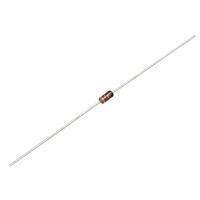
100V, 2.3mA, 300mW, axial through-hole, -30°C to 150°C: those limits decide whether E-202 belongs.
Quick Engineering Summary
| Field | Value |
|---|---|
| Manufacturer | Semitec USA Corp |
| Category | Current Regulation - Diodes, Transistors |
| Package | Not listed for this part |
| Core function | DIODE CUR REG 100V 2. |
| Key electrical range | DIODE CUR REG 100V 2.3MA 300MW |
| Reported stock | 2031 pcs reported — confirm on RFQ |
100V is the first gate, not the whole answer
100V comes first. It decides whether E-202 belongs on the schematic at all, because Vak is a ceiling and settles the maximum rail exposure question before anything else matters.
After that, the fit check gets narrower. The listed regulator current is 2.3mA, which puts E-202 in bias networks, charger trickle paths, and other low-current limiting roles, and rules it out as soon as the circuit expects more than a few milliamps. The 300mW rating is a ceiling too, but without thermal resistance or a derating curve, it still doesn't tell you how much ambient headroom the part really has.
That pushes E-202 toward small through-hole bias jobs
So the package matters just as much as the electrical line. E-202 is axial, through-hole, and sold in bulk, which points it toward designs that still accept leaded discretes and modest assembly density rather than boards already standardized on surface-mount current-setting parts.
The listing points to battery chargers, and that fits only inside the limits already on the table: 2.3mA regulated current, 100V as the anode-cathode ceiling, and -30°C to 150°C as the operating temperature span. That makes E-202 a plausible choice for low-current charger bias or maintenance paths, not for work that depends on pulse behavior, fast switching, or tight thermal modeling, because those deciding details are not shown here.
The weak point is missing detail, not lifecycle
The weak point is the missing detail. The stronger signal is lifecycle: E-202 is marked Active, the lifecycle indicators agree, and 2031 units are in stock, so this is a reasonable candidate for a new build rather than a sustaining-only buy.
What is missing is the information that closes a real part review. There is no pinout or drawing, which still matters on an axial device because body dimensions, lead form, and spacing drive the hole pattern and keepout. There is no thermal resistance or derating curve, so the 300mW ceiling cannot be turned into ambient margin. There is no forward regulation curve or tolerance detail around the 2.3mA figure, so current hold across voltage and temperature is still an open question. There is also no transient or surge figure, leaving fault behavior unanswered in charger inputs and any line-exposed path.
That is the real caution with E-202. The lifecycle story is clean, but layout release and stress signoff still depend on those missing items.
Buy it for running stock, not for guesswork
Buyable now. With 2031 in stock, bulk packaging, and EU RoHS compliance, E-202 is easy to place on a through-hole build. Stop short if the design depends on package dimensions or thermal derating that the listing does not show.
View the Win-Source product page for E-202.
Key Takeaways for Engineers & Buyers
- Keep E-202 on low-current paths only; 2.3mA is the listed regulation ceiling.
- Check rail stress first: E-202 carries a 100V Vak maximum, not an operating target.
- Reserve through-hole axial space early; E-202 is not a surface-mount option.