
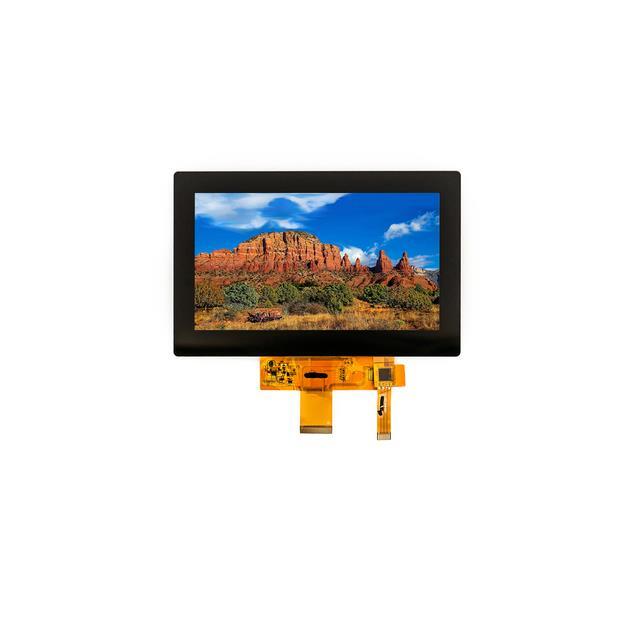
2.4" 240 x 320 TFT with capacitive touch, SPI or 18-Bit RGB, transmissive panel
Quick Engineering Summary
| Field | Value |
|---|---|
| Manufacturer | Focus LCDs |
| Category | LCD, OLED, Graphic |
| Package | Box |
| Core function | 2. |
| Key electrical range | Supply and Demand Status: Shortage |
| Reported stock | 1 pcs reported — confirm on RFQ |
Can you put E24RG12432LWIM800-C into a new build?
Can I release this into a new build today? No.
E24RG12432LWIM800-C has no explicit EOL flag, but lifecycle is Unknown, stock shows 1, and supply is marked Shortage. That leaves it as a cautious design-in, not a comfortable choice for a fresh program.
What keeps it relevant is the feature set: a 2.4" (60.96mm) transmissive TFT - Color module with 240 x 320 pixels, capacitive touch, and EU RoHS compliance. That can solve a compact HMI requirement quickly. It does not solve sourcing.
Wrong for simple character displays, right for compact HMIs
Start with where it does not fit. This is not the part for a low-pin-count display path or a barebones monochrome status screen.
E24RG12432LWIM800-C uses an ST7789 controller type and exposes Parallel, 18-Bit (RGB), SPI, so the real integration question is broader than panel size. Your processor, firmware stack, and connector budget all have to absorb a graphics display with touch.
It fits much better in a small operator interface that needs color, touch, and a real pixel matrix on a tight front panel. The 240 x 320 format supports icons, menus, and simple trend or status pages, while the 2.4" (60.96mm) diagonal and 36.72mm W x 48.96mm H viewing area keep it in the handheld or compact-instrument class rather than a wide dashboard or long-distance readout.
240 x 320 is the real decision point here
240 x 320 is the number that matters first, because it sets the ceiling on interface density before anyone gets distracted by the 2.4" label.
E24RG12432LWIM800-C is a color TFT with Red, Green, Blue (RGB), a transmissive mode, and capacitive touch. In practice, that puts it in designs where the display is expected to handle actual interaction, not just show state.
The interface options are the next filter. Parallel, 18-Bit (RGB), SPI gives you flexibility, but it also rules out casual assumptions about host attachment. SPI can ease integration when pin count is tight, while 18-Bit RGB commits you to a much wider bus; the listing says those paths exist, but it does not tell you the timing, frame-rate, initialization burden, or pinout for this exact module. Get that call wrong, and the display subsystem becomes the schedule problem long before the rest of the product is settled.
Mechanical fit is only partly covered here. The 36.72mm W x 48.96mm H viewing area tells you what the user sees, and the 2.4" (60.96mm) diagonal confirms the product class, but the outline drawing, active area stack-up, connector location, and pinout are not shown. For E24RG12432LWIM800-C, those missing details are the difference between a bench hookup and a board-and-enclosure release.
The buying constraint is supply, not compliance
Weak point first: stock is 1 and demand is Shortage. Strong point second: there is no explicit EOL signal, and EU RoHS is covered.
View the Win-Source product page for E24RG12432LWIM800-C.
Key Takeaways for Engineers & Buyers
- Match the host to SPI or Parallel, 18-Bit (RGB) before layout; that interface choice drives the connector and firmware path.
- Reserve the mechanical window for 36.72mm W x 48.96mm H viewing area, not just the 2.4" diagonal callout.
- Do not count on spot buys; shortage is flagged and stock shows 1.