
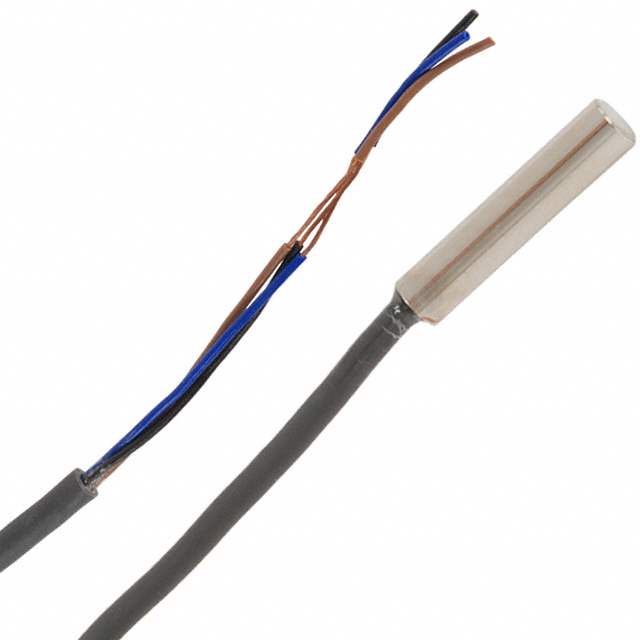
10 VDC to 30 VDC, 1 mm sensing, 3kHz response, IP67 cylinder for existing production only
Quick Engineering Summary
| Field | Value |
|---|---|
| Manufacturer | Omron |
| Category | Proximity Sensors |
| Package | Cylinder |
| Core function | SENSOR PROX INDUCTIVE 1MM CYLIND |
| Key electrical range | Operating Supply Voltage: 10 VDC ~ 30 VDC; Operating Temperature Range: -25°C ~ 70°C; Output Type: NPN-NO, 3-Wire; Response Frequency: 3kHz |
| Reported stock | 1 pcs reported — confirm on RFQ |
Sustaining only, not a new build choice
Do not design this in.
E2E-C1C1 is marked EOL, and that settles the new-design question. The stock position makes the situation more urgent: quantity is 1 and supply status is Limited, so even an existing production line should treat this as a short-term bridge rather than a part it can count on. RoHS is listed as EU RoHS compliant, but that does not change the lifecycle stop.
The weak point is reach; the useful part is speed
The weak point comes first: 1 mm sensing distance is a hard limit.
That puts E2E-C1C1 in fixtures where the target stays very close and repeatable, not in setups with loose mechanical stack-up, target wobble, or contamination that eats into an already narrow margin.
The useful counterweight is the 3kHz response frequency. It suits fast presence detection, not slow utility sensing, and it still cannot rescue a bad mechanical arrangement. The 10 VDC to 30 VDC operating supply range fits common industrial rails, but it says nothing about output loading, cable drop, or transient behavior.
Fit is narrow, and the package tells you why
10 VDC to 30 VDC is a broad supply window, but it only earns a place here because the rest of the part narrows the fit quickly.
The NPN-NO, 3-Wire output points to a control input that already accepts that switching style rather than a universal sensor interface. From there, the mechanical picture takes over: this is an inductive, shielded sensor in a cylinder body with cable leads, nickel-plated brass construction, and IP67 ingress protection, so it belongs in compact metal-target detection points on machinery where a threaded cylindrical body and fixed cable exit already match the bracket and harness.
That same package also rules out a lot. It is a poor fit where connectorized replacement speed matters, where nonmetal targets must be detected, or where the machine needs more stand-off than 0.039" (1mm) can tolerate without nuisance misses. Temperature range is -25°C to 70°C, and that is the operating window. If your cabinet, washdown area, or heated tooling goes past that ceiling, E2E-C1C1 is out before mounting details even enter the discussion.
The buy problem is availability, not paperwork
The constraint is immediate scarcity.
One unit is listed, and the status is Limited. If E2E-C1C1 is already on a running line, quarantine that unit for service support or failure analysis retention, not casual replenishment. If it is not already qualified in your build, move on now; the inventory position is too thin to support even a modest introduction lot.
View the Win-Source product page for E2E-C1C1.
What the listing still doesn’t answer
This is wrong for wiring closure.
What it is right for is a quick gap list: pinout, mechanical drawing, and load or output-current detail for the NPN-NO, 3-Wire interface are still missing.
View the Win-Source product page for E2E-C1C1.
Key Takeaways for Engineers & Buyers
- Freeze E2E-C1C1 out of new BOMs; lifecycle is EOL.
- Reserve the single listed unit only for line-down service or qualification hold.
- Check the machine target and bracket stackup against the 0.039" (1mm) sensing distance.