
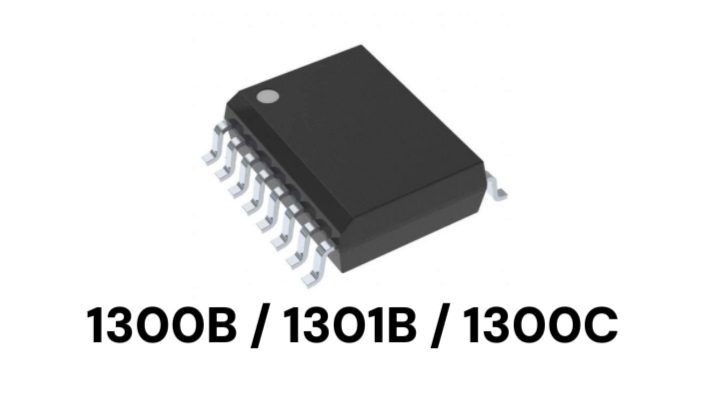
In industrial automation, motor control, and isolated interface designs, Analog Devices’ (ADI) iCoupler® magnetic isolation technology has largely replaced traditional optocouplers due to its high reliability, high speed, and low power consumption. The ADuM130x series is one of the most widely used triple-channel digital isolator families.
While the packaging and pin definitions are highly similar, the choice of channel direction configuration and maximum data rate is critical in engineering design, directly determining system communication logic and timing margins.
This guide compares three representative models from the ADuM130x series — ADUM1300BRWZ, ADUM1301BRWZ, and ADUM1300CRWZ — based on parameters and practical application scenarios to assist engineers in making precise component selections.
Parameter Comparison
| ADUM1300BRWZ | ADUM1301BRWZ | ADUM1300CRWZ | |
| Channel Config | 3/0 (All Forward) | 2/1 (2 Fwd / 1 Rev) | 3/0 (All Forward) |
| Max Data Rate | 10 Mbps | 10 Mbps | 90 Mbps |
| Propagation Delay (Max) | 50 ns | 50 ns | 32 ns |
| Pulse Width Distortion | 3 ns | 3 ns | 2 ns |
| Isolation Rating | 2500 Vrms | 2500 Vrms | 2500 Vrms |
| Temp Range | -40°C ~ +105°C | -40°C ~ +105°C | -40°C ~ +105°C |
| Logic Levels | 3.3V / 5V Compatible | 3.3V / 5V Compatible | 3.3V / 5V Compatible |
| Package | SOIC-16 (Wide) | SOIC-16 (Wide) | SOIC-16 (Wide) |
Application Analysis
- ADUM1300BRWZ
The ADUM1300BRWZ is the classic “all-unidirectional” medium-speed isolator in the series.
- Key Characteristics & Suitability:
3 channels transmitting from the primary to the secondary side (3/0 configuration).
10 Mbps rate is sufficient for most standard control signals, low-speed SPI, or PWM.
The BRWZ variant offers an excellent balance between cost and performance.
- Typical Applications:
Unidirectional data streaming (e.g., ADC capture card to host).
Parallel data bus isolation (where all lines are outputs).
Multi-channel control signal isolation (e.g., MCU controlling relays or LED drivers).
- ADUM1301BRWZ
The ADUM1301BRWZ is architecturally similar to the 1300, but the core difference lies in channel direction.
- Key Characteristics & Suitability:
Uses a 2/1 configuration (2 channels transmit, 1 channel receives).
Designed for communication protocols requiring bidirectional communication or feedback signaling.
Eliminates the need for an extra isolator chip just for a return signal, saving PCB space.
- Typical Applications:
SPI Interface Isolation: Fits CS, CLK (outputs), and MISO (input) configurations
Note: Standard 4-wire SPI requires an additional forward channel for MOSI.
Motor drive control with status feedback.
- ADUM1300CRWZ
The ADUM1300CRWZ is the high-performance version of the 1300 series.
- Key Characteristics & Suitability:
Retains the 3/0 all-forward configuration but boosts the data rate to 90 Mbps.
Lower propagation delay and pulse width distortion, suitable for high-frequency signals with strict timing requirements.
Ideal where B-Grade (10 Mbps) bandwidth is insufficient.
- Typical Applications:
High-speed SPI clock isolation (>5 MHz).
High-speed data links between FPGAs.
Precision instrumentation requiring tight timing skew and low propagation uncertainty.
Design Considerations
- Channel Directionality
This is the most common pitfall. If designing for an SPI bus (including MISO) or UART, you must choose ADUM1301 (2/1 config). If ADUM1300 (3/0 config) is selected by mistake, all signals can only travel in one direction, preventing the system from receiving data from the slave device.
For purely controlling DACs or drivers without readback, ADUM1300 is preferred.
- Speed Grade
BRWZ (10 Mbps) is suitable for general I/O and low-speed buses.
CRWZ (90 Mbps) is required for high-speed clocks and large data throughput.
Note: Do not use BRWZ models in >10 Mbps signal chains, as this may result in signal integrity degradation and unreliable communication; conversely, using CRWZ in low-speed apps is functional but may add unnecessary cost.
- Power Supply Decoupling
The ADuM series relies on magnetic isolation and contains internal high-frequency oscillators. A 0.1µF ~ 1µF capacitor must be placed immediately next to the VDD1 and VDD2 pins; otherwise, isolation performance may degrade, or radiated noise may occur.
Common Pitfalls
- Misconception 1: Assuming ADUM1300 and ADUM1301 are interchangeable because they look the same.
Result: PCB routing is completely different. Swapping them will cause I/O conflicts and potentially damage the chip.
- Misconception 2: Blindly choosing CRWZ (90 Mbps) for highest performance.
Result: Increases BOM cost unnecessarily. High-speed chips may also generate slightly more high-frequency noise than tuned low-speed versions. Select based on actual signal frequency.
- Misconception 3: Ignoring the “RL” suffix.
Result: “RL” stands for Tape & Reel. If ordering for automated assembly, RL is required. For manual prototyping, tube packaging might be acceptable.
Device Summary
| Model | Manufacturer | Key Takeaway | Order |
| ADUM1300BRWZ | Analog Devices | 3/0 Channels, Standard 10M Rate | Buy Now |
| ADUM1301BRWZ | Analog Devices | 2/1 Channels, Vital for Bi-directional | Buy Now |
| ADUM1300CRWZ | Analog Devices | 3/0 Channels, 90M High Speed | Buy Now |
WIN SOURCE supplies the full ADuM130x series of digital isolators, covering ADUM1300BRWZ, ADUM1301BRWZ, and ADUM1300CRWZ configurations. Engineers can quickly complete device selection based on system protocols and rate requirements by checking real-time inventory and lead-time information through WIN SOURCE, helping accelerate product development cycles.
©2026 Win Source Electronics. All rights reserved. This content is protected by copyright and may not be reproduced, distributed, transmitted, cached or otherwise used, except with the prior written permission of Win Source Electronics.

COMMENTS