
In mid- to high-performance electronic systems, low-dropout regulators (LDOs) serve roles far beyond basic 3.3 V regulation. They are essential for multi-rail power management, noise suppression, and precise power sequencing.
Engineers designing industrial, high-speed digital, and RF systems increasingly face higher input voltages, heavier load currents, and stringent noise and transient requirements. Under these conditions, traditional selection methods based solely on fixed-output LDOs are no longer sufficient.
This guide compares three representative adjustable, high-current LDOs—TL1963ADCQR, TPS7A4501DCQR, and TPS7A5201RPSR—focusing on input voltage range, internal architecture, and system-level features to support informed device selection.
Parameter Comparison
TL1963ADCQR | TPS7A4501DCQR | TPS7A5201RPSR | |
Max Input Voltage (Vin) | 20 V | 20 V | 6.5 V |
Output Voltage Range | 1.21–20 V | 1.21–20 V | 0.8–5.15 V |
Max Output Current | 1.5 A | 1.5 A | 2 A |
Output Noise (typ.) | ~40 µVrms | ~28 µVrms | ~4.4 µVrms (ultra-low) |
Dropout Voltage (typ.) | 0.34 V @ 1.5 A | 0.30 V @ 1.5 A | 0.225 V @ 2 A |
Protection Features | Reverse Current Protection, OCP, OTP | Reverse Current Protection, OCP, OTP | Foldback Current Limit, UVLO, OTP |
Capacitor Stability | Requires ESR Range Check | Stable with Ceramic Capacitors | Stable with Ceramic Capacitors (Low ESR) |
Application Analysis
- TL1963ADCQR
The TL1963ADCQR is a long-established high-current LDO supporting up to 20 V input voltage and 1.5 A output current. It has been widely deployed in industrial and communication systems.
Typical applications:
- Post-regulation from 12 V / 19 V / 20 V bus rails
- Power supplies for microprocessors, low-voltage logic, and peripherals
- Industrial control systems and power modules
Verdict: A mature and robust solution with a basic feature set and extensive field validation. Well suited for designs prioritizing long-term stability and compatibility.
- TPS7A4501DCQR
The TPS7A4501DCQR retains the 20 V input capability, 1.5 A output current, and SOT-223 package of the TL1963, while offering improved noise performance and higher PSRR.
Typical applications:
- Precision analog and RF circuits
- Noise-sensitive post-regulation stages
- Systems requiring enable-based power sequencing
Verdict: A preferred performance upgrade for TL1963-based designs, delivering improved power integrity without architectural changes.
- TPS7A5201RPSR
The TPS7A5201RPSR is a next-generation low-noise LDO optimized for high integration and advanced system-level features, with a distinctly lower input voltage range.
Typical applications:
- Systems powered from 5 V or lower input rails
- Core and I/O supplies for FPGA, DSP, and SoC devices
- Noise-critical interfaces such as high-speed SerDes and ADC/DAC
- Designs requiring Power Good (PG) and soft-start
Verdict: A flagship solution for high-performance, low-voltage architectures. Not suitable for 12 V or higher input rails.
Design Considerations
- Input Voltage Constraints
The TL1963ADCQR and TPS7A4501DCQR support input voltages up to 20 V, whereas the TPS7A5201RPSR is limited to 6.5 V.
This is the most critical and non-negotiable selection boundary among the three devices.
- Package and Thermal Management
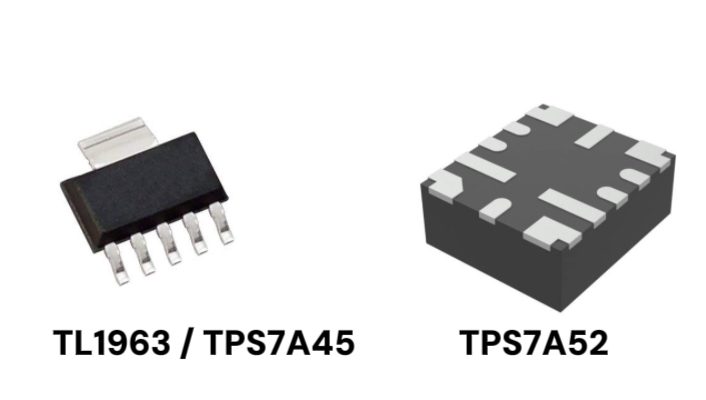
SOT-223: Provides a relatively direct thermal path and is suitable for medium- to high-power linear regulation.
VQFN: Offers a compact footprint but requires careful PCB copper allocation, high-quality soldering, and thorough thermal validation.
- System-Level Features
The TPS7A5201RPSR integrates Power Good and soft-start, enabling complex power sequencing in modern digital systems.
The TL1963ADCQR and TPS7A4501DCQR follow a more traditional LDO control model with fewer system-level functions.
Common Pitfalls
- Focusing Only on Output Current While Ignoring Input Voltage
Applying the TPS7A5201RPSR in 12 V or 19 V systems may result in immediate device failure.
- Assuming All Adjustable LDOs Are Interchangeable
Differences in internal architecture, loop stability, pin functions, and thermal behavior make direct substitution risky without evaluation.
- Overlooking Thermal Impact of Package Changes
Replacing a SOT-223 device with a VQFN package without revisiting the thermal design may lead to excessive junction temperature.
- Neglecting Output Capacitor ESR Effects
Stability margins vary across architectures under extreme temperature or load conditions.
When replacing devices or introducing new designs, load transient testing is recommended.
Replacement & Migration Recommendations
- TL1963ADCQR → TPS7A4501DCQR
This migration is feasible when input voltage and output requirements remain unchanged, and is recommended as a performance upgrade path.
- TL1963ADCQR / TPS7A4501DCQR → TPS7A5201RPSR
This migration is only feasible for systems with input rails ≤ 6.5 V and requires re-evaluation of package selection, thermal design, and stability.
- Recommendations for New Designs
High-voltage rails (12 V–20 V): Prioritize TPS7A4501DCQR
Low-voltage, high-performance systems (≤ 5 V): Prioritize TPS7A5201RPSR
Key Takeaways
- TL1963 — A classic, robust 20 V LDO for industrial applications
- TPS7A4501 — A performance-enhanced solution for 20 V input rails
- TPS7A5201 — A flagship low-noise LDO for low-voltage, performance-critical systems
WIN SOURCE provides access to TL1963, TPS7A4501, and TPS7A5201 devices, along with active equivalents and common alternatives. Whether supporting legacy designs or sourcing next-generation solutions, visit WIN SOURCE for real-time availability and lead-time information to keep projects on schedule.
©2026 Win Source Electronics. All rights reserved. This content is protected by copyright and may not be reproduced, distributed, transmitted, cached or otherwise used, except with the prior written permission of Win Source Electronics.

COMMENTS