
In applications such as high-speed signal detection, zero-crossing detection, clock recovery, and ADC front-end interfacing, high-speed comparators are used to convert analog signals into digital outputs with minimal delay. Their performance has a direct impact on timing accuracy and overall system stability.
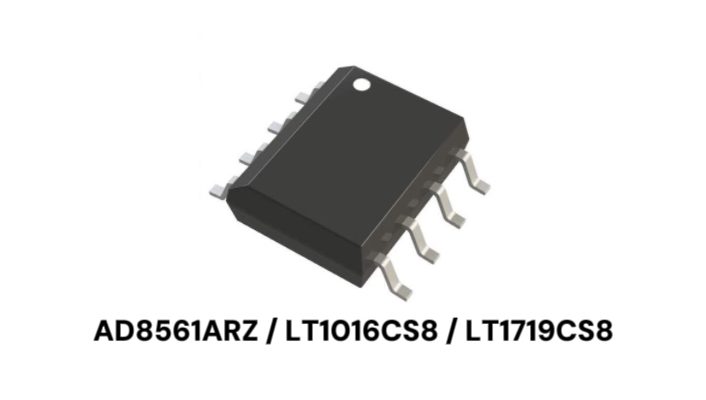
The AD8561ARZ, LT1016CS8, and LT1719CS8 from ADI are all single-channel high-speed comparators, but they differ in propagation delay, supply range, input characteristics, and output structure.
This article compares the three devices in terms of key specifications, target applications, and design considerations to help engineers make faster and more practical selection decisions for different platform requirements.
Parameter Comparison
| AD8561ARZ | LT1016CS8 | LT1719CS8 | |
| Channels | Single | Single | Single |
| Propagation Delay (Typ) | 7 ns | 10 ns | 4.5 ns (under high overdrive) |
| Supply Range | 3V to 10V (Single) / ±5V (Dual) | +5V (Single) / ±5V (Dual) | 2.7V to 6V (Single) |
| Quiescent Current (Typ) | ~3 mA | ~25 to 35 mA | ~4.7 mA |
| Input Stage Characteristics | Input common-mode range extends to the negative rail | Input range requires headroom from the supply rails | Rail-to-rail input (RRI) |
| Output Type | CMOS / TTL-compatible output | Complementary TTL outputs (Q and /Q) | Rail-to-rail CMOS / TTL-compatible output |
| Latch Function | Yes | Yes | No |
| Package | SOIC-8 | SOIC-8 | SOIC-8 |
Application Analysis
- AD8561ARZ
The AD8561ARZ offers a good balance of speed, power consumption, and supply flexibility. With a typical propagation delay of 7 ns and relatively low quiescent current, it is well suited to general-purpose high-speed comparison in systems with different supply configurations. Its input range can extend to the negative rail or signals near ground, which makes it especially practical in single-supply designs that need to process low-level inputs.
- Typical applications:
High-speed sample-and-hold front ends
General-purpose high-speed comparison in mixed 3.3 V / 5 V / ±5 V systems
Portable high-speed measurement equipment
- LT1016CS8
The LT1016CS8 is a well-established high-speed comparator that remains widely used in traditional 5 V and ±5 V platforms. Although its power consumption is significantly higher, it offers complementary TTL outputs (Q and /Q), which can be useful in interface circuits that require both true and inverted logic outputs without adding an external inverter stage.
- Typical applications:
BOM-compatible replacement in legacy platforms
Traditional TTL interface circuits
High-speed systems that require complementary outputs
- LT1719CS8
The LT1719CS8 is primarily designed for low-voltage 3 V and 5 V systems. It offers lower propagation delay and input/output characteristics that are better aligned with modern digital logic interfaces. Because it does not include a latch function, it is generally better suited to continuous high-speed comparison than to applications that require latch-based timing control.
- Typical applications
High-speed front-end interfaces for modern FPGAs and 3.3 V MCUs
High-speed edge detection and zero-crossing detection
Low-voltage portable broadband systems
Design Considerations
- Evaluate propagation delay together with input overdrive
Actual comparator speed should not be judged solely by the typical propagation delay listed on the front page of the datasheet. For example, the LT1719CS8’s 4.5 ns propagation delay is specified under relatively high input overdrive conditions. When the input signal only slightly exceeds the threshold, the delay of all three devices may increase noticeably.
For practical comparison between the AD8561ARZ, LT1016CS8, and LT1719CS8, it is better to review the datasheet curves that show propagation delay versus input overdrive rather than relying only on the headline typical values.
- Check output structure and latch compatibility in replacement designs
If an existing design is considering replacing the LT1016CS8 with the AD8561ARZ or LT1719CS8, the output structure and control functions should be reviewed carefully.
The LT1016CS8 provides complementary outputs (Q and /Q). If the original design uses the inverted output, a single-output device may not be a direct replacement. In addition, the LT1719CS8 does not include a latch function. If the original circuit depends on the latch pin for synchronization or timing control, its replacement suitability should be reassessed.
- Verify input behavior near the threshold
Although all three devices are intended for high-speed comparison, their allowable input ranges are not the same. In designs where the threshold is set near 0 V, or where small signals close to ground must be detected, the input-stage characteristics can directly affect output stability.
For example, under a single 5 V supply, the LT1016CS8 input range should not simply be assumed to support signals close to ground. If the threshold is set too low, false triggering or abnormal switching behavior may occur. By contrast, the AD8561ARZ and LT1719CS8 are generally easier to use in designs that handle signals near ground potential.
- PCB layout directly affects high-speed comparator stability
For nanosecond-class comparators, PCB parasitics can have a direct effect on edge quality and output stability. A continuous ground reference should be maintained, high-frequency decoupling capacitors should be placed as close as possible to the supply and ground pins, and input, output, and other high-speed traces should be kept short.
In compact layouts, or where output edges are particularly fast, small damping resistors may also be added at the input or output as needed to help reduce ringing and false triggering caused by parasitic coupling.
Product Summary
| Part Number | Manufacturer | Key Takeaway | Order |
| AD8561ARZ | ADI | Low power consumption, wide supply range, and well suited to general-purpose high-speed comparison | Buy Now |
| LT1016CS8 | ADI | A classic high-speed comparator with complementary outputs | Buy Now |
| LT1719CS8 | ADI | Optimized for low-voltage platforms with lower propagation delay | Buy Now |
WIN SOURCE offers in-stock availability for a full range of ADI high-speed comparators, including mainstream part numbers such as AD8561ARZ, LT1016CS8, and LT1719CS8. Engineers can quickly identify the right device based on supply voltage, speed requirements, and interface needs. Visit WIN SOURCE to check real-time inventory and lead-time information, shorten sourcing cycles and accelerate product development.
©2026 Win Source Electronics. All rights reserved. This content is protected by copyright and may not be reproduced, distributed, transmitted, cached or otherwise used, except with the prior written permission of Win Source Electronics.

COMMENTS