
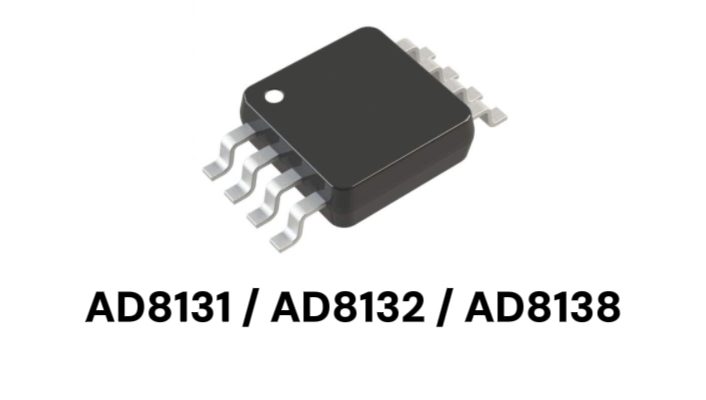
In high-speed data acquisition, video transmission, and industrial signal chains, differential drivers are critical components for ensuring signal integrity and interference rejection. Whether driving high-speed ADCs, managing long-distance differential transmission, or handling bias and common-mode adjustment, the capability of the high-speed differential amplifier directly impacts the system’s Signal-to-Noise Ratio (SNR) and bandwidth performance.
Analog Devices’ AD813x series offers differential driving solutions that cover varying levels of linearity and flexibility. This guide selects three representative models—AD8131ARMZ-REEL7, AD8132ARMZ-REEL7, and AD8138ARMZ-REEL7—and compares their parameters and applications to provide engineers with an efficient and reliable reference for component selection.
Parameter Comparison
| AD8131ARMZ-REEL7 | AD8132ARMZ-REEL7 | AD8138ARMZ-REEL7 |
-3 dB Bandwidth | 400 MHz | 360 MHz | 320 MHz |
Slew Rate | 2000 V/µs | 1200 V/µs | 1150 V/µs |
Input Bias Current | 500 nA | 3 µA | 3.5–7 µA |
Input Offset Voltage | 1.5 mV | 1 mV | ±1 mV (Typical) |
Output Current | 60 mA | 70 mA | 95 mA |
Supply Range | 2.8–11V / ±1.4–±5.5V | 2.7–11V / ±1.35–±5.5V | 2.7–11V / ±1.4–±5.5V |
Typical Positioning | High-speed General Purpose Driver | Flexible Adjustment, Low Distortion | High-precision ADC Driver, Excellent SFDR |
Application Analysis
AD8131
With its ease of use featuring a fixed gain of 2 and substantial bandwidth headroom, the AD8131 excels in general-purpose differential signal conditioning. It is suitable for video chains, data acquisition input stages, and industrial sensor signal balancing scenarios, providing designers with a streamlined configuration without external gain settings.
AD8132
The gain of the AD8132 can be flexibly configured via external feedback resistors, accommodating different system dynamic ranges and signal amplitude requirements. Especially in designs sensitive to gain error—such as image processing and measurement equipment—it balances linearity and power consumption, allowing greater freedom for signal chain optimization.
AD8138
Designed specifically for driving medium-to-high speed, high-resolution ADCs, the AD8138 features excellent harmonic and distortion specifications. Its common-mode feedback architecture ensures output balance for improved ADC sampling fidelity. It serves as an ideal replacement for transformers in single-ended to differential conversion, delivering stable, high-quality differential signals in communication infrastructure and medical imaging systems.
Design Considerations
Gain Configuration
The AD8131 features a fixed gain of 2, making it suitable for plug-and-play high-speed differential conversion. The AD8132 and AD8138 allow gain setting via external feedback, offering more flexibility for system dynamic range optimization. Note: Careful attention must be paid to feedback resistor matching to maintain high CMRR and distortion performance.
Common-Mode Management
The AD8132/AD8138 feature a VOCM pin for adjustable common-mode levels, facilitating easy interfacing with high-speed ADC input ports. The AD8131 has relatively simpler common-mode control capabilities, making it more suitable for basic differential driving needs.
Bandwidth vs. Distortion Trade-off
In terms of bandwidth, the order is AD8131 > AD8132 > AD8138. However, the AD8138 excels in linearity and SFDR performance, making it the preferred choice for high-precision sampling chains. Trade-offs should be made based on application priorities regarding high speed versus low distortion.
PCB & Interface
All three utilize the MSOP-8 package, ensuring consistent layout rules. High-speed layouts should focus on controlling input parasitic capacitance and ensuring differential trace symmetry. Placing decoupling capacitors close to power pins can suppress sampling transient coupling.
Drive Capability
The AD8138 offers the highest output current, making it suitable for low-impedance loads and high-speed ADC front-end driving. The AD8131/AD8132 offer higher power efficiency in general-purpose video chains and industrial signal conditioning.
Replacement & Migration Recommendations
AD8131 ↔ AD8132
Both maintain consistency in packaging and basic differential drive capability and can be viewed as options with different flexibility within the same platform. When the system requires gain adjustment to adapt to different dynamic ranges, the AD8132 serves as the adjustable gain alternative to the AD8131, making it better suited for applications with higher linearity requirements.
AD8132 ↔ AD8138
When a signal chain transitions from general industrial measurement to high-performance ADC driving scenarios, migrating to the AD8138 allows for better harmonic distortion and SFDR performance. During migration, focus primarily on the precision of the feedback network and matching with the sampling load.
AD8131 ↔ AD8138
The AD8131 targets general-purpose video and high-speed conditioning, whereas the AD8138 possesses significant performance advantages in high drive capability and high-precision sampling chains. Their compatibility in layout and power supply allows for a smooth upgrade based on system requirements for improved resolution and sampling consistency.
The AD8131, AD8132, and AD8138 form a clear distribution of high-speed differential drivers across different performance tiers:
AD8131 provides simple, reliable high-speed differentiation capabilities.
AD8132 offers linearity and configuration flexibility through adjustable gain.
AD8138 further elevates linearity specifications, output capability, and ADC driving performance to a higher level.
Whether for data acquisition, video links, or measurement systems, the AD813x series provides a stable foundation for balancing high speed, low distortion, and noise immunity, offering a reusable and iterable basis for diverse scenario designs.
Key Takeaways
AD8131 —— Fast & Easy
AD8132 —— Tune & Optimize
AD8138 —— Drive & Precision
WIN SOURCE provides stable supply and engineering support for the AD813x series, assisting customers in continuously improving performance and delivery reliability in high-speed signal chain designs. Visit the WIN SOURCE official website to obtain real-time inventory, lead times, and application support information.
©2025 Win Source Electronics. All rights reserved. This content is protected by copyright and may not be reproduced, distributed, transmitted, cached or otherwise used, except with the prior written permission of Win Source Electronics.

COMMENTS