
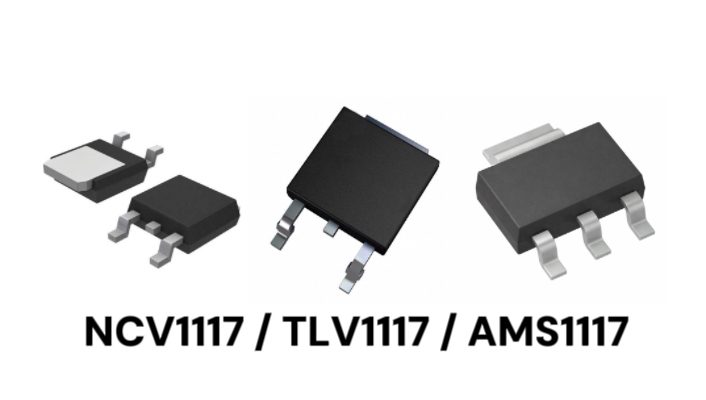
In linear power-supply design, LDOs are widely used to regulate input voltage down to a stable 3.3V rail for MCUs, communication modules, and peripherals. Choosing the right part directly affects reliability, thermal safety, and long-term maintainability.
This guide compares onsemi NCV1117DT33T5G, TI TLV1117-33IKVURG3, and AMS1117-3.3 for practical component selection.
Parameter Comparison
NCV1117DT33T5G | TLV1117-33IKVURG3 | AMS1117-3.3 | |
Maximum Input Voltage (Vin Max) | 20V | 16V | 15V-30V |
Recommended Operating Input | ≤ 15V | ≤ 15V | ≤ 12V |
Output Current Capability | 1A (Typ.) | 0.8A (Max.) | 1A |
Dropout (Typ. @ Iout) | 1.07V @ 800mA | 1.1V @ 800mA | 1.3V @ 1A |
Quiescent Current Iq (Max) | 10mA | 10mA | 10mA |
PSRR (120Hz) | 64dB | 75dB | 70-75dB |
Package / Thermal Platform | TO-252 / DPAK | TO-252 / DPAK | SOT-223 |
Key Advantage | Higher input margin, suited for harsh power environments | Stronger low-frequency ripple rejection | Widely available and cost-effective, but tighter thermal limits |
Note: Values are summarized from typical datasheet presentation. Always confirm the exact datasheet revision before final release.
Application Analysis
NCV1117DT33T5G
Recommended for: automotive and harsh power environments
- Automotive electronics (infotainment, body control, etc.)
- Industrial control boards with surge/transient risk
- Outdoor systems or main 3.3V rails requiring long-term stability
- Why: higher input voltage tolerance (20V) + DPAK thermal capability
TLV1117-33IKVURG3
Recommended for: clean 3.3V rails with <800mA load
- Analog/mixed-signal domains (ADC/DAC rails)
- Ripple-sensitive communication modules
- Stable input supply, moderate load current
- Why: stronger 120Hz PSRR + good industrial consistency
- Extra: often pin-to-pin compatible with NCV1117
AMS1117-3.3
Recommended for: cost-driven consumer designs with low dissipation
- Consumer electronics sub-boards
- Development / evaluation boards
- Low-power local 3.3V nodes
- Limitations: SOT-223 thermal resistance is higher; vendor-to-vendor variation is common, so production projects should validate lot consistency.
Design Considerations
Input voltage misconception
Not all “1117” regulators are suitable for >15V long-term operation.
- NCV1117 provides more headroom (Vin Max 20V)
- Many AMS1117 versions are better kept at ≤12V recommended
Dropout trap (battery use-case)
Do not assume an “LDO” can automatically regulate 3.7V Li-ion → 3.3V.
The 1117 family typically has ~1.1V–1.3V dropout, meaning under load the input often needs to be ≥4.5V to guarantee 3.3V output.
Recommendation: for low headroom designs, use a CMOS LDO (dropout <300mV) or buck-boost.
Thermal reality check
Power dissipation: P ≈ (Vin − Vout) × Iout
SOT-223 designs without proper copper area may hit thermal limits above ~0.8W.
Critical example:
12V → 3.3V @ 1A → 8.7W, which is far beyond what 1117 regulators can handle on typical PCBs.
Recommendation: use a buck converter first (e.g., 12V→5V), then LDO for 3.3V.
Package substitution risk
SOT-223 and TO-252/DPAK are not interchangeable.
Different footprints and significantly different thermal behavior. Using SOT-223 in high-loss positions may cause long-term reliability risks (thermal cycling, solder fatigue).
Replacement & Migration
- TLV1117 → NCV1117: suitable when higher surge tolerance / rugged input rail is required (same DPAK family, typically drop-in).
- AMS1117 → NCV1117 / TLV1117: usually requires PCB redesign (SOT-223 → DPAK), but greatly improves thermal margin.
- NCV1117/AMS1117 (1A) → TLV1117 (0.8A): not recommended if peak current approaches 1A.
Key Takeaways
NCV1117: automotive-grade, high voltage headroom, robust
TLV1117: cleaner output, strong low-frequency PSRR, 0.8A max
AMS1117: lowest cost, widely used, but tight thermal margin and vendor variability
WIN SOURCE supplies a full range of 1117-series LDO regulators, including NCV1117, TLV1117, and AMS1117, covering both active parts and commonly used replacement options. Designers can quickly complete part selection and ordering based on project requirements. Visit WIN SOURCE to check real-time inventory and lead times, ensuring on-time project delivery.
©2026 Win Source Electronics. All rights reserved. This content is protected by copyright and may not be reproduced, distributed, transmitted, cached or otherwise used, except with the prior written permission of Win Source Electronics.

COMMENTS