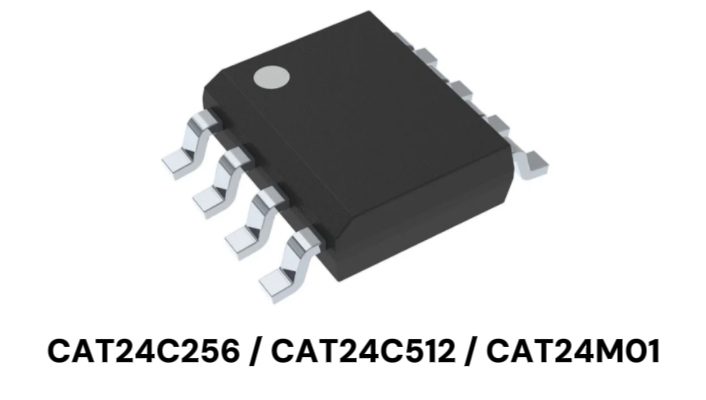
CAT24C256WI-GT3, CAT24C512WI-GT3, and CAT24M01WI-GT3 are onsemi I²C serial EEPROM devices in SOIC-8 JEDEC packages. They are commonly used in embedded systems to store configuration parameters, calibration data, logs, and other small amounts of non-volatile data.
While the three devices share a similar I²C interface, operating voltage range, and basic read/write mechanism, they are not simply interchangeable capacity upgrades. The main differences lie in storage capacity, page write buffer size, maximum number of devices on the same I²C bus, and write current.
Quick Selection Guide
- CAT24C256WI-GT3: Small capacity, cost-effective option
Suitable for device IDs, serial numbers, calibration parameters, user settings, and other data storage needs within 32 KB.
- CAT24C512WI-GT3: Well-balanced mainstream choice
A good fit for most embedded parameter storage, medium-size logs, and configuration table applications. It provides more capacity headroom while maintaining relatively low write current.
- CAT24M01WI-GT3: Higher capacity and higher page-write throughput
Suitable for applications requiring more than 64 KB of storage, such as logs, font tables, lookup tables, waveform data, or configuration snapshots. It offers a larger page write buffer, but also has higher write current and supports up to four devices on a single I²C bus.
Key Parameter Comparison
| Parameter | CAT24C256WI-GT3 | CAT24C512WI-GT3 | CAT24M01WI-GT3 |
| Capacity | 256 Kbit / 32 KB | 512 Kbit / 64 KB | 1 Mbit / 128 KB |
| Page write buffer | 64 B | 128 B | 256 B |
| I²C speed | 100 / 400 / 1000 kHz | 100 / 400 / 1000 kHz | 100 / 400 / 1000 kHz |
| Operating voltage | 1.8 V ~ 5.5 V | 1.8 V ~ 5.5 V | 1.8 V ~ 5.5 V |
| Voltage for 1 MHz operation | 2.5 V ~ 5.5 V | 2.5 V ~ 5.5 V | 2.5 V ~ 5.5 V |
| Max. devices on one bus | 8 (A0/A1/A2) | 8 (A0/A1/A2) | 4 (A1/A2; a16 is encoded in the slave address) |
| Write current, ICCW max | 3 mA | 2.5 mA @ 5.5 V | 5.0 mA @ 5.5 V |
| Write cycle time, tWR max | 5 ms | 5 ms | 5 ms |
| Best suited for | Small parameter storage | General configuration/logs | Large logs/table data |
Application Scenarios
- CAT24C256WI-GT3
CAT24C256WI-GT3 is suitable for small-capacity data storage within 32 KB. It is a cost-effective BOM choice for configuration and parameter storage. Note that the datasheet specifies a single maximum write current value of 3 mA for this device, rather than separate values by VCC.
- Typical applications include:
Device ID, MAC address, and serial number storage
User settings and preference data
Calibration coefficients and factory parameter tables
Status storage for small industrial instruments
Local parameter caching in display modules
- CAT24C512WI-GT3
CAT24C512WI-GT3 provides 64 KB of storage and a 128 B page write buffer, offering a good balance among capacity, power consumption, and bus scalability. For most embedded parameter storage, configuration tables, and medium-size log applications, it is often the most practical default choice.
- Typical applications include:
Main parameter storage in embedded systems
Medium-size log recording
Network device configuration tables
Field parameters for industrial controllers
BMS calibration and historical data
- CAT24M01WI-GT3
CAT24M01WI-GT3 is designed for applications requiring more than 64 KB of storage. Its main advantages are the larger 1 Mbit capacity and 256 B page write buffer, which can improve bulk write efficiency. Two points should be considered during design: its write current is about twice that of CAT24C512, and the maximum number of devices on a single I²C bus is reduced to four.
- Typical applications include:
Embedded logs and event records
Display font tables or dictionary data
Waveform acquisition and buffering
Configuration snapshots and parameter backups
Field-programmable parameter sets
If a design requires five or more EEPROM devices of the same type on one board, upgrading from 512 Kbit to 1 Mbit requires a reassessment of the I²C bus topology. An I²C multiplexer may be needed.
Key Design Trade-Offs
- Estimate the actual data size first
EEPROM capacity is not a case of “the larger, the better.” A better approach is to estimate the amount of data that must be stored over the product life cycle, then reserve around 30% to 50% additional capacity.
For device information and a small number of parameters, 32 KB is often enough. For logs, configuration tables, or parameter version backups, 64 KB provides more flexibility. For long-term logs, font tables, lookup tables, or configuration images, 128 KB is more appropriate.
- Page write buffer size affects bulk write efficiency
The page write buffer sizes of the three devices are 64 B, 128 B, and 256 B, while the maximum tWR is 5 ms for all three. Assuming page-aligned full-page writes and considering only the internal write cycle time, writing 1 KB of data requires approximately:
CAT24C256: 16 page writes, about 80 ms
CAT24C512: 8 page writes, about 40 ms
CAT24M01: 4 page writes, about 20 ms
For log storage or large parameter updates, a higher-capacity device not only provides more space but can also reduce the number of page write operations.
- CAT24M01 is not just a capacity upgrade
CAT24C256 and CAT24C512 use three external address pins, A0/A1/A2, allowing up to eight devices on the same I²C bus. CAT24M01 uses only A1/A2 for device addressing, so up to four devices can be connected on the same bus.
If the system already uses multiple EEPROM devices in parallel, upgrading to 1 Mbit requires checking the I²C address plan and driver logic.
- Write current matters in battery-powered designs
Using VCC = 5.5 V and tWR = 5 ms, the upper-bound estimate of the energy used during one internal page-write cycle is approximately:
CAT24C256: 3 mA × 5.5 V × 5 ms = 82.5 µJ
CAT24C512: 2.5 mA × 5.5 V × 5 ms = 68.75 µJ
CAT24M01: 5.0 mA × 5.5 V × 5 ms = 137.5 µJ
For battery-powered devices, low-power IoT products, or high-frequency logging applications, if 64 KB is sufficient, CAT24C512WI-GT3 is usually easier to manage from a write-energy perspective than CAT24M01WI-GT3.
- 1 MHz I²C requires VCC ≥ 2.5 V
All three devices support 1 MHz Fast-Plus I²C, but this mode applies when VCC is between 2.5 V and 5.5 V. If the system uses a 1.8 V supply, the design should use 100 kHz or 400 kHz operation.
- Use 4-byte alignment for frequent writes
All three devices include on-chip ECC. According to the onsemi datasheet, ECC operates on 4-byte units. For counters, circular logs, and wear-leveling designs, application data should be organized on 4-byte boundaries whenever possible to avoid frequent updates to a single byte.
When to Consider Other EEPROM Options
If higher serial bus transfer speed is required, SPI EEPROM can be considered. For example, onsemi CAT25M01 supports 10 MHz SPI, but its internal write cycle, page write mechanism, and endurance should still be checked against the corresponding datasheet.
If the project requires AEC-Q100 qualification, consider CAV24C256, CAV24C512, or CAV24M01 instead. Voltage range, temperature range, package options, and electrical characteristics should be checked against the CAV-series datasheets rather than directly reusing the industrial CAT24-series specifications.
If the application requires −40 °C to +125 °C operation, UDFN/TSSOP packages, or capacities below 256 Kbit, the exact ordering part number should be verified against the datasheet and ordering information.
Product Summary
| Part Number | Manufacturer | Key Features | Buy Now |
| CAT24C256WI-GT3 | onsemi | 256 Kbit, 64 B page write, cost-effective | Buy Now |
| CAT24C512WI-GT3 | onsemi | 512 Kbit, 128 B page write, low write current | Buy Now |
| CAT24M01WI-GT3 | onsemi | 1 Mbit, 256 B page write, high capacity | Buy Now |
WIN SOURCE offers a wide range of onsemi I²C/SPI serial EEPROM products for non-volatile data storage in industrial control, consumer electronics, communication modules, information equipment, and other embedded system applications. Visit WIN SOURCE to check real-time inventory and availability for CAT24C256WI-GT3, CAT24C512WI-GT3, and CAT24M01WI-GT3.
©2026 Win Source Electronics. All rights reserved. This content is protected by copyright and may not be reproduced, distributed, transmitted, cached or otherwise used, except with the prior written permission of Win Source Electronics.