
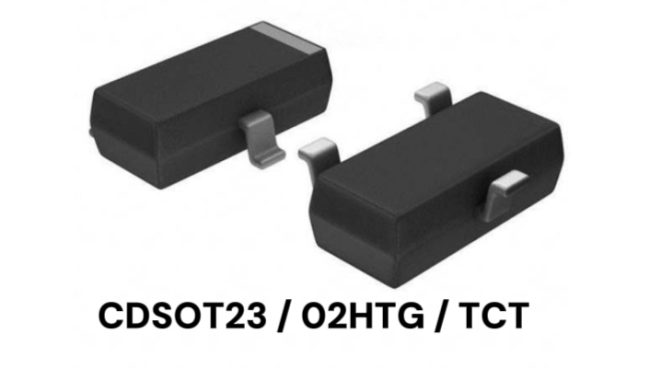
For RS-485 interface protection, industrial communication nodes, fieldbus equipment, and other differential bus designs, SM712-series TVS diodes are widely used to absorb ESD and surge transients and help protect downstream transceivers from damage.
CDSOT23-SM712, SM712-02HTG, and SM712.TCT are all bidirectional dual-line TVS diodes in the SOT-23-3 package, making them suitable for differential bus protection. Their main differences lie in clamping performance, surge handling capability, operating temperature range, and target application focus.
This guide compares these three devices in terms of key electrical characteristics and application positioning to help engineers make faster and more confident selection decisions.
Parameter Comparison
| CDSOT23-SM712 | SM712-02HTG | SM712.TCT | |
| Reverse Stand-off Voltage | 12V / 7V | 12V / 7V | 12V / 7V |
| Maximum Clamping Voltage | 26V / 14V | 31V / 19V | 26V / 12V |
| Peak Pulse Current | 17A | 19A | 17A |
| Peak Pulse Power | 400W | 600W | 400W |
| Typical Capacitance | ~75pF | ~75pF | ~75pF |
| Operating Temperature Range | -55°C to +150°C | -40°C to +125°C | -55°C to +125°C |
| Typical Application Positioning | Industrial RS-485 | Automotive / high-surge environments | General RS-485 |
Application Analysis
- CDSOT23-SM712
CDSOT23-SM712 is well suited for industrial RS-485 protection designs. Its key strengths are broader thermal margin and balanced clamping performance. In applications with elevated ambient temperatures, continuous operation, or high PCB thermal density, it is a strong choice.
- Typical applications include:
Industrial control communication interfaces
RS-485 nodes used in high-temperature environments
Fieldbus equipment requiring long-term stability
- SM712-02HTG
SM712-02HTG is better suited for harsh surge environments and automotive-related applications. Its main advantage is stronger surge handling capability rather than lower clamping voltage. For designs exposed to higher surge levels, severe external interference, or stricter qualification requirements, this device offers a clear advantage.
- Typical applications include:
Automotive communication interfaces
Industrial equipment exposed to heavy surge conditions
Board-level protection designs requiring automotive-grade qualification
- SM712.TCT
SM712.TCT is designed for general-purpose RS-485 interface protection. Its main advantage is lower clamping voltage combined with a clear application focus. For standard industrial control systems, building automation, and general communication nodes, it is a practical and efficient option.
- Typical applications include:
Standard RS-485 interface protection
General industrial communication boards
Building automation and security bus equipment
Design Considerations
- Do not assume they are drop-in replacements
Although these three devices share similar working voltages and the same package, they should not automatically be treated as direct replacements for one another.
When selecting an alternative, engineers should first compare clamping voltage and then confirm that it remains within the downstream transceiver’s absolute maximum ratings.
- If lower clamping voltage is the priority, SM712.TCT is a strong option.
- If higher thermal capability is also required, CDSOT23-SM712 should be prioritized.
- If the system has more voltage margin and stronger surge capability is needed, SM712-02HTG is also worth considering.
- Higher power capability is not always better
In TVS diode selection, clamping voltage and peak pulse power must usually be balanced.
A lower clamping voltage can provide tighter protection for downstream ICs, while higher peak pulse power allows the device to withstand stronger surge events. As a result, the highest-power option is not automatically the best choice for every design.
- If the downstream device is more voltage-sensitive, prioritize clamping performance.
- If the external surge environment is more severe, prioritize surge handling capability.
- Pay close attention to temperature range in high-temperature designs
If the equipment is expected to operate for long periods in high-temperature environments, or if heat sources are concentrated on the PCB, operating temperature range should not be overlooked.
In these cases, thermal margin has a direct impact on long-term reliability. For industrial control systems, enclosed modules, and outdoor equipment, CDSOT23-SM712 deserves close consideration.
- In standard RS-485 designs, overall balance matters most
Many standard RS-485 projects do not require the highest available surge rating. In practice, the most important factor is often the balance among clamping performance, surge capability, and application fit.
- For general-purpose projects, SM712.TCT is often the most balanced choice.
- When additional thermal margin is required, CDSOT23-SM712 may be the better fit.
Product Summary
| Part Number | Manufacturer | Key Takeaway | Buy |
| CDSOT23-SM712 | Bourns | Greater thermal margin; well suited for industrial-grade RS-485 protection | Buy Now |
| SM712-02HTG | Littelfuse | Higher surge handling capability; ideal for automotive and heavy-protection environments | Buy Now |
| SM712.TCT | Semtech | Lower clamping voltage; well suited for general RS-485 interface protection | Buy Now |
WIN SOURCE offers SM712-series TVS diodes from leading brands including Bourns, Littelfuse, and Semtech, such as CDSOT23-SM712, SM712-02HTG, and SM712.TCT. By comparing protection level, clamping performance, and application environment, engineers can select the most suitable device for their design requirements. Visit WIN SOURCE to check current availability and lead times for your next project.
©2026 Win Source Electronics. All rights reserved. This content is protected by copyright and may not be reproduced, distributed, transmitted, cached or otherwise used, except with the prior written permission of Win Source Electronics.

COMMENTS