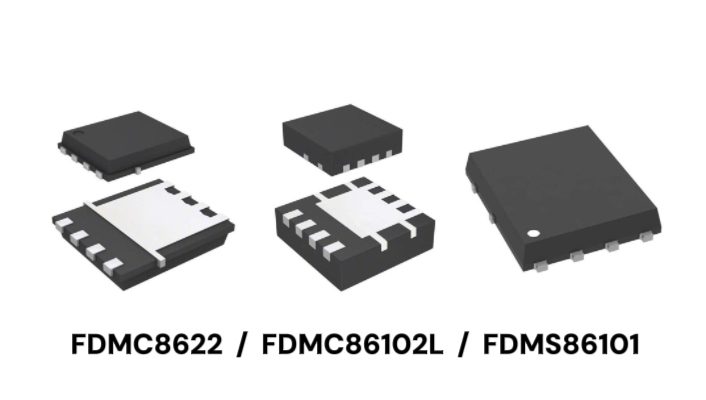
In 100 V power switching, motor drives, DC-DC power supplies, industrial load control, and synchronous rectification, MOSFET selection should not be based on a single parameter alone. On-resistance, gate charge, gate-drive requirements, package thermal capability, and actual current-handling performance all have a direct impact on system efficiency, thermal margin, and long-term reliability.
The onsemi FDMC8622, FDMC86102L, and FDMS86101 are all 100 V N-channel devices from the PowerTrench® family, but each is optimized with a different design focus in terms of conduction loss, drive complexity, and package capability. This guide compares the three devices from three perspectives—key parameters, typical applications, and design considerations—to help narrow down the right choice more efficiently during early-stage design evaluation.
Parameter Comparison
| Key Parameter | FDMC8622 | FDMC86102L | FDMS86101 |
| Type | N-Channel | N-Channel | N-Channel |
| Drain-Source Voltage, VDSS | 100 V | 100 V | 100 V |
| Continuous Drain Current, ID @ 25°C | 4 A (TA), 16 A (TC) | 7 A (TA), 18 A (TC) | 12.4 A (TA), 60 A (TC) |
| Gate Drive Voltage | 6 V, 10 V | 4.5 V, 10 V | 6 V, 10 V |
| Max RDS(on) @ ID, VGS | 56 mΩ @ 4 A, 10 V | 23 mΩ @ 7 A, 10 V | 8 mΩ @ 13 A, 10 V |
| Max VGS(th) @ ID | 4 V @ 250 µA | 3 V @ 250 µA | 4 V @ 250 µA |
| Max Gate Charge, Qg @ 10 V | 7.3 nC | 22 nC | 55 nC |
| Max Input Capacitance, Ciss @ 50 V | 402 pF | 1330 pF | 3000 pF |
| Max Power Dissipation | 2.5 W (TA), 31 W (TC) | 2.3 W (TA), 41 W (TC) | 2.5 W (TA), 104 W (TC) |
| Package | 8-MLP (3.3 × 3.3 mm) | 8-MLP (3.3 × 3.3 mm) | 8-PQFN (5 × 6 mm) |
Application Analysis
- FDMC8622
The main strengths of the FDMC8622 are its low gate charge and small input capacitance, which reduce the burden on the gate driver. In high-frequency switching designs or systems with limited drive capability, this type of device is often better suited for controlling dynamic loss and improving switching transitions.
Its limitations are equally clear. Because its RDS(on) is relatively high, conduction loss becomes more significant at higher load currents. As a result, the FDMC8622 is better suited for low-to-medium current nodes, high-frequency switching stages, or auxiliary power paths, rather than as the preferred choice for heavily loaded main power stages.
- Best-fit applications:
Low-to-medium current switching
High-frequency switching nodes
Auxiliary power stages
Compact designs with limited gate-drive capability
- FDMC86102L
A key advantage of the FDMC86102L is its support for 4.5 V gate drive, making it well suited to 5 V drive platforms and logic-level control environments. This is particularly valuable in systems using MCUs, low-voltage gate drivers, or otherwise constrained drive rails.
From an overall design perspective, the FDMC86102L offers a strong balance among on-resistance, gate charge, and package size. Its conduction loss is clearly lower than that of the FDMC8622, while its drive requirements remain less demanding than those of the FDMS86101. For applications where board space is limited, load current is moderate, and both efficiency and implementation complexity matter, the FDMC86102L is often the most balanced choice.
- Best-fit applications:
100 V industrial control switching
5 V gate-drive platforms
Medium-load power supplies
General-purpose designs requiring a balance of size, efficiency, and drive complexity
- FDMS86101
The FDMS86101 features lower RDS(on), higher current capability, and a larger package, giving it a clear advantage in high-current applications where minimizing conduction loss is a priority. It is typically better suited to main power switching stages, high-power DC-DC converters, and heavy-duty industrial power supplies, where lower conduction loss and greater thermal margin are especially important.
At the same time, its significantly higher Qg and Ciss place greater demands on the gate-drive circuit. If the driver is not strong enough, switching transitions may slow down, increasing dynamic loss and reducing the efficiency benefit gained from the lower RDS(on). For this reason, the FDMS86101 is best used in platforms with stronger gate-drive capability, better layout execution, and more robust thermal design.
- Best-fit applications:
High-current main switching stages
High-power DC-DC converters
Industrial power supplies where low conduction loss is the priority
Heavy-load applications requiring higher current capability and greater thermal headroom
Design Considerations
- Evaluate conduction loss and switching loss together
RDS(on) alone should not be used as the sole selection criterion. When load current is high and conduction time is long, conduction loss has a larger impact on system efficiency. In higher-frequency designs, however, gate charge, input capacitance, gate-drive current capability, and actual switching waveforms also play a major role in total loss.
A lower RDS(on) does not automatically guarantee better overall efficiency. In high-frequency or drive-limited applications, a lower-Qg device often delivers better system-level performance. In lower-frequency, high-current applications, a device with lower conduction resistance is usually more advantageous. Selection should therefore be based on the actual operating point, not on isolated comparison of a single parameter.
- Confirm gate-drive compatibility upfront
Although all three devices are 100 V N-channel MOSFETs, they are not equally suited to the same gate-drive conditions. The FDMC86102L supports 4.5 V / 10 V drive platforms, while the FDMC8622 and FDMS86101 are more oriented toward 6 V / 10 V drive conditions.
Using a device that is better suited to 6 V / 10 V drive in a 5 V gate-drive system may prevent it from being fully enhanced. In practice, this can lead to a much higher effective RDS(on) than the datasheet value suggests, resulting in additional heat and lower efficiency. Also note that VGS(th) only indicates the threshold at which the device begins to turn on; it does not mean the MOSFET is fully enhanced at the target current. Drive suitability should instead be judged primarily by the specified RDS(on) at the relevant VGS, together with load current and thermal performance.
- Package choice affects both thermal path and current capability
In the onsemi / Fairchild naming system, the FDMC series typically uses the 3.3 × 3.3 mm Power33 package, while the FDMS series typically uses the 5 × 6 mm Power56 package. A larger package generally offers better heat spreading and greater current-handling potential, although actual thermal performance still depends heavily on PCB copper area, copper thickness, via design, and overall cooling conditions. In other words, package selection affects not only board space, but also real board-level thermal resistance and operating margin.
In space-constrained, low-to-mid-power applications, smaller packages are often preferable. In applications where high current and thermal capability are key priorities, larger packages are usually the better fit.
- Correctly interpret current ratings under TA and TC conditions
Datasheets usually specify continuous drain current under both TA (ambient temperature) and TC (case temperature) conditions. In practice, the TA rating is generally closer to what designers should reference for real board-level applications. These current ratings are typically derived under specific test-board, copper-thickness, and thermal conditions. If the actual PCB has limited copper area, restricted heat-spreading paths, or a higher ambient temperature, the usable current capability may fall well below the datasheet value. Therefore, the TC-based current rating should not be treated as the actual available current in end equipment; it should always be validated against junction temperature, thermal resistance, and real power dissipation.
Product Summary
| Part Number | Manufacturer | Key Takeaway | Purchase |
| FDMC8622 | onsemi | Low Qg and compact package; suitable for high-frequency designs and applications with limited gate-drive capability | Buy Now |
| FDMC86102L | onsemi | 4.5 V / 10 V drive support; ideal for logic-level platforms and balanced design trade-offs | Buy Now |
| FDMS86101 | onsemi | Low on-resistance and larger package; suitable for high-current main power stages | Buy Now |
WIN SOURCE offers in-stock availability across the onsemi power MOSFET portfolio, including mainstream parts such as FDMC8622, FDMC86102L, and FDMS86101. Engineers can use system gate-drive conditions, conduction-loss targets, and package thermal requirements to complete device selection more efficiently. Visit WIN SOURCE to check real-time inventory and lead-time information, helping shorten procurement cycles and accelerate project execution.
©2026 Win Source Electronics. All rights reserved. This content is protected by copyright and may not be reproduced, distributed, transmitted, cached or otherwise used, except with the prior written permission of Win Source Electronics.