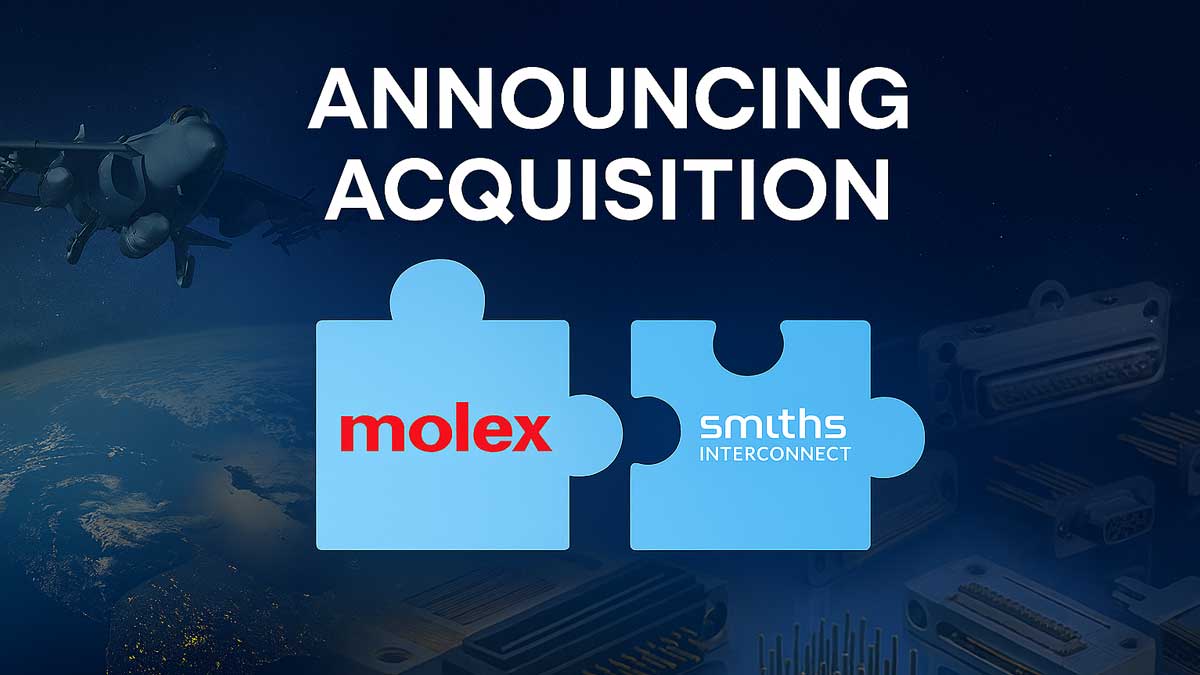
*Image from the internet; all rights belong to the original author, for reference only.
What Does Molex’s Acquisition of Smiths Interconnect Really Mean?
In April 2026, Molex officially completed its acquisition of Smiths Interconnect. The deal was first announced in 2025 and represents one of the most structurally significant transactions in the connector industry in recent years.
Smiths Interconnect has long specialized in RF components, high-reliability interconnects, and semiconductor test interfaces. Molex, on the other hand, has built strong capabilities in data communications and industrial connectivity.
This combination is widely seen as a strategic move toward high-frequency, high-reliability, and system-level interconnect capabilities.
Q1: Why Did Molex Acquire Smiths Interconnect?
The goal is not simply scale expansion—it is capability expansion.
Molex’s portfolio has traditionally focused on:
- High-speed board-to-board connectors (e.g., Molex 204220-0001)
- Data center interconnect platforms (such as the Impel and Mirror Mezz series)
Smiths Interconnect brings complementary strengths in:
- RF connectivity (e.g., SMP / SMPM coaxial connectors)
- Semiconductor test interfaces (test sockets, spring probes)
- Aerospace-grade and custom high-reliability interconnects
In essence, this acquisition marks a shift:
from supplying connectors to delivering integrated capabilities across interconnect, RF, and test.
Q2: What Does This Mean for High-Speed and High-Frequency Applications?
In modern systems—especially AI servers and high-speed networking—connectors are no longer passive components. They are performance-limiting elements.
Consider current high-speed architectures:
- 224G PAM4 backplane systems
- QSFP-DD and OSFP interfaces
Key constraints now include:
- Insertion loss
- Return loss
- Crosstalk and channel consistency
Smiths Interconnect’s expertise in microwave and RF connectivity (such as SMPM solutions) strengthens Molex’s position in millimeter-wave and ultra-high-frequency environments.
This is directly relevant to:
- AI training infrastructure and switching systems
- 5G / 6G RF front ends
- Radar and satellite communication platforms
The key shift:
connectors are no longer just channels—they are performance bottlenecks.
Q3: How Does This Affect Semiconductor Testing?
This is one of the most structurally important aspects of the acquisition.
Smiths Interconnect provides critical test interface products, including:
- High-frequency test sockets
- Spring probe contacts
- Burn-in test interconnect systems
This extends Molex’s reach from:
- Board-level interconnect
into:
the test interface layer at the chip level.
With the rise of chiplets and advanced packaging:
- Test density is increasing
- High-frequency test requirements are growing
- Contact reliability is becoming a yield-critical factor
This shift will influence how test equipment manufacturers and OSATs approach interface design and selection.
Q4: What Are the Implications for Procurement and Supply Chain Strategy?
The impact is structural rather than short-term pricing.
1. Increased Concentration in High-End Segments
High-performance products such as:
- RF connectors (SMP / SMPM)
- High-speed backplane connectors
will become more concentrated among leading players like Molex, TE Connectivity, and Amphenol.
2. Product Line Consolidation and Potential Obsolescence
Post-acquisition integration often leads to:
- Gradual phase-out of legacy part numbers
- Migration toward unified platform products
This will particularly affect OEMs and EMS providers with designs already in production.
3. Rising Risk Around EOL and Long-Tail Components
For:
- Legacy connectors
- Semi-custom designs
- Long-lifecycle industrial systems
supply continuity risks may increase.
This reinforces the role of:
independent distribution and spot sourcing in maintaining production continuity.
Q5: How Will Engineering Design and Component Selection Change?
The shift is from component-level decisions to system-level decisions.
1. Longer Design-In Lock Cycles
As interconnect and test interfaces become more tightly coupled:
- Replacement becomes more difficult
- Requalification costs increase
This makes second-source strategies more critical.
2. Greater Adoption of Platform-Based Architectures
Examples include:
- High-speed backplane platforms (Impel, Mirror Mezz)
- Hybrid RF + high-speed interconnect solutions
Benefits include:
- Improved design reuse
- Better system-level consistency
However, this also means:
greater dependency on a single ecosystem.
Q6: Does This Signal a New Phase for the Connector Industry?
Yes—this is a clear signal of structural change.
The industry is shifting:
From:
- Standardized components
- Cost-driven competition
To:
- High-speed and high-frequency driven design
- High-reliability applications
- System-level interconnect competition
Key product categories impacted include:
- High-speed backplane connectors (224G and beyond)
- RF coaxial connectors (SMP / SMPM)
- Test sockets and probe systems
- Aerospace-grade interconnects
Conclusion
The significance of this acquisition lies not in its size, but in its direction.
It highlights a broader shift:
interconnects are no longer peripheral components—they are critical layers that define signal integrity, test efficiency, and system reliability.
For both engineers and procurement teams, the question is no longer:
“Which part number should we choose?”
But rather:
“Which interconnect ecosystem are we designing into?”
© 2026 Win Source Electronics. All rights reserved. This content is protected by copyright and may not be reproduced, distributed, transmitted, cached or otherwise used, except with the prior written permission of Win Source Electronics.