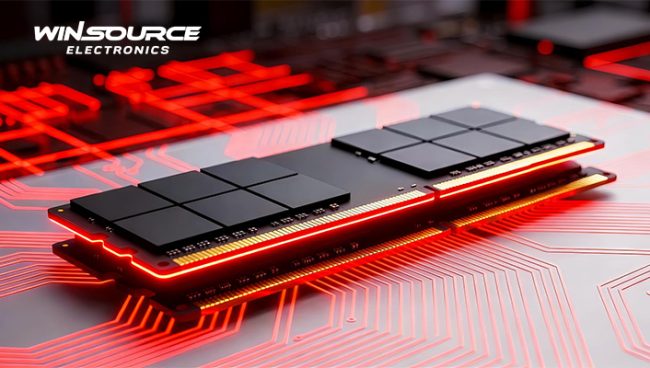
Modern systems—from embedded controllers to AI clusters—depend on reliable memory and storage to perform consistently under all conditions. This guide explains how to source trustworthy memory modules and storage components, from defining performance requirements to qualifying vendors and planning lifecycle maintenance. It’s particularly useful for purchasing professionals, engineers, and IT managers seeking reliable, compliant, and traceable solutions backed by verified suppliers.
Define Device Role and Workload Requirements
Before sourcing, define the specific purpose and operational stresses of your target application. Selecting a module or storage drive that truly meets the real-world workload is the cornerstone of system reliability.
Memory and storage roles vary widely:
- Boot or read-intensive systems use fast SSDs to host operating systems and application startup data.
- Write-intensive environments like data logging or video capture need high-endurance NAND or industrial SSDs.
- Archival storage benefits from magnetic or tape solutions capable of long-term data retention.
Consider worst-case conditions—24/7 operation, high temperatures, or erratic write patterns—when evaluating specifications. A key endurance metric such as Total Bytes Written (TBW) shows how much data can be stored before wear-out. Drive Writes Per Day (DWPD) expresses how many full drive writes are guaranteed each day over the warranty period. Align both metrics with your actual workload, not idealized test conditions.
Verify Platform Compatibility and Vendor Qualification
Sourcing reliability starts with compatibility and validated partners. Even the best hardware will fail prematurely if mismatched with system architecture or purchased from unqualified suppliers.
Match specifications closely: DDR generation (e.g., DDR4, DDR5), form factor (SO-DIMM, DIMM, or LPCAMM2), and officially verified platform support. Vendor qualification—the controlled process of testing memory modules on real chipsets and performing burn-in verification—protects against early-life failures.
When evaluating vendors, ask:
Compatibility & Qualification Checklist | Considerations |
Has the module been tested on your specific board or platform? | Prevents BIOS or timing errors |
Does the supplier provide a burn-in certificate or QA record? | Confirms screening quality |
Are environmental and thermal tests included? | Validates performance under stress |
Are traceable lot codes and RoHS/REACH compliance available? | Ensures regulatory consistency |
Working with qualified distributors such as WIN SOURCE, which maintains ISO/AS-certified processes and an audited supplier network, helps ensure component authenticity and traceability across every stage of the supply chain.
Validate Endurance and Reliability Specifications
Endurance metrics must be interpreted in the context of your planned workload and environment. Don’t rely solely on nominal datasheet numbers—ask for workload-aligned values and supporting test data.
Key measures include:
- TBW/DWPD: Quantify actual write capacity relative to expected daily operations.
- MTBF (Mean Time Between Failures): The statistically predicted average operational time between device failures under specified conditions.
- Data retention: The guaranteed duration data remains readable when the drive is idle or powered off.
- Firmware and failure-analysis support: Proof that the vendor can replicate and resolve field failures through laboratory verification.
Be cautious of unrealistic endurance claims based on ideal test conditions or low Write Amplification assumptions. Industrial- or server-grade products should include clear validation documentation. WIN SOURCE ensures all procured memory and storage devices undergo compliance verification for these performance criteria.
Design Lifecycle Planning and Media Maintenance
Every component should fit into a defined maintenance lifecycle. Plan replacements before failure signals emerge to protect uptime and data integrity.
Establish a replacement cycle using MTBF and MTTR (Mean Time to Repair, the time required to restore a device to operation). Include periodic integrity checks for less frequently accessed archives—at least once a year—and maintain redundant data copies for 30 days post-deployment. Use asset tracking to monitor drive age and trigger timely replacements before warranty expiration.
Maintenance Process | Recommended Interval |
Integrity verification | Annually (or semi-annually for active datasets) |
Redundant copy retention | 30 days minimum after deployment |
Device age/replacement tracking | Replace at 80–90% of rated service life |
WIN SOURCE supports lifecycle management with data-driven sourcing insights and component traceability tools to help teams predict replacement needs with confidence.
Evaluate Alternate Sourcing Options with Risk Controls
During shortages or product phase-outs, secondary sourcing of refurbished or pulled memory can sustain operations—if tightly controlled.
Refurbished memory is reprocessed and retested to match OEM standards. Pulled memory originates from functioning systems and may suit legacy applications. In both cases, verify authenticity through:
- Lot-level traceability and serial inspection.
- Documentation aligned with AS6081 or AS6496 counterfeit-avoidance standards.
- Independent test reports confirming electrical and parametric performance.
- Packaging inspection to avoid ESD or transportation-induced failures.
A disciplined qualification checklist ensures these alternates uphold operational safety and compliance. Partnering with a trusted distributor like WIN SOURCE provides additional assurance through formal counterfeit-prevention and certification frameworks.
Select Memory and Storage Solutions for AI Applications
AI systems require a unique balance between speed, persistence, and scalability. Memory and storage choices directly impact inference responsiveness and training throughput.
In-memory structures such as Redis enable sub-millisecond data access, while vector or document memory frameworks—like Mem0, Zep, or LlamaIndex—preserve context and semantic reasoning. In-memory storage holds data in RAM for immediate retrieval; persistent stores log contextual associations on disk or SSD for recall.
AI Memory Approach | Core Use | Trade-Offs |
Redis / Memcached | High-speed transient access | High cost, volatile |
Mem0 / Zep | Moderate latency, persistent | Contextual memory for AI agents |
LangChain / LlamaIndex | Long-term vector storage | Requires larger capacity, more management |
For any framework, consider privacy, observability, and compliance when connecting memory frameworks to enterprise or cloud environments. WIN SOURCE provides reliable component options to support AI data workloads with stable supply and traceable certification.
Implement Monitoring and Observability Tools
Visibility is the ongoing safeguard of reliability. Integrate monitoring tools at purchase and deployment stages to maintain health awareness across storage assets.
Observability—the ability to understand a system’s internal state through metrics, logs, and traces—helps identify degradation early. Monitor key indicators such as:
- Error or reallocation rates
- Latency and throughput patterns
- Remaining expected lifetime (SMART data)
- Health and temperature alerts
Solutions such as SolarWinds Storage Resource Monitor or other enterprise-grade tools integrate seamlessly with supplier dashboards. Distributors like WIN SOURCE assist teams in aligning these monitoring solutions with certified component data for unified asset management and risk oversight.
Frequently Asked Questions
How do I determine if my system supports memory upgrades?
Check your system’s specifications or use vendor-provided tools to confirm slot type, generation, and supported capacity. WIN SOURCE’s technical support team can help verify compatibility before purchase.
What specifications are critical for reliable memory and storage sourcing?
Align endurance metrics such as TBW and DWPD with workload conditions, and choose fully qualified modules from audited suppliers like WIN SOURCE.
How can I avoid common mistakes when purchasing memory modules?
Verify generation, form factor, and authenticity documentation, and source only from certified distributors such as WIN SOURCE.
When should I consider refurbished or pulled-stock memory?
Use these only during supply constraints or to maintain legacy systems, ensuring complete traceability and independent testing through trusted channels like WIN SOURCE.
What practices ensure data integrity and media longevity?
Maintain redundant data copies, schedule periodic integrity checks, and replace drives based on verified MTBF and MTTR guidance. WIN SOURCE’s data and lifecycle management insights support these best practices.
References & Links
WIN SOURCE Memory Modules
WIN SOURCE IT Infrastructure Memory
WIN SOURCE Memory Cards
These WIN SOURCE resources provide a verified supply of memory modules from trusted manufacturers, backed by stringent quality control and certification for reliable, long-term sourcing.
© 2026 Win Source Electronics. All rights reserved. This content is protected by copyright and may not be reproduced, distributed, transmitted, cached or otherwise used, except with the prior written permission of Win Source Electronics.