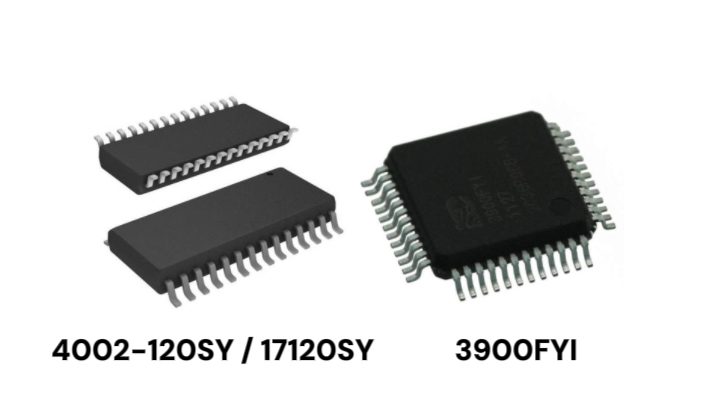
In applications such as voice prompt systems, audio record/playback terminals, industrial alarm devices, and portable voice modules, selecting a voice IC should not be based on recording duration alone. Storage architecture, control method, supply voltage range, temperature rating, package constraints, and the system’s dependence on an MCU, external memory, or digital audio interfaces all have a direct impact on solution complexity, development time, and future scalability.
Using Nuvoton ChipCorder® products as examples, the ISD4002-120SY, ISD17120SY, and ISD3900FYI can all be used for voice recording and playback, but they are positioned quite differently. The first two are single-chip voice solutions, while the ISD3900FYI is an upgraded platform designed for long-duration audio and digital audio expansion. For that reason, comparing them only by “maximum recording time” often fails to reflect their true system-level fit.
Parameter Comparison
| ISD4002-120SY | ISD17120SY | ISD3900FYI | |
| Solution Type | Single-chip voice record/playback | Single-chip multi-segment voice record/playback | Dual-chip voice platform |
| Memory Architecture | On-chip Flash | On-chip Flash | External Winbond 25X/25Q SPI Flash |
| Record/Playback Duration | 120 s | 80–240 s | 0–64 min |
| Sampling Rate | 8.0 kHz | Adjustable, 4–12 kHz | Supports I2S input at 32/44.1/48 kHz; up to about 64 min at 8 kHz / 4-bit ADPCM |
| Control Interface | SPI / Microwire | Standalone / SPI | SPI / I2S |
| Supply Voltage | 2.7 V–3.3 V | 2.4 V–5.5 V | 2.7 V–3.6 V |
| Package | 28-lead SOIC | SOP-28 | LQFP-48 |
| Operating Temperature | 0°C to 70°C | 0°C to 70°C | -40°C to 85°C |
| Typical Positioning | Traditional short-message MCU-controlled solution | Highly integrated single-chip voice solution | Long-duration and expandable voice platform |
Application Analysis
- ISD4002-120SY
The ISD4002-120SY is a classic single-chip device for short-duration voice record/playback applications. It uses on-chip Flash storage and is controlled through SPI or Microwire, making it well suited to fixed voice prompt playback and short-message management in 3 V systems. For projects that already have an MCU-based control framework, require relatively short voice content, and have a fairly fixed system structure, this type of device offers the advantages of a mature solution path and straightforward implementation.
- Best-fit applications:
Short voice prompts
3 V MCU-controlled systems
Record/playback modules with relatively fixed architectures
Platform continuity for existing ISD4002-based designs
- ISD17120SY
The ISD17120SY also follows the single-chip, on-chip Flash approach, but offers higher integration and greater flexibility. According to the official specifications, this series supports both Standalone and SPI modes, operates across a 2.4 V to 5.5 V supply range, and integrates features such as message management, AGC, a PWM Class-D speaker driver, and analog output. For products that aim to reduce MCU involvement without introducing external Flash, this device is easier to build into a complete standalone solution.
- Best-fit applications:
Standalone key-triggered voice prompt terminals
2.4 V to 5.5 V power platforms
Voice products requiring on-chip message management
Designs seeking a balance between single-chip simplicity and functional completeness
- ISD3900FYI
The ISD3900FYI is more suitable as an upgrade path. It adopts a dual-chip architecture with external Winbond 25X/25Q SPI Flash, supports SPI and I2S digital audio interfaces, and offers stronger voice resource management and expansion capability. Compared with conventional single-chip short-duration voice solutions, its core value lies in its significantly higher performance ceiling.
- Best-fit applications:
Long-duration voice playback systems
Platforms requiring SPI or I2S digital audio interfaces
Projects involving multi-segment voice resource management
Equipment requiring industrial temperature ratings or greater system scalability
Design Considerations
- Define the functional boundary before comparing duration
The first step in voice IC selection is to determine whether the project is a fixed-function voice application or a scalable voice platform. If the system only handles prompt tones, alarm playback, or basic recording/playback, the focus is usually on structural simplicity and direct implementation. If the project involves multi-segment voice management, content expansion, or future upgrades, then platform capability and scalability should take priority.
- Architecture choice directly affects implementation difficulty
Single-chip solutions are generally better suited to projects with clearly defined functions, tight development schedules, and a need for fast integration. Expandable platforms offer more capability, but they also introduce higher hardware and software integration costs. In practice, the key question is whether the project prioritizes rapid deployment or long-term scalability.
- The control method defines system-level task allocation
The control method affects more than just interface design; it also determines which part of the system takes the lead in managing voice functions. Some solutions rely more heavily on the MCU to manage recording, addressing, and playback, while others emphasize device-level autonomy to reduce the burden on the host controller. In resource-constrained designs, higher device integration is often more valuable. In systems with an established control platform, a more flexible architecture may be the better fit.
- Selection decisions should be made in the context of the actual application
Whether a device is the right choice ultimately depends on the product in which it is used. For terminals with clearly defined functions and relatively stable operating environments, simplicity of implementation and cost control are usually the main priorities. For projects with more complex power conditions, stricter environmental requirements, or a need for platform reuse, system margin and scalability should be given greater weight.
Product Summary
| Part Number | Solution Positioning | Key Takeaway | Purchase |
| ISD4002-120SY | Baseline traditional single-chip solution | Short-duration voice, single-chip, ideal for continuity with legacy designs | Buy Now |
| ISD17120SY | Enhanced single-chip solution in the same class | Higher integration, better suited to more flexible single-chip designs | Buy Now |
| ISD3900FYI | Upgraded expandable solution | Designed as an upgrade path for long-duration audio and scalable voice platforms | Buy Now |
WIN SOURCE offers in-stock availability across a wide range of voice record/playback ICs, including widely used devices such as ISD4002-120SY, ISD17120SY, and ISD3900FYI. Engineers can evaluate recording duration, control interface, memory architecture, and thermal or power-supply requirements more efficiently to complete device selection with greater confidence. Visit WIN SOURCE to check real-time inventory and lead-time information, helping shorten sourcing cycles and accelerate project development.
©2026 Win Source Electronics. All rights reserved. This content is protected by copyright and may not be reproduced, distributed, transmitted, cached or otherwise used, except with the prior written permission of Win Source Electronics.