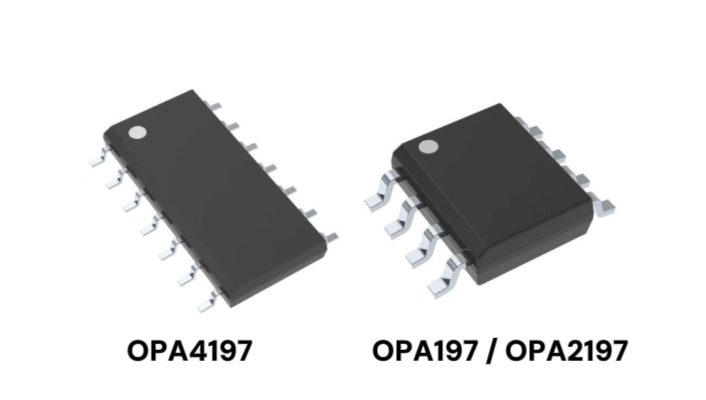
The OPA4197IDR, OPA2197IDR, and OPA197IDR share the same 36 V precision rail-to-rail input/output platform, including low offset voltage, 10 MHz GBW, low noise, and strong output drive capability.
The choice between single, dual, and quad is not mainly about core amplifier performance. It is about channel architecture: matching, crosstalk, thermal coupling, layout flexibility, and failure containment.
Quick Decision
OPA4197IDR (quad) — centralized multi-channel front ends with similar loads
OPA2197IDR (dual) — paired or differential signal chains where channel consistency matters
OPA197IDR (single) — distributed precision nodes, asymmetric loads, or designs that require stronger channel isolation
Shared Specifications
The OPA197, OPA2197, and OPA4197 share the same OPAx197 performance platform.
| Parameter | Value |
| Supply voltage | 4.5 V to 36 V / ±2.25 V to ±18 V |
| GBW / slew rate | 10 MHz / 20 V/µs |
| Input offset voltage | ±25 µV typ, ±100 µV max |
| Offset drift | ±0.25 µV/°C typ, ±2.5 µV/°C max |
| Voltage noise | 5.5 nV/√Hz at 1 kHz |
| CMRR | 120 dB min |
| Output short-circuit current | ±65 mA |
| Capacitive load drive | 1 nF at unity gain |
| Quiescent current | 1 mA/amp typ |
| Operating temperature | –40 °C to +125 °C |
Side-by-Side Comparison
| OPA4197IDR | OPA2197IDR | OPA197IDR | |
| Channels / package | 4 / 14-SOIC | 2 / 8-SOIC | 1 / 8-SOIC |
| Iq typ | 4 mA | 2 mA | 1 mA |
| Channel consistency | Good across multiple channels | Strong for paired paths | Device-to-device variation |
| On-chip crosstalk | Needs evaluation | Lower, but possible | None |
| Thermal coupling | Highest | Moderate | None |
| Single-point failure impact | Up to 4 channels | Up to 2 channels | Usually 1 channel |
| Best for | Centralized AFE | Paired chains | Distributed nodes |
When to Pick Each
- OPA4197IDR
Choose it when four signals are physically close, similar in amplitude, and have reasonably balanced loads. It reduces device count, simplifies the BOM, and keeps power and decoupling layout centralized.
- Typical fits:
PLC analog inputs
Multiplexed ADC front ends
Multi-channel ADC buffers
Centralized sensor interfaces
Watch for crosstalk and thermal coupling. If one channel carries a large dynamic signal or drives a heavier load, it can affect nearby precision channels. At ±18 V, static dissipation alone is about 144 mW, before adding output-stage power. Check the package thermal budget with: Tj ≈ TA + θJA × PD
- OPA2197IDR
Choose it when two channels form a natural pair. Two amplifiers in one package the same process and a similar thermal environment, which helps improve relative consistency between paired paths.
- Typical fits:
Differential signal conditioning
Bridge sensor readout
Simultaneous-sampling ADC buffers
Second-order active filters
Three-op-amp instrumentation amplifier front ends
Compared with two separate OPA197IDR devices, OPA2197IDR usually makes it easier to build a compact, symmetrical, and thermally consistent layout. Without calibration, two separate OPA197 devices can show up to 200 µV of worst-case offset mismatch, based on the ±100 µV maximum offset specification per device.
- OPA197IDR
Choose it when layout freedom and channel isolation matter more than integration. A single amplifier can be placed close to the critical analog node, reducing long high-impedance traces, noise pickup, and parasitic coupling.
- Typical fits:
High-side and low-side current sensing
SAR ADC reference buffers
High-impedance sensor interfaces
Single-point voltage sensing
Distributed precision measurement nodes
Redundant or safety-related acquisition channels
OPA197IDR has no on-chip channel-to-channel crosstalk and no inter-channel thermal coupling. It also limits the impact of a single device failure to one channel.
Critical Trade-Offs
- Natural pairing favors dual.
If two channels belong to the same differential chain, bridge sensor, filter structure, or synchronous sampling system, OPA2197IDR is usually the better choice. If the channels are merely similar but physically unrelated, OPA197IDR may offer better layout flexibility.
- Quad integration is not just a BOM decision.
OPA4197IDR works best when channels are similar in function, amplitude, frequency, and load. If channel behavior is very different, the risks from crosstalk and thermal asymmetry may outweigh the BOM savings.
- Thermal budget often limits quad designs.
In 36 V systems, the quad device’s static dissipation is already meaningful. With output load power added, splitting one OPA4197IDR into two OPA2197IDR devices or four OPA197IDR devices can improve heat distribution.
- Failure containment matters in safety-related designs.
A quad device failure can affect up to four channels. In redundant acquisition, medical monitoring, protection, or functional-safety-oriented designs, single or dual devices can make fault isolation easier.
Outside the OPAx197 Family
If another requirement matters more than channel count, choose the amplifier family first:
- Higher precision: OPAx192
- Lower power: OPAx191
- Lower cost, relaxed precision: OPAx170
- Automotive qualification: OPAx197-Q1
Then decide whether single, dual, or quad is the best fit.
Product Summary
| Part Number | Manufacturer | Key Advantage | Buy Now |
| OPA4197IDR | Texas Instruments | Quad integration, centralized multi-channel analog front ends | Buy Now |
| OPA2197IDR | Texas Instruments | Dual-channel consistency, paired or differential signal chains | Buy Now |
| OPA197IDR | Texas Instruments | Single-channel isolation, distributed precision analog nodes | Buy Now |
WIN SOURCE offers TI OPAx197 precision operational amplifiers for industrial control, data acquisition, ADC drivers, and precision analog front-end designs. Check current inventory and availability for OPA197, OPA2197, and OPA4197 devices at WIN SOURCE.
©2026 Win Source Electronics. All rights reserved. This content is protected by copyright and may not be reproduced, distributed, transmitted, cached or otherwise used, except with the prior written permission of Win Source Electronics.