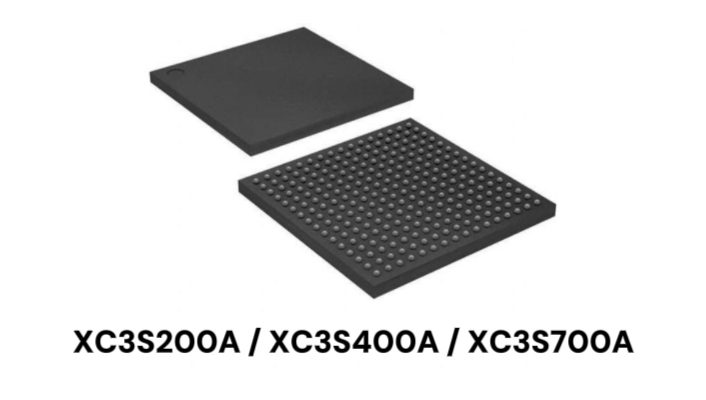
The XC3S200A-4FTG256I, XC3S400A-4FTG256I, and XC3S700A-4FTG256I are AMD/Xilinx Spartan-3A FPGAs in the same 256-FTBGA package, measuring 17 × 17 mm. However, the same package does not make them drop-in replacements. In the FTG256 package, the XC3S700A actually provides fewer user I/Os than the XC3S200A and XC3S400A: 161 versus 195.
Before migrating between these devices, three factors should be checked carefully: cross-density pin compatibility, actual logic and multiplier utilization, and whether the configuration memory has enough capacity for the target device bitstream.
Parameter Comparison
| Parameter | XC3S200A-4FTG256I | XC3S400A-4FTG256I | XC3S700A-4FTG256I |
| Logic Cells | 4,032 | 8,064 | 13,248 |
| CLBs | 448 | 896 | 1,472 |
| 18 × 18 Hard Multipliers | 16 | 20 | 20 |
| Block RAM | 294,912 bits | 368,640 bits | 368,640 bits |
| DCMs | 4 | 4 | 8 |
| User I/O, FTG256 | 195 | 195 | 161 |
| Lifecycle | Obsolete | Obsolete | Obsolete |
Recommended Use Cases
- XC3S200A-4FTG256I
Recommended for: existing platform repair, cost-down evaluation for legacy designs, and projects that require 195 user I/Os but have low logic utilization.
Key points:
- Compared with the XC3S400A, the XC3S200A reduces the logic cell count from 8,064 to 4,032, hard multipliers from 20 to 16, and Block RAM from 368,640 bits to 294,912 bits. Before stepping down, check the Multiplier / MULT18X18S utilization in the ISE implementation report.
If more than 16 multipliers are required, some multiplication logic may be implemented in LUTs or may fail to meet implementation constraints, increasing LUT usage and timing risk.
- Migration threshold: If the current XC3S400A design uses more than 16 multipliers, a direct step-down to the XC3S200A is not recommended. If multiplier usage is between 13 and 16, evaluate timing margin, LUT utilization, and implementation results before migration.
- XC3S400A-4FTG256I
Recommended for: repair, restocking, and production continuation for existing XC3S400A platforms. It also serves as the baseline device when evaluating a step-up or step-down within the same Spartan-3A FTG256 group.
Key points:
- The XC3S400A offers the most balanced configuration among the three devices: 8,064 logic cells, 20 hard multipliers, and 195 user I/Os. It shares the FTG256 package with the XC3S200A, but cross-density pin compatibility still needs to be verified pin by pin against the DS529 pin migration table.
- XC3S700A-4FTG256I
Recommended for: designs where logic utilization is above 80% and total I/O usage remains within 161 pins.
Key points:
- Compared with the XC3S400A, the XC3S700A increases logic cells to 13,248 and doubles the number of DCMs from 4 to 8. Block RAM and multiplier count remain unchanged at 368,640 bits and 20 hard multipliers. However, user I/O in the FTG256 package drops from 195 to 161.
- If the current design uses more than 161 I/Os, migration to the XC3S700A will require PCB changes. Switching density also requires re-synthesis and a new bitstream. Configuration memory capacity must be rechecked, as the existing PROM may be too small when upgrading from the 400A to the 700A.
Key Considerations
- Same Package, Different Densities: Pin Functions May Change
In the FTG256 package, JTAG pins such as TDI, TDO, TMS, and TCK, as well as configuration pins such as PROG_B, DONE, INIT_B, CCLK, and DIN, are fixed across the three devices. User I/Os, however, can change bank assignments between densities, and some pins may have different functions or become unavailable.
- Before replacement, check the DS529 pin migration table and compare the FTG256 pin assignments bank by bank. Pay particular attention to LVDS, SSTL, HSTL, and other I/O standards that depend on bank-level power and reference-voltage settings. If a bank assignment changes, VCCO or VREF connections on the PCB may also need to be reviewed.
- Differential pairs should also be checked to confirm that both the positive and negative pins remain in the same bank and that polarity assignments are unchanged.
A common migration mistake is assuming that identical package size means direct replacement. If some I/Os fail to respond or show incorrect voltage levels after power-up, the root cause is often a bank VCCO mismatch rather than a defective FPGA.
- A Density Change Requires a New Bitstream and Configuration Memory Check
Bitstreams are not interchangeable across FPGA densities. Even when the package is the same, different densities have different configuration frame structures and bitstream lengths. Loading a bitstream generated for the wrong density may cause configuration failure, with INIT_B or DONE not asserting correctly.
- Check the “Configuration size: N bits” field in the bitstream information, or confirm the equivalent information in the ISE .mrp report. The XCF PROM or external SPI Flash must be large enough to store the target device bitstream.
- When stepping down from the XC3S400A to the XC3S200A, the existing PROM is usually oversized but still usable. When upgrading from the XC3S400A to the XC3S700A, the existing PROM may not have enough capacity, so memory size should be confirmed before ordering.
- Multipliers Are a Hidden Limit When Stepping Down
The XC3S200A provides 16 hard 18 × 18 multipliers, while the XC3S400A and XC3S700A each provide 20. When hard multiplier resources are exhausted, ISE XST may implement additional multiplication logic in LUTs instead of dedicated multiplier blocks. This may not generate a hard error, but it can increase LUT usage and degrade timing on critical paths.
Typical multiplier usage examples:
| Design Example | Typical Multiplier Usage |
| 16-tap FIR filter, parallel implementation, 16-bit coefficients | Usually 16 multipliers |
| FOC motor control, Park/Clarke transforms plus PI loop | 4–6 multipliers |
| Pure control logic, state machines, counters, interface bridging | 0–2 multipliers |
- To check multiplier usage, search for “Multipliers” in the ISE .mrp report or filter for MULT18X18S primitives in FPGA Editor. If usage is 16 or below, a step-down to the XC3S200A can be evaluated. If usage is above 16, direct migration is not recommended. If usage is between 13 and 16, review timing margin and LUT headroom before proceeding.
Selection Summary
| Scenario | Recommendation |
| Repair or restock an existing XC3S400A platform | Use XC3S400A-4FTG256I |
| Logic utilization below 50%, cost-down evaluation | Check multiplier usage first; if usage is ≤16, evaluate XC3S200A-4FTG256I |
| Step-down candidate with multiplier usage above 16 | Do not migrate directly to XC3S200A-4FTG256I |
| Logic utilization above 80%, I/O usage ≤161 | Evaluate XC3S700A-4FTG256I |
| Logic utilization above 80%, I/O usage >161 | XC3S700A-4FTG256I is not suitable without PCB redesign |
| Same-package density migration without PCB changes | Pin-by-pin review of the DS529 pin migration table is required |
| New design or long production lifecycle | Do not base new designs on this series; evaluate an active FPGA platform |
Product Summary
| Part Number | Manufacturer | Key Positioning | Buy Now |
| XC3S200A-4FTG256I | AMD/Xilinx | Lightweight logic, 16 multipliers, and 195 user I/Os; suitable for cost-down evaluation when resource usage is low | Buy Now |
| XC3S400A-4FTG256I | AMD/Xilinx | Balanced logic and I/O resources, 20 multipliers, and 195 user I/Os; baseline option for legacy platform maintenance | Buy Now |
| XC3S700A-4FTG256I | AMD/Xilinx | Highest logic capacity in this comparison, 20 multipliers, 8 DCMs, and 161 user I/Os; suitable for logic and DCM expansion when I/O headroom allows | Buy Now |
WIN SOURCE supplies AMD/Xilinx FPGAs, CPLDs, and configuration memory devices for industrial control, interface bridging, data acquisition, and legacy platform maintenance. Visit WIN SOURCE to check real-time inventory and availability for the XC3S200A-4FTG256I, XC3S400A-4FTG256I, and XC3S700A-4FTG256I.
©2026 Win Source Electronics. All rights reserved. This content is protected by copyright and may not be reproduced, distributed, transmitted, cached or otherwise used, except with the prior written permission of Win Source Electronics.