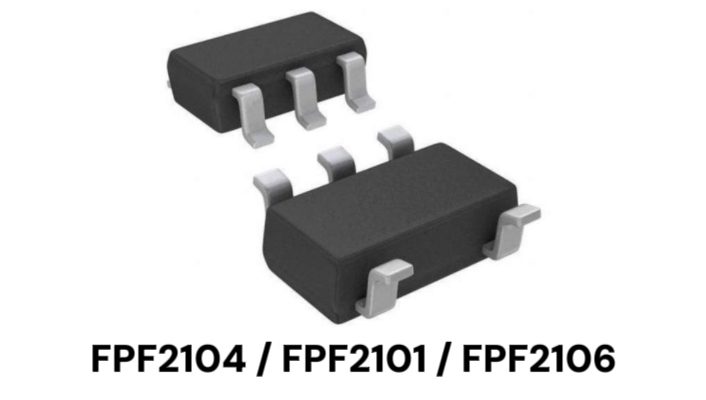
The FPF2104, FPF2101, and FPF2106 are Full Function Load Switches from onsemi’s IntelliMAX™ series, built on the same current-limited P-channel MOSFET platform. They integrate current limiting, thermal shutdown, under-voltage lockout (UVLO), and a fault flag (FLAG) output, widely used in MCU power control, portable device power-path management, and industrial signal power isolation.
The core value of this series is matching three dimensions to system requirements: current limit class (200mA vs. 400mA), control logic polarity (Active High vs. Active Low), and fault recovery mechanism (Auto-restart vs. Latch-off). The FPF2104 is a 400mA general-purpose standard part; the FPF2101 is a 200mA part focused on small-current-load fit and active-low false-trigger prevention; the FPF2106 is a 400mA latch-off device for high-safety systems.
Parameter Comparison
Key Differentiating Parameters
| Parameter | FPF2101 | FPF2104 | FPF2106 |
| Current Level | 200mA class (~300mA typ trip) | 400mA class (~600mA typ trip) | 400mA class (~600mA typ trip) |
| ON Control Logic | Active Low | Active High | Active High |
| Fault Recovery | Auto-restart (160ms retry) | Auto-restart (160ms retry) | Latch-off |
Shared Platform Parameters
| Parameter | FPF2101 / FPF2104 / FPF2106 |
| Supply VIN | 1.8 – 5.5V |
| RDS(on) | ~125 mΩ (typ, 25°C) |
| Shutdown Current | <1µA |
| FLAG Output | Open-drain, active low |
| UVLO | ~1.5–1.7V(typ 1.6V) |
| Thermal Shutdown | ~140°C (typ) / 130°C recovery |
| Package | SOT-23-5 |
Application Scenarios
- FPF2104
Standard 400mA model, Active High control, auto-restart. Handles transient overcurrent without software intervention, lowest design complexity.
- Best for:
consumer power management and general load switching;
internal power branches in portable devices;
standard MCU GPIO-controlled rails.
400mA class falls short of the 500mA+ typical for a USB downstream port or PD fast-charge rail — better suited to a small-current sub-branch inside a USB-powered device.
- FPF2101
200mA class, Active Low control. Fits smaller-current loads and prevents false triggers when MCU GPIOs default high during reset, avoiding accidental power-rail activation at startup.
- Best for:
low-current MCU-controlled power rails;
systems where GPIOs default high on power-up;
portable device control paths and small-signal isolated supplies.
- FPF2106
Highest safety grade in the 400mA camp. Active High control with Latch-off — no hiccup or auto-restart after an over-current event; recovery requires toggling the ON pin. Eliminates continuous thermal stress and oscillation while a short persists. If your system has a full-power-cycle scenario, verify on the bench whether a power-down/power-up cycle also clears the latch.
- Best for:
industrial control and motor-drive pre-stage protection;
high-reliability paths where auto-recovery is prohibited;
environments requiring host confirmation before re-powering.
Design Considerations
- Control Logic Combination Gap
Active Low only pairs with Auto-restart on this platform — no Active-Low-plus-Latch-off part exists. If you need both, you’ll need an external inverter stage or a different family; confirm this before freezing the design.
- No True Reverse-Current Blocking
The integral body diode means CIN should exceed COUT, or VOUT can rise above VIN when the main supply is removed, driving current backward. None of these three parts suit battery/adapter OR-ing or hot-swap nodes needing strict reverse isolation — look to onsemi’s newer families with explicit reverse-current protection if needed.
- External Capacitor Sizing Is a Hard Constraint
The datasheet specifies COUT(max) — exceeding it can register a false over-current at power-up. Always check this formula before adding bulk decoupling rather than reusing values from another design.
- Auto-Restart’s Heating Duty Cycle Can Be Quantified
The hiccup cycle is 10ms current-limit detection + 160ms cooldown, roughly a 5.9% duty cycle in the heat-generating state — useful for checking whether existing copper-plane dissipation is adequate. Latch-off skips this entirely, locking after one event.
Selection Recommendations
- 400mA need, peak load confirmed under ~600mA, no specific initial-state requirement, auto-recovery acceptable → FPF2104 (not for a USB main power path).
- Small-current load, MCU GPIOs default high on power-up → FPF2101.
- Industrial design, downstream load may see sustained shorts, auto re-powering strictly prohibited → FPF2106.
Product Summary
| Part | Manufacturer | Core Positioning | Buy |
| FPF2104 | onsemi | 400mA general-purpose, auto-restart standard part (not for USB main power path) | Buy Now |
| FPF2101 | onsemi | 200mA small-current load + Active Low control | Buy Now |
| FPF2106 | onsemi | 400mA high-safety, latch-off fault protection | Buy Now |
WIN SOURCE supplies the full onsemi IntelliMAX™ series of load switch devices for power path management, system-level protection, and embedded control designs. Visit WIN SOURCE to check real-time stock for the FPF2104, FPF2101, and FPF2106, and confirm current production and lifecycle status before ordering.
©2026 Win Source Electronics. All rights reserved. This content is protected by copyright and may not be reproduced, distributed, transmitted, cached or otherwise used, except with the prior written permission of Win Source Electronics.