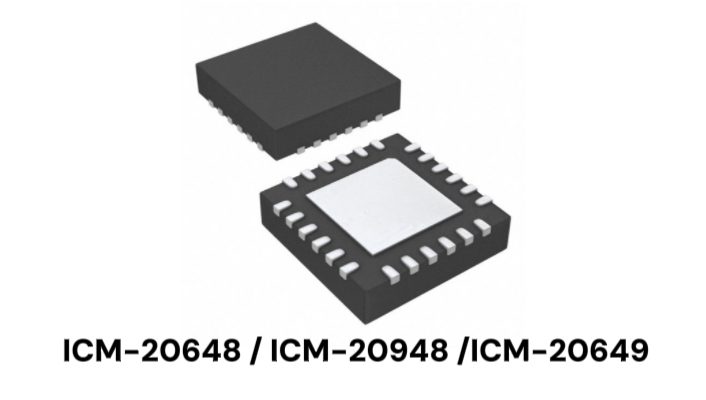
In wearables, electronic image stabilization (EIS), IoT nodes, drones, and sports-analysis systems, an IMU measures linear acceleration and angular rate. Some designs also require magnetic-field data for an absolute heading reference. Selection therefore depends on sensor composition, dynamic range, noise, output data rate, FIFO capacity, operating-current conditions, host interface, logic voltage, and lifecycle status.
The TDK InvenSense ICM-20648 is a general-purpose 6-axis device with a DMP for wearables, EIS, and IoT. The ICM-20948 adds an AK09916 3-axis magnetometer to a similar accelerometer and gyroscope core, creating a 9-axis solution. The ICM-20649 extends the gyroscope and accelerometer ranges for sports and high-impact measurements.
Parameter Comparison
| Parameter | ICM-20648 | ICM-20948 | ICM-20649 |
| Sensor configuration | 6-axis: gyro + accel + DMP | 9-axis: gyro + accel + mag + DMP | 6-axis: gyro + accel + DMP |
| Gyroscope range | ±250/500/1000/2000 dps | ±250/500/1000/2000 dps | ±500/1000/2000/4000 dps |
| Accelerometer range | ±2/4/8/16 g | ±2/4/8/16 g | ±4/8/16/30 g |
| Noise density | Gyro 0.015 dps/√Hz; accel 230 µg/√Hz | Gyro 0.015 dps/√Hz; accel 230 µg/√Hz | Gyro 0.0175 dps/√Hz; accel 285 µg/√Hz |
| Integrated magnetometer | None | AK09916; ±4900 µT; 16-bit | None |
| Maximum ODR | Gyro 9 kHz; accel 4.5 kHz | Gyro 9 kHz; accel 4.5 kHz; mag 100 Hz | Gyro 9 kHz; accel 4.5 kHz |
| FIFO capacity | 512 bytes | 4 kB | 4 kB |
| VDDIO range | 1.71–3.6 V | 1.71–1.95 V | 1.71–3.6 V |
| Product status | Production (NRND) | EOL | Obsolete |
Note: Noise-density values use the 10 Hz noise-bandwidth condition specified in the datasheets. The 9 kHz gyroscope and 4.5 kHz accelerometer ODRs apply when the digital low-pass filter is bypassed.
Application Fit
- ICM-20648
Best for: Products that require 6-axis motion sensing, DMP motion functions, and EIS timing support without an internal magnetometer. Typical applications include smartwatches, activity trackers, handheld devices, EIS assistance, and battery-powered IoT nodes.
Key takeaway: The ICM-20648 provides gyroscope and accelerometer ranges up to ±2000 dps and ±16 g, with noise densities of 0.015 dps/√Hz and 230 µg/√Hz. Its DMP supports functions such as step counting, activity classification, Bring-to-See, and runtime calibration, while enhanced FSYNC supports EIS timing. Its 512-byte FIFO requires more frequent host servicing than the 4 kB FIFOs in the other two devices.
- ICM-20948
Best for: Products that require acceleration, angular rate, and an absolute magnetic heading reference in one 3×3 mm package. Examples include drone heading assistance, direction-aware wearables, robot attitude and heading estimation, and IoT navigation terminals.
Key takeaway: The ICM-20948 closely matches the ICM-20648 in its principal accelerometer and gyroscope ranges and noise figures while adding an AK09916 magnetometer with a ±4900 µT range, 16-bit output, and up to 100 Hz ODR. It supports 6- and 9-axis calibration and fusion, but the system still requires hard-iron, soft-iron, and installation calibration. Its 1.95 V VDDIO ceiling is the most important electrical constraint during migration.
- ICM-20649
Best for: Fast rotation and impact measurements that may exceed ±2000 dps or ±16 g, including golf and tennis swing analysis, soccer-ball impact, smart basketballs, connected sports equipment, and other contact-sport recorders.
Key takeaway: The ICM-20649 extends the gyroscope range to ±4000 dps and the accelerometer range to ±30 g. Its 4 kB FIFO supports continuous data capture before, during, and after an impact. The wider range reduces clipping risk, but its gyro and accel noise densities increase to 0.0175 dps/√Hz and 285 µg/√Hz. If the motion never approaches the conventional limits, the wider-range device does not automatically provide a better measurement.
Design Considerations
- Determine whether an absolute heading is required
The ICM-20648 and ICM-20649 directly measure only acceleration and angular rate. Gravity provides a tilt reference when acceleration is limited, but 6-axis fusion cannot constrain long-term heading drift about the gravity axis. Use the ICM-20948, or an external magnetometer with a 6-axis device, when magnetic north, 9-axis orientation, or heading hold is required.
An integrated magnetometer does not eliminate magnetic-system design. Motors, batteries, high-current traces, steel structures, and enclosure materials can still dominate heading accuracy.
- Select range from clipping risk
General wearables, EIS, and attitude sensing often remain within ±2000 dps and ±16 g. For lower-amplitude motion, the ICM-20648 and ICM-20948 offer additional ±250 dps and ±2 g range settings together with lower noise density. Select the ICM-20649 only when measured peaks may exceed the conventional limits.
The extended range comes with higher noise density. Prototype testing should record peak magnitude, duration, and bandwidth before the range is finalized.
- Coordinate FIFO, ODR, bandwidth, and host servicing
With the digital low-pass filter bypassed, the gyro and accelerometer can reach 9 kHz and 4.5 kHz respectively, but maximum ODR is rarely the optimum system setting. Bandwidth, noise, data throughput, and current must be selected together.
The ICM-20648 has a 512-byte FIFO, compared with 4 kB in the ICM-20948 and ICM-20649. A larger FIFO is useful for impact capture and longer host-sleep intervals; EIS designs should prioritize FSYNC, timing alignment, and deterministic latency.
- Recheck VDDIO, pinout, and software during migration
All three devices support I²C and SPI and use 24-QFN packages, but package size alone does not establish drop-in compatibility. Review pin functions, WHO_AM_I, register settings, DMP firmware, driver initialization, and interrupt behavior.
The ICM-20948 restricts VDDIO to 1.71-1.95 V, whereas the ICM-20648 and ICM-20649 allow up to 3.6 V. A 3.3 V MCU may therefore require a suitable I/O power domain or level translation.
- Separate measurement range, shock survival, calibration, and lifecycle
The ±16 g or ±30 g figures describe measurable acceleration. The 10,000 g or 20,000 g figures describe mechanical shock tolerance. Mechanical survival does not mean that an impact waveform remained inside the ADC measurement range.
These are legacy devices: the ICM-20648 is Production (NRND), the current ICM-20948 product page is marked EOL, and the ICM-20649 is Obsolete. New designs should evaluate active alternatives and supply horizon, while existing designs should complete electrical, driver, calibration, and system-dynamics validation.
Product Summary
| Part | Manufacturer | Recommended use | Buy |
| ICM-20648 | TDK InvenSense | General 6-axis DMP device for wearables, EIS, and IoT motion sensing | Buy Now |
| ICM-20948 | TDK InvenSense | Integrated 9-axis device for heading and 9-axis fusion | Buy Now |
| ICM-20649 | TDK InvenSense | Wide-range 6-axis device for fast rotation, sports, and high-impact sensing | Buy Now |
WIN SOURCE provides sourcing support for TDK InvenSense motion sensors, including the ICM-20648, ICM-20948, and ICM-20649. Evaluate sensor composition, dynamic range, noise, FIFO capacity, DMP functions, logic voltage, software compatibility, and lifecycle status, and validate the selected device at the system level. Visit WIN SOURCE to check real-time inventory and pricing.
©2026 Win Source Electronics. All rights reserved. This content is protected by copyright and may not be reproduced, distributed, transmitted, cached or otherwise used, except with the prior written permission of Win Source Electronics.