For years, data center optical interconnects followed a predictable path: purchase pluggable optical modules, insert them for use, and replace them upon failure. Today, this operational model is gradually approaching its thermal limits. As switch bandwidth advances toward 51.2T and higher, 800G and 1.6T pluggable modules are nearing the practical ceiling of rack-level power budgets.
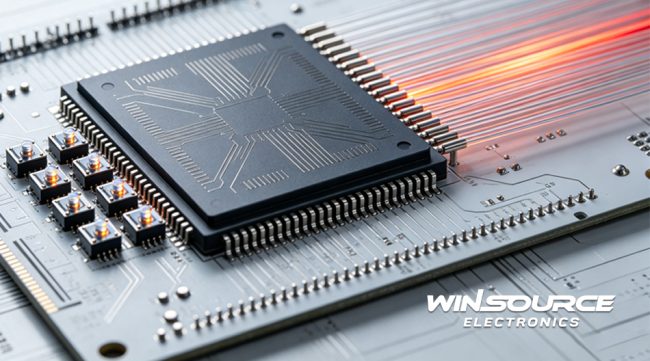
Co-Packaged Optics (CPO)—integrating optical engines directly onto the switch substrate, just millimeters away from the ASIC—is transitioning from the validation stage to mass production. According to NVIDIA announcements and reports from StorageReview, NVIDIA’s Spectrum-X Ethernet photonic switch entered full mass production in August 2026; industry reports also indicate that Broadcom’s 51.2T Bailly switch has entered volume manufacturing. Both report significant power savings compared to pluggable solutions, albeit under different comparison baselines: Broadcom claims a power reduction of up to approximately 70%, while NVIDIA reports about five times the energy efficiency and a roughly fourfold reduction in the required number of lasers.
This transition brings a low-key yet significant impact to component buyers at equipment manufacturers: it is altering the actual material composition consumed by the supply chain.
Why the Shift Is Happening Now
The primary driver is power consumption, not merely bandwidth. According to industry technical analysis, shortening the electrical path between the switch chip and the optical engine reduces signal loss penalties from 20–25 dB down to approximately 4 dB, thereby diminishing the need for compensation circuitry. Broadcom reports that its CPO solution can reduce power consumption by up to approximately 70% compared to pluggable optical modules; NVIDIA states that its CPO switch achieves roughly five times the energy efficiency.
The market remains in its early stages. According to Yole Intelligence, the global CPO market size was approximately $46 million in 2024 and is projected to reach around $8.1 billion by 2030 (a compound annual growth rate of approximately 137%). This implies that 2026 remains a low-volume adoption period, with larger-scale production ramp-ups expected around 2027–2028.
A New Bill of Materials
For procurement teams, the practical question is: what does CPO replace, and what does it add? A pluggable optical module is a self-contained component, whereas a CPO system disperses this functionality across multiple component categories—reducing certain materials while adding others.
Materials that will decrease: Due to shortened electrical paths and reduced signal loss, the demand for internal retimer and signal conditioning chips used for loss compensation decreases accordingly; the metal housings, standalone thermal heat sinks, and mechanical structures of the modules are also simplified.
Materials that will be added:
Silicon Photonics Engines: CPO optical engines rely on silicon photonic modulators manufactured using advanced wafer processes. A single 102.4T switch may require dozens of silicon photonics engines, which impose high precision requirements for manufacturing and co-packaging, as well as long capacity expansion cycles.
InP Continuous Wave Laser Sources: Silicon photonic modulators do not emit light on their own and rely on external continuous wave laser sources based on Indium Phosphide (InP). Supply in this sector is concentrated among a few vendors such as Lumentum and Coherent (Source: NVIDIA disclosures / company announcements), meaning laser supply could become a constraining factor for optical engine output.
Fiber Arrays and Precision Coupling: Aligning and connecting hundreds of optical fibers to the engine with micron-level precision makes Fiber Array Units (FAUs) and coupling components new, precision-critical material items. NVIDIA’s disclosed CPO supply chain spans silicon photonics manufacturing (TSMC), chip-level packaging and testing (SPIL), laser chips (Lumentum), laser module sub-assemblies (TFC Communication), and full-system assembly (Foxconn)—illustrating the degree of dispersion in the new bill of materials.
Advanced Packaging: CPO switches using wafer-level packaging compete for the same 2.5D/3D packaging capacity as AI accelerators, linking the optical production ramp-up to an already tight packaging market (Source: TrendForce).
What Procurement Should Focus On
1.Track silicon photonics and InP laser capacity down to specific part numbers. Given supply concentration and long expansion cycles, these two categories are most likely to tighten first. It is recommended to establish lead-time tracking at the part-number level and initiate dual-sourcing evaluations immediately when lead times begin to stretch, rather than waiting for formal allocation notices.
2.Reserve time for longer, more complex qualification cycles and initiate dual-source qualification early. CPO transfers complexity from the module to the system, implying more component-level verification. It is advised to reserve a 6–12 month qualification cycle and start validating samples from a second supply source alongside the primary part numbers to avoid hasty switches during shortages.
3.Re-evaluate maintainability assumptions and formulate maintenance plans. Fixed fiber connections alter system installation and field maintenance practices. It is recommended to evaluate pluggable chip-to-fiber interface options during the selection stage and factor maintenance costs into Total Cost of Ownership (TCO) calculations.
4.Maintain procurement flexibility between old and new architectures, allocating resources according to project needs. Pluggable optical modules remain the primary shipping format in the near term, so most teams will need to cover both pluggable and CPO-adjacent categories simultaneously during the transition period. Avoid locking into a single architecture prematurely.
The move of CPO toward mass production marks a measured yet profound shift in data center component composition—moving from self-contained pluggable modules toward dispersed silicon photonics, lasers, and precision coupling components. For procurement teams, the real challenges lie in concrete execution areas such as extending lead times, dual-source qualification, batch traceability, and maintenance strategies.
For the procurement challenges outlined above, WIN SOURCE can provide supply support based on specific part numbers and project requirements. Through its global supply network, WIN SOURCE can assist in identifying available inventory and other sourcing options for optical, interconnect, and package-related components, as well as provide information on potential alternative parts for further customer validation. In addition, the team can, based on available supplier and market information, help monitor lead times and supply changes for specified part numbers, providing reference information for procurement evaluation and the development of alternative sourcing plans.
If you need to evaluate lead times, dual-sourcing strategies, or replacement parts for CPO-related materials, feel free to contact the WIN SOURCE team for procurement advice tailored to your specific BOM.
© 2026 Win Source Electronics. All rights reserved. This content is protected by copyright and may not be reproduced, distributed, transmitted, cached or otherwise used, except with the prior written permission of Win Source Electronics.