* Question
What Is a Cold Reset?
* Answer
A cold reset, also called a power-on reset or cold boot, restarts an electronic system from a fully unpowered or completely initialized state. It normally occurs when power is first applied or when the power supply is removed long enough for internal voltage rails, capacitors, and retention circuits to discharge before power is restored.
During a cold reset, the processor and peripheral devices return to their defined startup conditions. The system then executes its complete boot sequence, which may include hardware initialization, memory testing, firmware loading, device enumeration, and configuration-data retrieval.
How Does a Cold Reset Work?
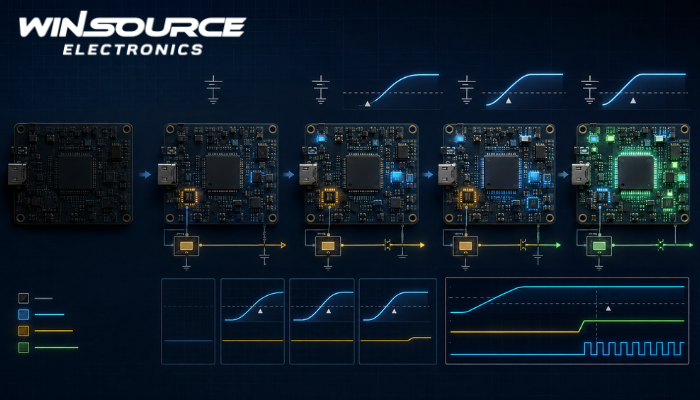
Most digital systems include a power-on-reset circuit or a dedicated reset supervisor. This circuit monitors the supply voltage and holds the reset signal active until the voltage is high enough and sufficiently stable for reliable operation.
A typical cold-reset sequence is:
- Power is applied to the system.
- Supply rails rise toward their specified operating voltages.
- The reset circuit keeps the processor and peripherals in reset.
- Oscillators and phase-locked loops stabilize.
- The reset signal is released after the required delay.
- The processor begins execution from its reset vector.
- Boot firmware initializes memory, clocks, interfaces, and peripheral devices.
Brownout detectors may assert another reset if the supply falls below a safe operating threshold.
Cold Reset vs. Warm Reset
A warm reset restarts the processor without completely removing system power. It may be triggered by software, a watchdog timer, or an external reset input. Some memory, peripheral, and power-management states can remain unchanged during a warm reset.
A cold reset generally performs a more complete initialization because power-dependent state is cleared. However, not every stored value is necessarily erased. Nonvolatile memory, battery-backed registers, real-time clocks, and retention RAM may preserve data across a cold reset.
Common Applications
Cold resets are used when:
- A device is powered on for the first time
- Hardware becomes unresponsive and a warm reset is insufficient
- Supply voltages or clock circuits must be fully reinitialized
- New hardware or configuration changes need to be detected
- Engineers need a known startup state during testing
Design Considerations
A reliable cold-reset circuit must account for the supply ramp rate, minimum reset-pulse width, voltage thresholds, reset-release delay, oscillator startup time, and power-rail sequencing. Reset should normally be asserted asynchronously when a fault occurs but released in synchronization with the relevant clock domain to reduce metastability risks.
Designers should also verify the behavior of external memories, communication transceivers, programmable logic, and peripheral power domains. If these devices start at different times, the processor may attempt to communicate before they are ready. Dedicated voltage supervisors, watchdogs, decoupling capacitors, and properly defined boot-pin states help ensure repeatable cold-start operation.