* Question
What Is the Independent RGB Emission Method?
* Answer
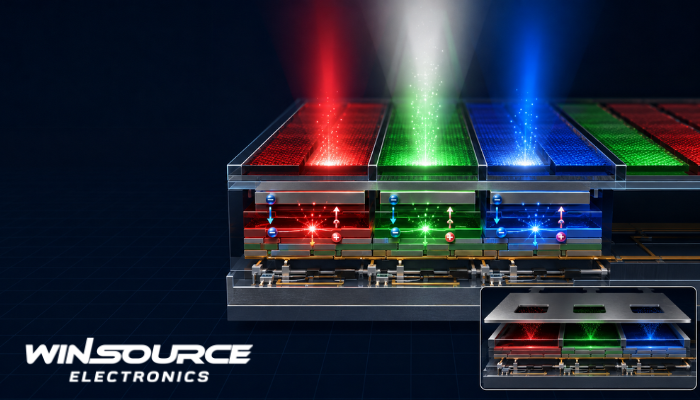
The independent RGB emission method, sometimes translated as the “independent luminescent material method,” is a full-color display technique in which separate red, green, and blue light-emitting materials form the individual subpixels. Each subpixel produces its own primary color directly when electrically driven.
This method is commonly associated with OLED and other self-emissive displays. Unlike LCD panels, it does not require a separate backlight. It also differs from white-emitter displays with color filters and blue-emitter displays with color-conversion layers.
How Does It Work?
Each pixel is divided into red, green, and blue subpixels. The emissive material in each subpixel is selected to generate a specific wavelength range:
- The red subpixel contains a red-emitting material.
- The green subpixel contains a green-emitting material.
- The blue subpixel contains a blue-emitting material.
The display driver controls the current supplied to each subpixel. Adjusting the relative intensity of the three primary colors produces the required output color. Driving all three subpixels at suitable levels creates white, while switching them off produces black.
In an OLED, electrons and holes are injected into the organic layers and recombine in the emissive layer. The resulting energy is released as photons. Because each RGB subpixel uses its own emitter, no color filter is required to remove unwanted wavelengths.
Manufacturing Methods
The RGB materials must be deposited or transferred into precisely defined subpixel areas. Common patterning methods include:
- Fine metal mask vacuum deposition
- Inkjet printing
- Photolithographic patterning
- Transfer printing
- Other high-resolution material-deposition processes
Side-by-side emitter patterning can produce highly efficient direct-emission pixels, but accurately patterning multiple sensitive materials becomes increasingly difficult as pixel density and substrate size increase. Photolithographic OLED patterning has been investigated as an alternative to conventional fine metal masks.
Advantages and Limitations
The main advantages include high color purity, wide color gamut, strong contrast, efficient use of emitted light, and independent control of each primary color. Since the light does not pass through absorptive color filters, optical efficiency can be higher.
The major challenges are manufacturing complexity, material alignment, differential aging, and yield. Red, green, and blue emitters have different efficiencies and operating lifetimes, with blue often presenting the greatest durability challenge. Uneven aging can cause color shift or image retention over time.
When evaluating this display architecture, engineers should consider emitter lifetime, external quantum efficiency, color coordinates, subpixel layout, aperture ratio, patterning accuracy, current density, encapsulation, and compensation circuitry. Alternative architectures use white emitters with color filters or color-conversion layers to simplify RGB patterning, although they introduce different efficiency and material tradeoffs.