
* Question
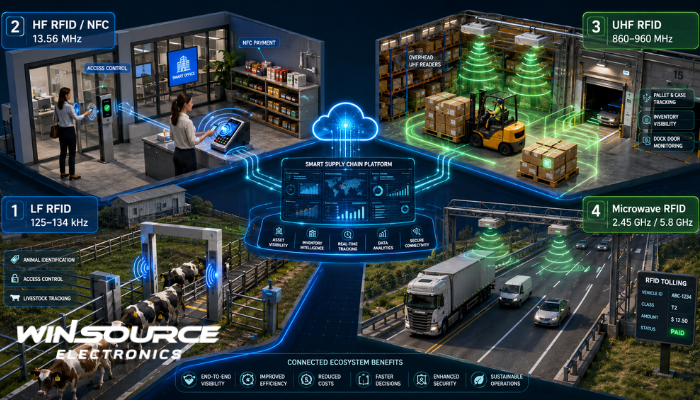
What Are the RFID Frequency Bands?
* Answer
What Are the RFID Frequency Bands?
1. Low Frequency (LF)
- Frequency range:125–134 kHz
- Read range:Very short (typically < 10 cm)
- Characteristics:
- Low data rate
- Strong performance near metal or liquid
- Very stable and interference-resistant
Typical applications:
- Animal tracking (livestock tags)
- Access control systems
- Car immobilizers (anti-theft systems)
2. High Frequency (HF)
- Frequency range:56 MHz
- Read range:Up to ~1 meter (usually 10 cm–1 m)
- Characteristics:
- Moderate data rate
- Works well in industrial and consumer environments
- Supports NFC (Near Field Communication)
Typical applications:
- Smart cards (ID cards, payment cards)
- Library systems
- Ticketing systems
- NFC smartphones
3. Ultra High Frequency (UHF)
- Frequency range:
- 860–960 MHz(varies by region)
- Europe: ~865–868 MHz
- USA: ~902–928 MHz
- Read range:Several meters (up to 10+ meters depending on system)
- Characteristics:
- High-speed data transfer
- Supports bulk reading (multiple tags simultaneously)
- More sensitive to liquids and metals
Typical applications:
- Supply chain and logistics tracking
- Warehouse management
- Retail inventory systems
- Pallet and container tracking
4. Microwave RFID (Super High Frequency in some classifications)
- Frequency range:45 GHz (and sometimes 5.8 GHz)
- Read range:Long, but depends heavily on environment
- Characteristics:
- Very high data rate
- More directional communication
- Higher power consumption
Typical applications:
- Electronic toll collection (ETC)
- Real-time vehicle tracking
- High-speed industrial tracking systems
5. Active RFID (Special Case Frequency Use)
- Often operates at:
- 433 MHz (common in industrial RTLS systems)
- 4 GHz (Wi-Fi-like environments)
- Key difference:Tags have their own power source (battery)
Typical applications:
- Real-time location systems (RTLS)
- Asset tracking in large facilities
- Mining, oil & gas monitoring
Summary Comparison
Band | Frequency | Range | Best For |
LF | 125–134 kHz | Very short | Animal ID, access control |
HF | 13.56 MHz | Short | NFC, cards, ticketing |
UHF | 860–960 MHz | Medium–long | Logistics, inventory |
Microwave | 2.45 GHz | Long | Toll, high-speed tracking |
Conclusion
RFID systems use multiple frequency bands depending on range, environment, and data requirements.
- LF = stability
- HF = secure short-range communication
- UHF = supply chain efficiency and bulk scanning
- Microwave = high-speed or special industrial applications

COMMENTS