* Question
What Is a Carbon Film Resistor? Key Parameters Explained
* Answer
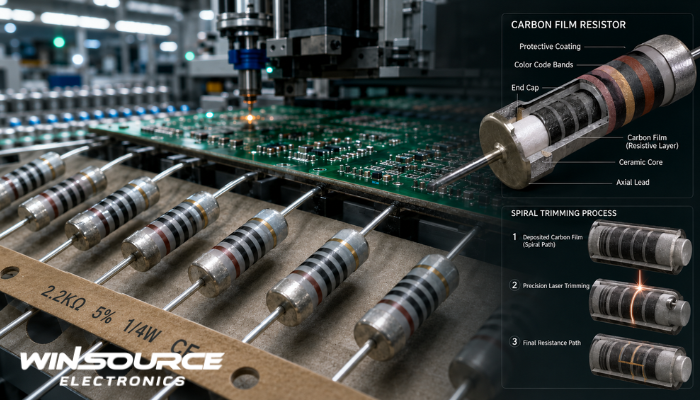
A carbon film resistor is a type of fixed resistor made by depositing a thin layer of carbon onto a ceramic substrate. The carbon layer acts as the resistive element, and its resistance value is precisely adjusted by cutting a spiral groove into the film.
It is widely used in general-purpose electronic circuits due to its low cost, stable performance, and broad resistance range.
How a Carbon Film Resistor Works
The basic structure includes:
- A ceramic rod as the insulating base
- A thin carbon film coated on the surface
- A spiral cut that controls resistance value
- Metal end caps for electrical connection
- A protective coating for insulation and environmental protection
By adjusting the spiral pattern, manufacturers can fine-tune the resistance value accurately.
Key Characteristics of Carbon Film Resistors
- Low cost: Ideal for mass production and consumer electronics
- Wide resistance range: Typically from 1Ω to 10MΩ
- Moderate precision: Common tolerances are ±2%, ±5%, and ±10%
- Higher noise level: Compared to metal film resistors
- Good general stability: Suitable for non-critical applications
- Standard power ratings: From 1/8W to 2W depending on size
Electrical Parameters of Carbon Film Resistors
1. Resistance Value (Ω)
Defines how much the resistor limits current.
Typical range: 1Ω to 10MΩ
2. Tolerance
Indicates allowable deviation from nominal value:
- ±2%
- ±5%
- ±10% (most common for low-cost types)
3. Power Rating (W)
Maximum power the resistor can safely dissipate:
- 1/8W
- 1/4W
- 1/2W
- 1W and above (depending on size)
4. Temperature Coefficient (TCR)
Shows resistance change with temperature:
- Typically -200 to -1000 ppm/°C
- Less stable than metal film resistors
5. Operating Temperature Range
- Usually -55°C to +155°C
6. Voltage Rating
Maximum continuous working voltage before breakdown occurs.
Depends on resistor size and resistance value.
7. Noise Characteristics
- Relatively higher electrical noise
- Acceptable for general-purpose circuits, not precision analog systems
Typical Applications
Carbon film resistors are commonly used in:
- Consumer electronics (TVs, radios, chargers)
- Power supply circuits
- General analog and digital circuits
- Pull-up / pull-down networks
- Signal conditioning applications
Conclusion
A carbon film resistor is a cost-effective and widely used passive component designed for general-purpose electronic applications. While it does not offer high precision or ultra-low noise performance, it remains a reliable choice for mass-market electronics where cost efficiency is a priority.