* Question
What are the main data types in VHDL?
* Answer
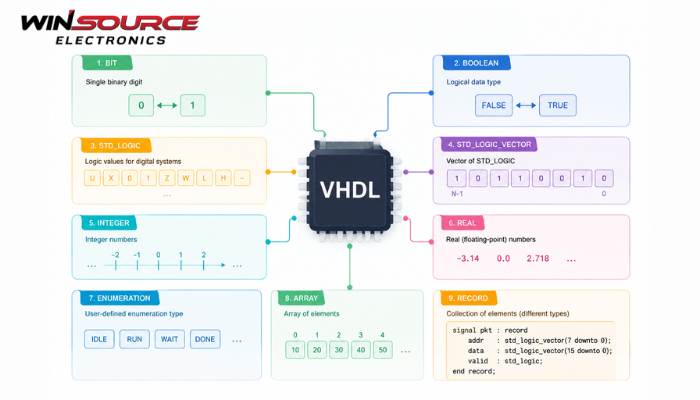
VHDL (VHSIC Hardware Description Language) provides a range of data types for modeling digital circuits. These data types are essential for defining signals, variables, and constants in designs, and they can be grouped into several categories:
1. Scalar Types
Scalar types represent a single value at a time.
- BIT: Represents a single binary value, ‘0’or ‘1’.
- BOOLEAN: Logical type with values TRUEor FALSE.
- INTEGER: Whole numbers within a defined range (default: −2,147,483,648 to +2,147,483,647).
- REAL: Floating-point numbers for analog or calculation purposes.
- TIME: Represents simulation time, e.g., 10 ns, 5 us.
2. Composite Types
Composite types combine multiple elements.
- ARRAY: A collection of elements of the same type. Commonly used for vectors and memory structures.
- Example: std_logic_vector(7 downto 0)for an 8-bit bus.
- RECORD: Groups elements of potentially different types into a single structure.
- Useful for packaging related signals.
3. Access Types
- Pointers in VHDL, known as access types, allow dynamic referencing of objects in memory.
- Example: TYPE ptr_type IS ACCESS INTEGER;
4. File Types
- Used for reading from or writing to external files during simulation.
- Example: TEXTtype for reading test vectors.
5. Physical Types
- Represents measurable quantities with units (like voltage, time, frequency).
Example:
TYPE voltage IS RANGE 0 TO 5 UNITS V;
SIGNAL v1: voltage := 3 V;
6. Enumerated Types
- User-defined types that allow a fixed set of named values.
Example:
TYPE state_type IS (IDLE, RUN, STOP);
SIGNAL state: state_type;
7. Standard Logic Types (from IEEE Packages)
For digital design, scalar and vector signals often use std_logic and std_logic_vector:
- STD_LOGIC: Can represent ‘0’, ‘1’, ‘Z’, ‘X’, ‘U’, ‘W’, ‘L’, ‘H’, ‘-‘.
- Handles unknown, high-impedance, and conflicting states, which BIT cannot.
- STD_LOGIC_VECTOR: Array of STD_LOGICfor buses and multi-bit signals.
Summary:
In VHDL, the main data types include scalar types (BIT, BOOLEAN, INTEGER, REAL, TIME), composite types (ARRAY, RECORD), access types, file types, physical types, enumerated types, and standard logic types (STD_LOGIC, STD_LOGIC_VECTOR). Choosing the right type depends on whether you are modeling simple logic, buses, state machines, or analog-like signals in your design.