* Question
What Is the LIN Bus in the Audi A6 Comfort System and What Are Its Key Characteristics?
* Answer
In the Audi A6, the comfort system network relies heavily on a communication protocol called the LIN bus (Local Interconnect Network). It is designed to support non-critical body electronics where cost efficiency, simplicity, and reliability are more important than high-speed data transfer.
The LIN bus typically works alongside the CAN network, acting as a sub-network for comfort-related functions inside the vehicle.
Overview of the LIN Bus in Automotive Comfort Systems
The LIN bus in the Audi A6 is used to connect various body control and comfort modules, such as:
- Power windows and door modules
- Seat adjustment systems
- Mirror control (folding, heating, positioning)
- Interior lighting control
- HVAC flap actuators
- Rain/light sensors (in some configurations)
Instead of each component communicating directly over CAN, LIN allows multiple low-cost slave nodes to communicate through a single master ECU.
Key Characteristics of the Audi A6 LIN Bus System
1. Single-Wire, Low-Cost Communication
LIN uses a single-wire communication line, making it significantly cheaper and simpler than CAN.
- One master node controls multiple slave nodes
- Reduced wiring harness complexity
- Lower vehicle weight and cost
2. Low-Speed Data Transmission
LIN is designed for comfort and body electronics, not high-speed control systems.
- Typical speed: up to 2 kbps
- Suitable for slow-changing signals (e.g., window position, seat adjustment)
3. Master-Slave Architecture
The system follows a strict hierarchy:
- Master ECU (usually door module or body control module)initiates communication
- Slave nodes (actuators and sensors)respond only when requested
- No direct communication between slaves
This ensures predictable and controlled communication flow.
4. Deterministic and Schedule-Based Communication
LIN uses a predefined schedule table controlled by the master node.
- Messages are transmitted at fixed intervals
- Ensures stable and predictable performance
- Ideal for comfort functions where timing is not safety-critical
5. Cost-Efficient Network Integration
Compared to CAN or FlexRay systems, LIN significantly reduces system cost.
- Simple hardware design
- Low-cost microcontrollers can be used
- Minimal transceiver complexity
6. High Compatibility with Automotive Electronics
LIN is widely supported in automotive semiconductor ecosystems, including:
- LIN transceivers (e.g., NXP, Infineon, Microchip)
- Low-power MCUs with integrated LIN interfaces
- Actuator ICs for motors and sensors
This makes it a standard choice across OEM platforms like Audi, BMW, and Mercedes-Benz.
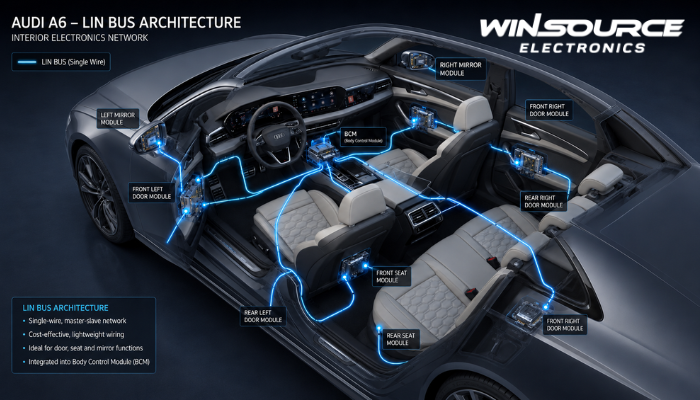
LIN Bus Architecture in the Audi A6 (Simplified View)
In the Audi A6 comfort system, the structure typically looks like this:
CAN Gateway / Body Control Module (BCM)
→ connects to
Door Control Modules (LIN Masters)
→ control
Window motors, mirror modules, seat controllers, interior actuators (LIN Slaves)
This layered structure allows Audi to reduce wiring complexity while maintaining modular control.
Why LIN Bus Is Important for Automotive Electronics Supply Chain
For electronic component distributors and OEM suppliers, LIN-based systems directly influence demand for:
- Automotive-grade microcontrollers (MCUs)
- LIN transceiver ICs
- Motor driver ICs
- Position sensors and actuator control chips
As vehicles like the Audi A6 become more electronically integrated, LIN remains a stable and high-volume protocol in body electronics.
Conclusion
The Audi A6 LIN bus system is a low-speed, cost-efficient, and highly structured communication network designed specifically for comfort and body control functions. Its simplicity, reliability, and scalability make it a foundational technology in modern automotive electronics architecture.