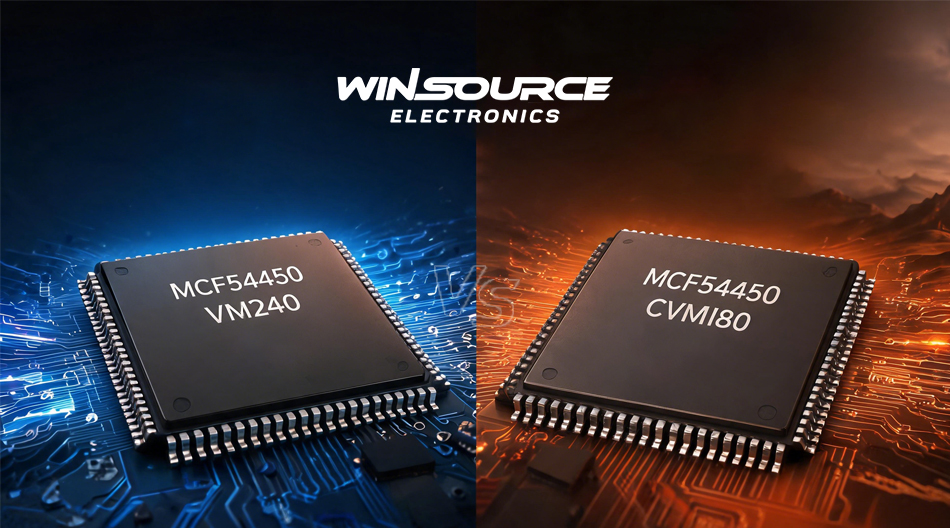
MCF54450VM240 and MCF54450CVM180 both belong to NXP’s MCF54450 ColdFire microprocessor family and are offered in a 256 MAPBGA package. Their key differences lie in operating frequency and specified temperature range. These parameters directly affect system performance and environmental suitability, so maintenance, BOM continuity, and replacement evaluations should be based on the actual application conditions.
1. Key Differences in Operating Frequency and Temperature Range
MCF54450VM240 supports an operating frequency of 240 MHz, compared with 180 MHz for MCF54450CVM180. Under similar software architectures, memory configurations, and peripheral conditions, the higher clock frequency can provide greater performance headroom for computational tasks, protocol processing, and multitasking. However, processor frequency is only one factor influencing overall system performance. External memory access, software execution efficiency, and peripheral data loads must also be considered.
MCF54450CVM180, by contrast, offers a wider operating temperature range. Its −40°C to +85°C rating can accommodate low-temperature startup, high-temperature operation, and applications exposed to greater environmental temperature variation. MCF54450VM240 is specified for 0°C to +70°C, making it more suitable for systems operating under relatively controlled temperature conditions.
The two devices therefore emphasize different design priorities. MCF54450VM240 provides a higher operating frequency, while MCF54450CVM180 offers broader temperature tolerance. Engineering selection should balance computing performance, operating environment, and overall system design margin.
2. System Selection Should Consider Both Performance and Thermal Conditions
For designs with higher processing demands and operating temperatures that can be maintained within the specified range, the 240 MHz operating frequency of MCF54450VM240 can provide greater performance headroom. The actual benefit still depends on application software, memory access behavior, and system task allocation. Overall system performance should not be inferred from clock frequency alone.
For industrial equipment, outdoor systems, or applications with limited temperature control, the −40°C to +85°C range of MCF54450CVM180 provides broader environmental coverage. When selecting this version, engineers should also confirm that 180 MHz is sufficient for the system’s real-time tasks, communication throughput, and software workload. If the original design is already operating close to its processing limit, a change in frequency may require renewed system-level performance validation.
Thermal evaluation should also reflect the device’s actual operating environment. Heat accumulation inside the enclosure, power dissipation from surrounding components, PCB layout, cooling design, and continuous operating time can all affect the processor’s local temperature and junction temperature. Keeping the ambient temperature within the specified range does not eliminate the need for thermal design. Device power dissipation, board-level thermal conditions, and actual workload should also be considered when establishing adequate thermal margin, particularly to avoid prolonged operation near the temperature limits.
3. Replacement Within the Same Series Still Requires Validation of Key System Conditions
MCF54450VM240 and MCF54450CVM180 belong to the same MCF54450 platform and use the same 256 MAPBGA package. However, belonging to the same series and sharing the same package are not sufficient grounds for assuming direct interchangeability in an existing design. A change in operating frequency may affect clock configuration, software execution performance, external memory timing, and overall thermal design, all of which should be reviewed individually.
For ColdFire systems that have been in service for an extended period, replacement evaluation should also take into account the full part-number suffix, PCB revision, software version, actual system load, and original validation conditions. This is particularly important when maintaining legacy equipment or extending an existing design, as specification differences may have a direct impact on system stability and performance.
For equipment maintenance, stocking, or replacement evaluation, WIN SOURCE recommends using the complete part number and original manufacturer specifications as the primary reference. Operating frequency, temperature range, package, and actual system conditions should be reviewed together. Where necessary, system-level validation should also be performed to confirm that the proposed replacement continues to meet the requirements of the original design.
© 2026 Win Source Electronics. All rights reserved. This content is protected by copyright and may not be reproduced, distributed, transmitted, cached or otherwise used, except with the prior written permission of Win Source Electronics.