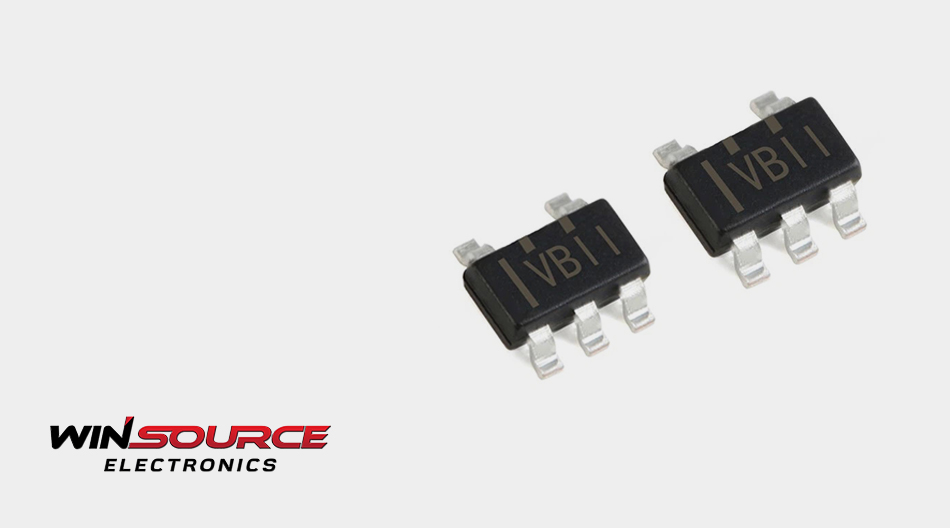
In sensor system design, the choice of an operational amplifier can affect signal conditioning quality, power consumption, and overall circuit stability. For low-speed detection, battery-powered equipment, and long-standby devices, engineers often focus on low power consumption, wide supply voltage range, compact packaging, and suitable output swing. As a low-power single-channel operational amplifier, the TLV27L1IDBVR is well suited for basic signal conditioning in a variety of sensor and monitoring applications.
1. Understanding the Role of TLV27L1IDBVR in Sensor Front Ends
In sensor systems, operational amplifiers are commonly used for signal buffering, amplification, filtering, or voltage conditioning. In applications such as temperature sensing, pressure sensing, smoke detection, battery monitoring, and low-speed status acquisition, engineers do not evaluate an amplifier based on a single specification alone. They also need to consider whether the device can provide a balanced combination of power consumption, supply range, package size, and system stability.
The TLV27L1IDBVR is a single-channel low-power operational amplifier from Texas Instruments’ TLV27Lx series. It is available in a compact SOT-23-5 package, making it suitable for space-constrained sensor modules, portable electronic devices, and low-speed analog front-end designs.
From a system selection perspective, the TLV27L1IDBVR is not designed for high-speed sampling or high-precision measurement. Instead, it is better suited for low-power, low-speed signal chains and compact circuit designs. The device supports a 2.7V to 16V single-supply operating range, covering common 3V, 5V, and some 12V systems. This provides flexibility for sensor interfaces with different power architectures.
For applications with low sampling rates, slowly changing signals, and long standby time requirements, the value of the TLV27L1IDBVR lies mainly in reducing system quiescent power consumption, saving PCB space, and simplifying basic signal conditioning circuit design.
2. Design Value of Low Power Consumption and Rail-to-Rail Output
In battery-powered or long-standby devices, quiescent current has a direct impact on the system power budget. The TLV27L1IDBVR has a typical supply current of approximately 7µA, making it suitable for designs that are sensitive to battery life. Typical examples include portable detection equipment, security sensors, smoke alarms, and remote monitoring nodes.
In these products, the analog front end may need to remain active or in standby mode for extended periods. A lower quiescent current helps extend battery life and reduce the system’s baseline power consumption.
The rail-to-rail output feature of the TLV27L1IDBVR also gives it better output swing performance in low-voltage systems. Its output signal can swing closer to the supply rails, which helps improve the usable dynamic range. This feature is useful in low-speed ADC front ends, threshold detection circuits, and simple signal buffering applications. It can reduce design limitations caused by insufficient output headroom and make it easier to achieve stable signal conditioning in low-voltage sensor interfaces.
In practical selection, engineers still need to pay attention to the device’s operating boundaries. The TLV27L1IDBVR emphasizes rail-to-rail output, but this does not mean it provides full rail-to-rail input/output performance. For sensor interface design, the input common-mode range should be checked carefully to ensure that the sensor output voltage stays within the allowable range of the device.
Its 160kHz gain bandwidth product is more suitable for low-speed signal conditioning. If the system involves high-speed dynamic signals, wideband audio, or fast pulse detection, engineers should consider an operational amplifier with higher bandwidth, lower noise, or stronger slew rate performance.
3. Suitable Applications and Selection Considerations
The TLV27L1IDBVR is better suited for low-speed analog conditioning within sensor signal chains. In temperature sensing, battery voltage monitoring, low-power security detection, portable medical devices, and industrial status acquisition modules, it can be used as part of a buffer, low-gain amplifier, or simple filtering circuit. For these applications, the system usually places greater emphasis on power consumption, stability, and package size rather than maximum speed.
The SOT-23-5 package helps reduce the size of the analog front end, but a compact package also makes PCB layout details more important. Power supply decoupling capacitors should be placed as close as possible to the device’s supply pins. Input traces should be kept away from high-frequency switching nodes. When needed, RC filtering can be used to reduce sensor input noise. For high-impedance sensors, engineers should also pay attention to input bias current, leakage paths, and PCB surface contamination, as these factors may affect measurement results.
If engineers plan to use the TLV27L1IDBVR as a replacement option, they should not compare only the package and channel count. A more reliable approach is to check the following parameters:
- Whether the supply voltage range matches the system power architecture
- Whether the input common-mode range and output swing meet the sensor signal range
- Whether the gain bandwidth product, slew rate, and noise performance suit the target signal speed
- Whether the input offset voltage, quiescent current, package size, and pin configuration meet the original design requirements
For sensor systems, an operational amplifier that appears similar may not always be a direct replacement. Differences in input range, output swing, or power consumption may affect system calibration results. Therefore, replacement selection should be based on actual circuit conditions, rather than relying only on model similarity or package compatibility.
Overall, the TLV27L1IDBVR is suitable for low-power, low-speed, and space-constrained sensor and monitoring designs. Its strength does not lie in extremely high precision or high-speed performance. Instead, it provides stable basic signal conditioning with low power consumption. For engineering teams working on BOM optimization, component replacement, or compact sensor module development, WIN SOURCE can support the evaluation of the TLV27L1IDBVR and related operational amplifier options through inventory checks, part matching, and supply chain support.
© 2026 Win Source Electronics. All rights reserved. This content is protected by copyright and may not be reproduced, distributed, transmitted, cached or otherwise used, except with the prior written permission of Win Source Electronics.