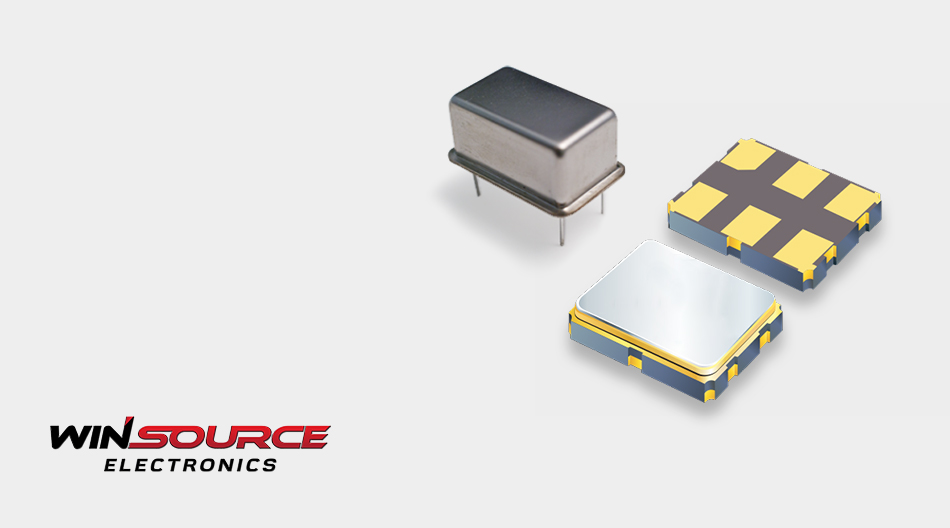
In communication equipment, industrial control systems, test and measurement instruments, and embedded systems, stable clock signals are essential for data transmission and system synchronization. Compared with crystal oscillators (XO) that provide fixed-frequency output, voltage-controlled crystal oscillators (VCXO) can adjust output frequency through an external control voltage, providing flexible clock solutions for applications requiring frequency calibration, clock synchronization, and dynamic compensation.
1. Working Principle and Technical Characteristics of VCXO Oscillators
A VCXO is a frequency control device based on the resonant characteristics of quartz crystals. It mainly consists of a crystal resonator, oscillation circuit, and voltage-controlled tuning network. By changing the input control voltage, the internal tuning circuit adjusts the oscillation parameters, allowing the output frequency to vary within a certain range.
Compared with standard crystal oscillators (XO), the key difference of VCXO is its frequency adjustment capability. XO typically provides a fixed output frequency, while VCXO allows fine frequency adjustment according to system requirements, making it easier to meet synchronization, calibration, and frequency compensation requirements.
The frequency adjustment range of a VCXO is commonly referred to as the pull range. This parameter indicates the frequency deviation that can be achieved through voltage control. In actual system design, engineers need to evaluate the target frequency, stability requirements, control voltage range, and overall clock architecture together.
2. Typical Applications of VCXO Oscillators
The value of VCXO technology is mainly reflected in electronic systems that require precise clock control. Through its adjustable frequency capability, a VCXO can help compensate for clock errors and improve synchronization between different system modules.
Common applications include:
- Communication equipment: Used as reference clock sources in wireless communication systems, network equipment, and data transmission systems to support stable data synchronization and timing control.
- Test and measurement equipment: Provides adjustable clock references for frequency calibration, signal generation, and precision measurement systems, supporting frequency adjustment under different testing conditions.
- Industrial control systems: Applied in automation equipment, control platforms, and embedded systems to support stable timing management in long-term operating environments.
- High-integration electronic devices: Provides compact clock solutions for designs with limited PCB space, helping optimize system layout.
For example, Microchip’s PL502-37QC-R is a clock device designed for clock generation and frequency control applications. It supports flexible frequency configuration and adopts a compact package design. The device can serve as a reference example for VCXO-related clock solutions in electronic designs that require clock configuration flexibility, efficient PCB space utilization, and system integration.
3. Key Parameters to Consider When Selecting a VCXO
VCXO selection depends not only on output frequency but also on the system clock architecture, performance requirements, and application environment. Different applications have different requirements for frequency adjustment capability, stability, power consumption, and package form factors.
Engineers typically consider the following parameters during design:
- Output Frequency: Determines whether the device meets the system clock requirements and serves as a fundamental selection parameter.
- Pull Range: Indicates the frequency adjustment capability achieved through control voltage and is important for systems requiring frequency compensation and synchronization control.
- Phase Noise and Jitter: Affect clock signal quality in high-speed communication, data transmission, and precision measurement applications.
- Frequency Stability: Measures the ability of the device to maintain frequency accuracy under changes in temperature, voltage, and other operating conditions.
- Supply Voltage and Power Consumption: Affect system power design and overall power management requirements.
Package and Interface: Influence PCB layout and system integration compatibility.
During the actual selection process, engineering teams also need to consider product lifecycle, supply stability, and the availability of alternative solutions. For example, integrated clock devices such as Microchip’s PL502-37QC-R require evaluation of factors including frequency configuration methods, package format, and system compatibility during the design process.
4. VCXO Design and Supply Chain Considerations for Long-Term Projects
In practical projects, timing components often need to support long product lifecycles. Even if a VCXO meets current technical requirements, insufficient supply availability or product lifecycle changes may affect ongoing production and maintenance. Therefore, when selecting a VCXO, engineering teams need to evaluate not only electrical performance but also manufacturer support, lot consistency, replacement compatibility, and supply channel reliability to reduce potential risks during future production and maintenance.
As communication, industrial automation, and smart devices continue to develop, the demand for stable timing and flexible frequency control remains strong. With both frequency adjustment capability and crystal-based stability, VCXO devices continue to provide important timing solutions across various electronic systems. WIN SOURCE focuses on the supply needs of timing components, semiconductors, and other electronic components, providing sourcing support to help customers identify suitable component solutions based on their project requirements.
© 2026 Win Source Electronics. All rights reserved. This content is protected by copyright and may not be reproduced, distributed, transmitted, cached or otherwise used, except with the prior written permission of Win Source Electronics.