Overview
The SN65MLVD201DR is a half-duplex multipoint low-voltage differential signaling (M-LVDS) transceiver from Texas Instruments (TI) . It integrates one driver and one receiver and is specifically designed for multipoint data and clock transmission applications. This device supports signaling rates up to 200 Mbps , complies with the TIA/EIA-899 M-LVDS standard, and can be used in short-range, high-speed, multi-node digital communication systems.
The SN65MLVD201DR is designed with multi-point bus communication as its primary focus. Unlike traditional point-to-point LVDS, M-LVDS is optimized for shared bus architectures. The driver can support bus loads as low as 30Ω and employs controlled output transition times to accommodate stub connections on the main bus.
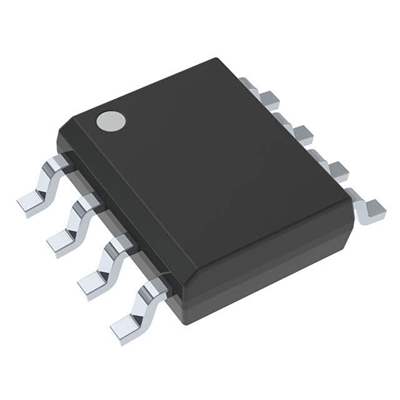
Core parameters
| Parameter | Value |
| Product Type | Half-duplex M-LVDS transceiver |
| Manufacturer | Texas Instruments |
| Communication Standards | TIA/EIA-899 M-LVDS |
| Send and receive channels | 1 driver + 1 receiver |
| Maximum signaling rate | 200Mbps |
| Input signal | LVTTL, M-LVDS |
| Output signal | LVTTL, M-LVDS |
| Power supply voltage | 3.3V |
| Receiver sensitivity | Differential input as low as 50mV |
| Type-1 receiver hysteresis | 25mV |
| Common mode voltage range | -1V to 3.4V |
| Bus load capacity | As low as 30Ω |
| Bus pin status | High impedance state when disabled or when VCC ≤ 1.5V. |
| Output conversion control | support |
| Bus power supply power-on and power-off | Glitch-Free |
| Operating temperature | -40°C to +85°C |
| Packaging | SOIC |
| Number of pins | 8 |
| Package suffix | D |
| Rated class | Catalog |
TI’s official product page defines SN65MLVD201 as… The Half-duplex M-LVDS transceiver is listed with a signaling rate of 200 Mbps, 3.3V power supply, one transmitter and one receiver, and an operating temperature range of −40°C to +85°C.
Features
Half-duplex M-LVDS transceiver architecture
The SN65MLVD201DR integrates line drive and receive functions into a single device, enabling half-duplex communication via a shared differential bus.
This architecture is suitable for systems where multiple nodes share the same physical communication line. The controller can drive the M-LVDS bus in transmit mode and listen to bus data in receive mode, thereby reducing the number of devices required for separate transmitters and receivers.
Supports signaling rates up to 200Mbps
SN65MLVD201DR supports up to With a signaling rate of 200Mbps , it is suitable for high-speed, short-distance data and clock transmission.
In systems where multiple nodes need to exchange high-speed digital data via a shared differential bus, M-LVDS can adapt to multi-point connection structures while maintaining the advantages of differential transmission.
Compliant with TIA/EIA-899 M-LVDS standard
The SN65MLVD201DR conforms to the TIA/EIA-899 M-LVDS standard and can be used in multipoint differential communication systems designed according to this standard.
Compared to traditional point-to-point LVDS, M-LVDS adds electrical characteristics for multi-point bus applications, making it more suitable for backplane, shared bus, and multi-node communication structures.
Low differential input detection capability
The SN65MLVD201DR receiver is capable of detecting differential input signals as low as 50mV .
A lower differential detection threshold helps to receive weak differential signals, while the differential communication structure reduces the impact of common-mode noise on logic decisions.
Typical application scenarios
Backplane communication
In communication equipment, industrial equipment, and large control systems, multiple functional modules may share a data bus via a backplane.
The SN65MLVD201DR can be used for M-LVDS data or clock transmission between modules, enabling high-speed differential communication within a limited PCB space.
Multi-point data transmission
A key feature of M-LVDS is its multi-point bus architecture. Multiple nodes can connect to the same bus and achieve half-duplex communication through transmit/receive control.
Network switches and routers
TI lists applications for the SN65MLVD201 series including Network Switches and Routers . Within network devices, it can be used for high-speed board-level control signals , backplane data, or clock signal transmission.
Cellular base stations
Cellular base stations typically contain multiple digital processing and control modules, requiring data and control signal transmission between modules.
Central exchange equipment
In central offices and communication infrastructure equipment, shared bus communication between multiple modules needs to balance data rate, noise tolerance, and cabling flexibility.
The SN65MLVD201DR can be used for related M-LVDS differential data or clock links.
Industrial control equipment
Industrial equipment may contain multiple control boards or remote I/O nodes. M-LVDS differential communication enables high-speed, short-distance interconnection within the equipment and improves interference immunity through differential transmission.
Comparative Advantage Analysis
| Performance indicators | SN65MLVD201DR | Standard LVDS transceiver |
| Communication type | M-LVDS | LVDS |
| Communication structure | Multi-point bus | Mainly point-to-point |
| Work mode | half-duplex | Depending on the model |
| Maximum signaling rate | 200Mbps | Depending on the model |
| Receiver hysteresis | 25mV (Type-1) | Depending on the model |
| Common mode range | -1V to 3.4V | Depending on the model |
| Low differential input detection | As low as 50mV | Depending on the model |
| Bus load | Supports impedance as low as 30Ω | Depending on the model |
| High Impedance Bus Status | support | Depending on the model |
| Multi-branch design | Optimization for M-LVDS | Usually there are limitations. |
The main difference between the SN65MLVD201DR and traditional LVDS devices lies in its multi-point bus positioning . It does not simply pursue higher data rates, but rather optimizes the electrical and drive structure for scenarios where multiple nodes share a single differential bus.
Manufacturer Profile: Texas Instruments
Texas Instruments (TI) is a leading global manufacturer of analog and embedded semiconductors, with products covering power management, amplifiers, data converters, interfaces, isolators, logic devices, and various communication interface ICs.
Why choose SN65MLVD201DR?
● Half-duplex M-LVDS transceiver for multipoint buses
● Integrated driver and receiver
● Supports signaling rates up to 200Mbps
● Compliant with TIA/EIA-899 M-LVDS standard
● Supports differential input detection down to 50mV
● Type-1 receiver provides 25mV input hysteresis
● Wide common-mode voltage range from -1V to 3.4V
● Supports multipoint bus loads down to 30Ω
● Controlled output transition time improves signal integrity
● Bus enters high-impedance state under disabled or low supply voltage conditions
● Supports glitch-free M-LVDS bus power-on/off
● 8-pin SOIC package for compact PCB designs
● Suitable for backplane, communication equipment, network switches, and router applications
Frequently Asked Questions (FAQ)
Q1: What chip is SN65MLVD201DR?
half-duplex M-LVDS transceiver from TI , which integrates a line driver and a receiver and is mainly used for multi-point differential data and clock transmission.
Q2: What is the maximum communication rate of SN65MLVD201DR?
This device supports the highest 200Mbps signaling rate . The actual effective communication performance achievable by the system will be affected by factors such as bus length, number of nodes , topology, load, and terminal matching.
For more details and to explore our inventory, please visit the following link:
Product Details: Win Source – SN65MLVD201DR
Price: Win Source – SN65MLVD201DR
©2026 Win Source Electronics. All rights reserved. This content is protected by copyright and may not be reproduced, distributed, transmitted, cached or otherwise used, except with the prior written permission of Win Source Electronics.