
* Question
How Does a Basic UART Communicate?
* Answer
UART (Universal Asynchronous Receiver/Transmitter) is a widely used communication method that enables serial data transmission between two devices without requiring a shared clock signal.
A basic UART communicates by sending data bit by bit over a single data line, using predefined timing and framing rules agreed upon by both devices.
1. Asynchronous Communication (No Shared Clock)
Unlike synchronous interfaces, UART:
- Does notuse a clock line
- Relies on a preset baud rate
Both the transmitting and receiving devices must be configured with:
- The same baud rate
- The same data format
This allows the receiver to sample incoming data at the correct times.
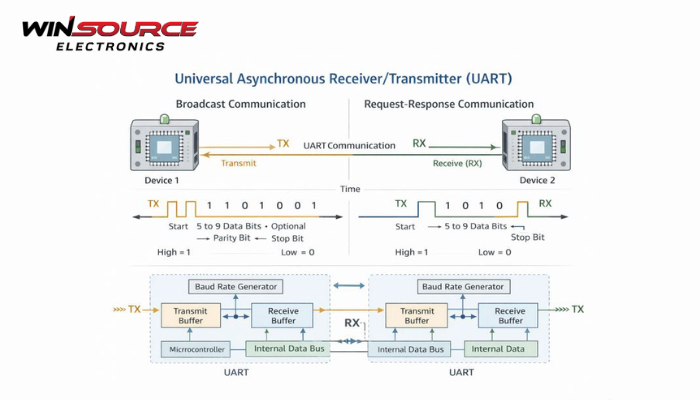
2. Data Framing Structure
Each UART data frame typically consists of:
- Start Bit
- Signals the beginning of data transmission
- Usually a logic LOW
- Data Bits
- Commonly 7 or 8 bits
- Transmitted least significant bit (LSB) first
- Optional Parity Bit
- Used for basic error checking
- Stop Bit(s)
- Marks the end of the data frame
- Usually one or two logic HIGH bits
This framing allows the receiver to correctly identify and reconstruct each data byte.
3. Transmission Process
During transmission:
- The transmitter places the start bit on the line
- Sends data bits sequentially
- Adds parity (if enabled)
- Ends with stop bit(s)
The line remains idle (logic HIGH) when no data is being sent.
4. Reception Process
On the receiving side:
- The receiver detects the start bit
- Uses the configured baud rate to sample each data bit
- Reassembles the data byte
- Checks parity and stop bits for errors
If the frame format is incorrect, the receiver flags an error.
5. Communication Lines Used
A basic UART connection typically uses:
- TX (Transmit)
- RX (Receive)
For simple communication:
- TX of one device connects to RX of the other
- A common ground is required
Optional control lines (RTS, CTS) may be used for flow control, but are not required in basic UART communication.
Engineering Insight
UART communication is simple, reliable, and widely supported, but:
- It is relatively slow compared to modern interfaces
- It is usually point-to-point
- It does not support multi-device addressing natively
Despite these limitations, UART remains popular for debugging, configuration, and low-speed data exchange.
Conclusion
A basic UART communicates by transmitting data serially using start bits, data bits, optional parity, and stop bits, without a shared clock signal.
By agreeing on baud rate and data format, two devices can reliably exchange data over simple TX and RX lines.

COMMENTS