* Question
What is the speed at which the system responds to each interrupt?
* Answer
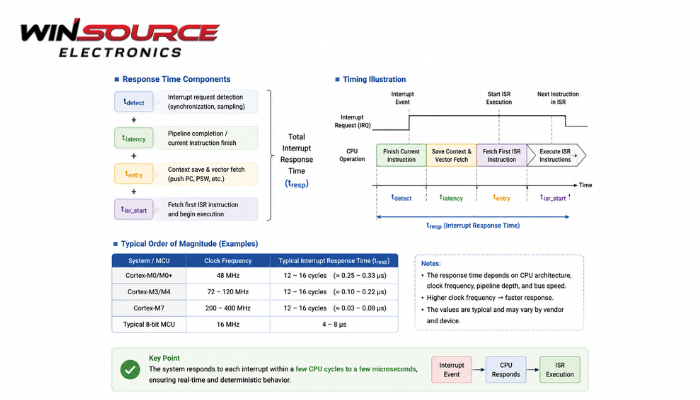
The speed at which a system responds to an interrupt is commonly referred to as interrupt latency. It is defined as the time interval from when an interrupt request (IRQ) is asserted to when the CPU begins executing the first instruction of the corresponding interrupt service routine (ISR).
Key Points:
1.Definition:
Interrupt Latency=Time from interrupt request assertion to ISR execution start
2.Factors Affecting Interrupt Latency:
- CPU clock frequency:Higher clock speeds generally reduce latency.
- Interrupt priority and nesting:High-priority interrupts can preempt lower-priority tasks, reducing response time.
- Current instruction execution:Long or complex instructions in progress may delay ISR start.
- Hardware propagation delay:Time for the external signal to pass through input circuitry and interrupt controller.
- Pipeline and cache effects:Pipeline stalls or branch prediction failures can slightly increase latency.
3.Typical Values (General MCU/DSP Reference):
- Fast DSPs or microcontrollers can achieve interrupt latencies in the range of tens to hundreds of CPU cycles.
- For example, at a 200 MHz CPU clock (cycle = 5 ns), 50–200 cycles correspond to 250 ns to 1 µsof latency.
4.Optimization Strategies:
- Assign higher priority to time-critical interrupts.
- Keep ISR routines short and efficient.
- For extremely time-sensitive events, consider hardware triggers or DMA to handle data without CPU intervention.
Summary:
Interrupt latency determines how quickly a system can respond to external events. Minimizing it is crucial in real-time applications, and it depends on both hardware and software design choices.