* Question
What factors explain the differences between the WirelessHART standard and the OSI model?
* Answer
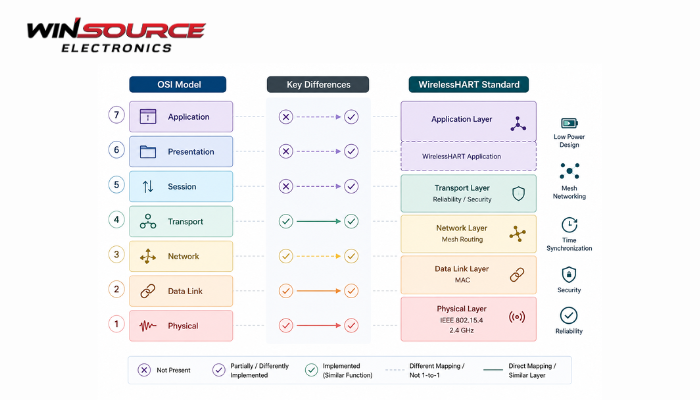
The differences between the WirelessHART standard and the OSI model mainly come from their different purposes. The OSI model is a general reference framework for describing network communication in seven abstract layers. WirelessHART, however, is a practical industrial wireless communication standard designed for process automation, field instrumentation, and reliable data transmission in harsh industrial environments.
WirelessHART is based on the layered idea of the OSI model, but it does not strictly implement all seven layers as separate functional blocks. Instead, it focuses on the layers and mechanisms required for industrial wireless communication, including the physical layer, data link layer, network layer, transport layer, and application layer. The presentation, session, and some transport-related functions in the OSI model are simplified, merged, or handled inside other protocol functions.
One major reason for the difference is application specificity. The OSI model applies broadly to many communication systems, while WirelessHART serves a specific field: industrial monitoring and control. It must support low-power field devices, stable sensor communication, process data transmission, and compatibility with existing HART-based systems.
Another factor is industrial reliability. WirelessHART uses mechanisms such as time-synchronized communication, TDMA scheduling, channel hopping, and mesh networking to improve reliability in noisy factory or plant environments. These mechanisms are not defined in the OSI model itself because OSI is only a conceptual model, not a complete industrial protocol implementation.
Security requirements also create differences. WirelessHART includes security functions such as authentication, encryption, message integrity checking, and key management. These features are deeply integrated into the protocol stack because industrial wireless networks must protect process data and prevent unauthorized device access.
Power consumption and device constraints are also important. Many WirelessHART devices are battery-powered field instruments. Therefore, the protocol must reduce unnecessary communication overhead and support predictable, scheduled data exchange. A strict seven-layer implementation would be less efficient for such constrained devices.
Finally, WirelessHART must support interoperability with industrial systems. As IEC 62591, it defines wireless procedures, gateways, and communication profiles for industrial networks. This makes it more implementation-oriented than the OSI model, which mainly provides a theoretical structure for understanding communication layers.
In summary, the difference exists because the OSI model is a universal communication reference model, while WirelessHART is an optimized industrial wireless standard. WirelessHART borrows the layered concept from OSI but adapts it for real-time reliability, low power consumption, security, mesh networking, and industrial process control.