* Question
What Are the Applications of Adders in Digital Electronics?
* Answer
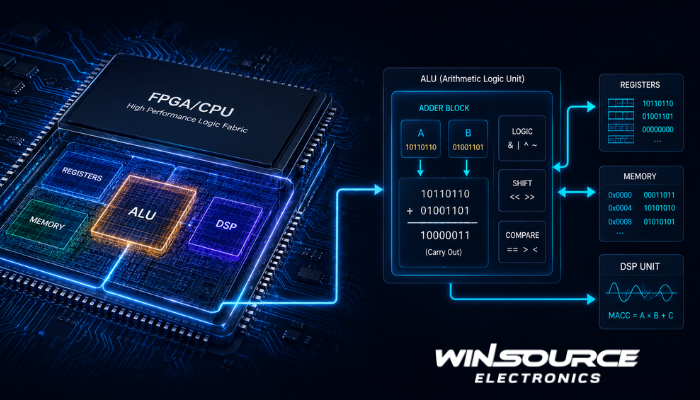
An adder is a fundamental digital circuit used to perform binary addition. It is one of the most important building blocks in arithmetic logic units (ALUs), processors, and digital systems.
Adders are used wherever numerical computation or address calculation is required in digital electronics.
Key Applications of Adders
1. Arithmetic Logic Units (ALU)
Adders are the core component of an ALU in CPUs and microcontrollers.
- Perform addition and subtraction operations
- Support arithmetic instructions in processors
- Form the basis of computational logic
Without adders, modern processors cannot perform arithmetic tasks.
2. Multiplication and Division Circuits
Adders are heavily used in implementing:
- Binary multiplication (repeated addition + shift operations)
- Division algorithms (repeated subtraction)
In digital systems, multiplication is often built using multiple adder stages.
3. Address Calculation in Memory Systems
Adders are used to calculate memory addresses in:
- RAM and ROM access
- Cache memory systems
- Instruction fetching in CPUs
Example:
Effective address = Base address + Offset
4. Digital Signal Processing (DSP)
In DSP systems, adders are used for:
- Filtering (FIR and IIR filters)
- Convolution operations
- Audio and image processing
They help process continuous data in discrete time systems.
5. Counter and Increment Circuits
Adders are used in:
- Counters (up counters, down counters)
- Timers and clock generation circuits
- Event counting systems
A simple increment operation is essentially:
A + 1 → performed using an adder
6. Arithmetic Operations in Microcontrollers
Microcontrollers use adders for:
- Sensor data processing
- Control algorithms (PID controllers)
- Embedded system calculations
7. Digital Communication Systems
Adders are used in:
- Error detection and correction algorithms
- Signal encoding/decoding
- Data packet processing
8. Graphics and Image Processing Units (GPU)
In GPUs, adders are used for:
- Pixel value calculations
- Coordinate transformations
- Matrix operations in rendering
9. ALU Subtraction and Logic Operations
Using complements (2’s complement method), adders can perform:
- Subtraction
- Comparison operations
- Logical arithmetic transformations
This makes the adder a universal arithmetic building block.
10. FPGA and ASIC Design
In hardware design (FPGA/ASIC):
- Adders are used to build custom arithmetic circuits
- Implement DSP blocks and hardware accelerators
- Optimize performance-critical logic paths
Summary Table
Application Area | Role of Adder |
CPU/ALU | Core arithmetic operations |
Memory systems | Address calculation |
DSP | Signal processing operations |
Counters | Increment/decrement functions |
Microcontrollers | Embedded calculations |
Communication systems | Data processing |
GPU | Graphics computation |
Digital design | Custom hardware logic |
Conclusion
The adder is one of the most essential building blocks in digital electronics. It is used not only for simple binary addition but also as a foundation for arithmetic, logic, signal processing, memory addressing, and processor design.
Without adders, modern computing systems—from microcontrollers to GPUs—would not be able to perform efficient numerical operations.