* Question
What Are the Common Brightness Adjustment Techniques in Electronic Displays and LED Systems?
* Answer
Brightness adjustment is the process of controlling the light output of a display, LED, or lighting module to meet different visual, power, and environmental requirements. It is widely used in LCD backlights, LED indicators, display panels, automotive lighting, industrial control panels, and consumer electronic devices.
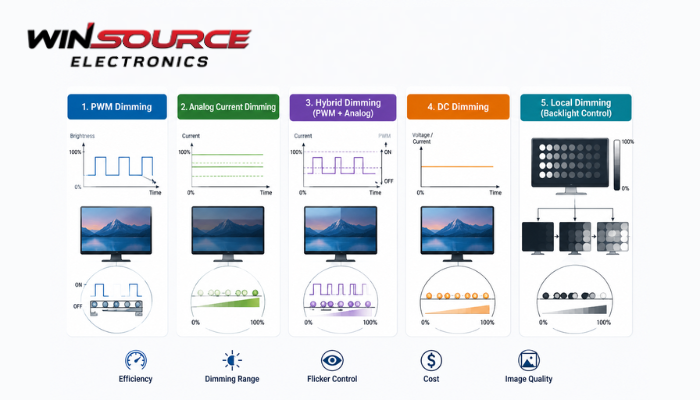
The most common brightness adjustment techniques include analog dimming, PWM dimming, DC dimming, hybrid dimming, and automatic brightness control. Each method has different advantages, limitations, and application scenarios.
- Analog Dimming
Analog dimming adjusts brightness by changing the drive current supplied to the LED or backlight. When the current increases, the light output becomes stronger. When the current decreases, the brightness becomes lower.
This method provides smooth brightness control and can reduce flicker because the light source remains continuously on. However, changing the current may affect LED color consistency, especially at very low brightness levels. In some applications, analog dimming may also reduce color accuracy or cause uneven brightness.
Analog dimming is commonly used in applications where flicker control is important, such as industrial displays, medical instruments, and precision visual systems.
- PWM Dimming
PWM dimming, or pulse-width modulation dimming, controls brightness by rapidly switching the LED on and off. The perceived brightness depends on the duty cycle. A higher duty cycle means the LED stays on longer and appears brighter. A lower duty cycle means the LED stays on for a shorter time and appears dimmer.
PWM dimming is widely used because it offers high efficiency, stable color performance, and precise brightness control. Since the LED usually operates at its rated current during each pulse, its color characteristics remain relatively consistent.
However, if the PWM frequency is too low, users may notice flicker. Low-frequency PWM can also cause eye strain or interfere with cameras, sensors, or machine vision systems. For this reason, many modern designs use high-frequency PWM to improve visual comfort and reduce interference.
- DC Dimming
DC dimming controls brightness by directly reducing the current or voltage supplied to the light source. In many display and LED driver applications, DC dimming is closely related to analog dimming.
Its main advantage is reduced visible flicker, especially at low brightness. This makes it useful for smartphones, monitors, and display systems where eye comfort is important.
The limitation is that DC dimming may affect color accuracy, grayscale performance, and brightness uniformity. In OLED displays, for example, DC dimming can sometimes cause color shift or uneven low-brightness performance.
- Hybrid Dimming
Hybrid dimming combines PWM dimming and analog or DC dimming. At higher brightness levels, the system may use analog dimming to maintain smooth light output. At lower brightness levels, it may use PWM dimming to improve control accuracy and maintain color consistency.
This technique balances efficiency, flicker reduction, color stability, and dimming range. It is often used in high-quality display panels, automotive lighting, portable electronics, and LED backlight systems.
Hybrid dimming is especially useful when a product needs both a wide brightness adjustment range and good visual performance.
- Automatic Brightness Control
Automatic brightness control adjusts brightness according to ambient light conditions. It usually relies on an ambient light sensor, a microcontroller, and a driver circuit.
For example, a display can increase brightness under strong sunlight and reduce brightness in a dark environment. This improves readability, reduces power consumption, and enhances user comfort.
Automatic brightness control is common in smartphones, tablets, automotive dashboards, smart meters, industrial HMIs, and outdoor electronic displays.
- Resistor-Based Brightness Adjustment
In simple LED circuits, brightness can be adjusted by changing the series resistor value. A larger resistor reduces current and lowers brightness, while a smaller resistor increases current and raises brightness.
This method is simple and low-cost, but it is not suitable for precise or dynamic brightness control. It is mainly used in basic indicator lights, simple panels, and low-cost electronic products.
- Driver IC-Based Brightness Control
In more advanced systems, LED driver ICs are used to provide stable current regulation and programmable dimming control. These ICs may support PWM input, analog dimming input, I2C/SPI control, fault protection, thermal regulation, and multi-channel brightness matching.
Driver IC-based control improves brightness accuracy, reliability, and system integration. It is widely used in LED backlights, automotive lighting, display modules, signage, and industrial equipment.
Summary
The main brightness adjustment techniques include analog dimming, PWM dimming, DC dimming, hybrid dimming, automatic brightness control, resistor-based adjustment, and driver IC-based control. For simple LED indicators, resistor adjustment may be enough. For displays, backlights, and professional lighting systems, PWM dimming, DC dimming, hybrid dimming, or dedicated LED driver ICs are more suitable.
In electronic design, the best brightness adjustment method depends on several factors, including flicker requirements, color stability, power efficiency, dimming range, circuit cost, thermal performance, and the final application environment.